Aladdin
Vibe
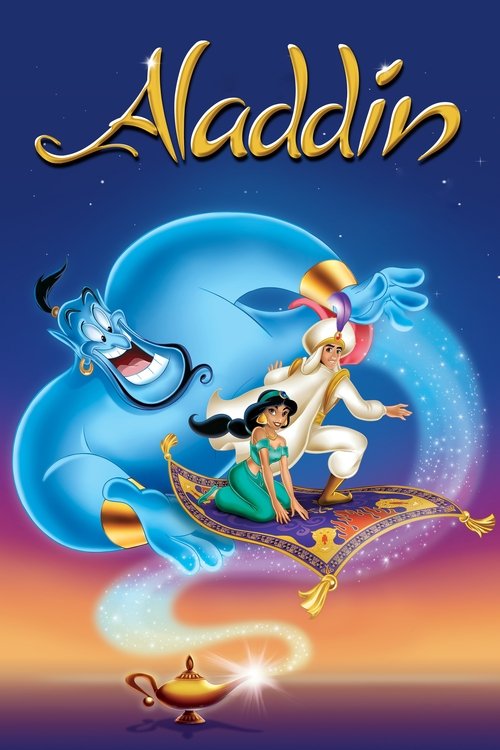
Walt Disney's electrifying musical comedy follows Aladdin, a quick-witted street thief in the fictional desert city of Agrabah, who discovers a magic lamp containing a wish-granting Genie and uses it to disguise himself as a prince in hopes of winning the heart of Princess Jasmine. Directed by Ron Clements and John Musker, the film is propelled by Robin Williams's volcanic voice performance as the Genie — a performance so free and inventive that it rewrote what an animated supporting character could do and feel like on screen. The songs by Alan Menken and Howard Ashman and Tim Rice are among the Disney Renaissance's finest, and the visual design — rich with Persian miniature influence — gives Agrabah a beautiful, distinctive atmosphere. A story about identity, authenticity, and the courage to be seen for who you actually are rather than who you pretend to be, Aladdin is one of the most purely entertaining films the studio ever made.
Watch for
- Robin Williams's Genie performance and how it required entirely new approaches to character animation — Eric Goldberg had to develop animation principles for a character who could transform, multiply, and reference any cultural archetype at full speed. Watch how each of Williams's improvisational shifts is tracked by the animation frame by frame, with Goldberg's loose, caricature-influenced line style specifically chosen to accommodate the performance's velocity.
- The Cave of Wonders entrance as a CGI landmark — the tiger-head cave required computer animation techniques that had never before been used in a Disney feature, with geometry, particle effects, and camera movement all handled digitally and composited with the hand-drawn characters, pointing directly toward the approach the studio would fully embrace in the following decade.
- The Aladdin character's design as a visual argument — his physical looseness and warmth is contrasted with Jafar's angular rigidity in every shared scene, and watch how the animators use posture, proportion, and the specific quality of each character's line weight to communicate the moral binary before a single word of dialogue.
- The Agrabah visual design and how it draws from Persian miniature painting — the geometric tile patterns, the specific quality of architectural detail, the warm amber light of the marketplace — and how that visual specificity distinguishes the film from a generically fantasized Orient into something with genuine cultural reference points.
Production notes
Aladdin returned Ron Clements and John Musker to the director's chair after Beauty and the Beast had gone in a different direction. Their original pitch — a more grounded, faithful adaptation of the One Thousand and One Nights story — was repeatedly rejected by Jeffrey Katzenberg, who pushed for broader comedy and contemporary energy. Howard Ashman wrote three songs before his death (only 'Friend Like Me,' 'Arabian Nights,' and 'Prince Ali' survived); Tim Rice (Evita, Jesus Christ Superstar) was brought in to complete the lyrics. Robin Williams was famously paid scale ($75,000) for voicing the Genie because Disney wanted to avoid ego inflation, and was given enormous latitude to improvise — he reportedly recorded 16 hours of material. Eric Goldberg animated the Genie; his style was inspired by the work of caricaturist Al Hirschfeld.
Trivia
- Robin Williams asked that the Genie not be used in advertising and that his voice not exceed 25% of the marketing materials; Disney violated the agreement, leading to a public falling-out with Williams that took years to repair.
- Eric Goldberg animated the Genie using Al Hirschfeld's flowing-line caricature style as a model; the morphing of the Genie's body into dozens of impressions throughout the film is direct riffing on Williams's recording-booth improvisations.
- The character of Aladdin was originally designed to look like Michael J. Fox, but Jeffrey Katzenberg ordered him redesigned with more 'masculine' features partway through production — Glen Keane based the new design on Tom Cruise.
- Aladdin was the first Disney animated film to gross over $200 million domestically, and it briefly became the highest-grossing film of 1992 — outperforming the live-action competition.
- Howard Ashman's original concept had Aladdin's mother as a major character and a much darker plot involving Jafar's ambition; the surviving material was extensively reworked but several Ashman songs and structural ideas remained in the final film.
Legacy
Aladdin grossed over $500 million worldwide on first release and won two Academy Awards (Best Original Score, Best Original Song for 'A Whole New World'), becoming the first Disney animated film to gross over $200 million domestically and briefly the highest-grossing film of 1992. Robin Williams's Genie remains one of the most celebrated voice performances in animated history; the Hirschfeld-styled morphing animation by Eric Goldberg is regularly studied as one of the great character performances of the era. The film generated direct-to-video sequels (The Return of Jafar, Aladdin and the King of Thieves), a long-running television series, the long-running Aladdin: The Musical on Broadway (2014–2025), and Guy Ritchie's 2019 live-action remake starring Will Smith, which grossed over $1 billion. Critical reassessment has examined the film's racial caricatures and the early-1990s Hollywood approach to Arab and Middle Eastern representation; the live-action remake addressed several of these concerns. The film entered the National Film Registry in 2017 and remains a peak achievement of the Disney Renaissance — bigger and louder than Beauty and the Beast, less classically perfect, but unmatched in star-driven energy.