Alice in Wonderland
Vibe
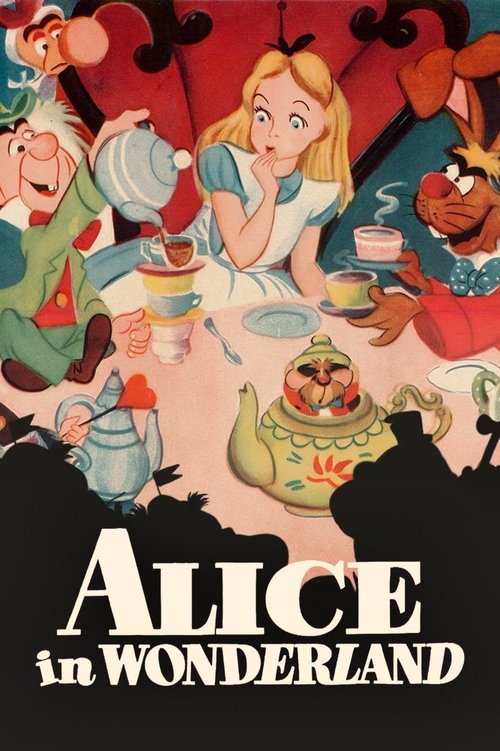
Walt Disney's adaptation of Lewis Carroll's classic follows Alice, a curious and somewhat impatient girl who tumbles down a rabbit hole and into a world of cheerful nonsense, logical impossibility, and colorful eccentrics who seem to operate by rules she can never quite grasp. Directed by Clyde Geronimi, Hamilton Luske, and Wilfred Jackson, the film is structured more as a series of dazzling encounters than a conventional narrative, moving rapidly from one surreal vignette to the next — the Cheshire Cat, the Mad Hatter's tea party, the argumentative caterpillar, the explosive Queen of Hearts. Its visual inventiveness is consistently high, and its willingness to embrace pure absurdism gives it an energy that sets it apart from the more grounded fairy tales on either side of it. Playful, slightly anarchic, and unafraid to let its dreamlike logic remain unresolved, Alice in Wonderland is one of the studio's most distinctively strange and pleasurable films.
Watch for
- The deliberate acceleration of the film's pace as Wonderland's logic becomes increasingly unstable — scenes grow shorter, characters more irrational, and the visual world more compressed as Alice's sanity frays, a structural reflection of psychological disorientation that works subliminally but unmistakably.
- Ed Wynn's Mad Hatter as a study in character animation derived from voice performance — the voice was recorded first, and animator Ward Kimball designed all of the Hatter's physical business around the specific rhythms and inflections of Wynn's delivery, making the character unusually integrated between visual and vocal personality.
- The Caterpillar sequence's unusual pace — deliberately slow and confrontational, with the Caterpillar's rings of smoke creating a visual language of contempt, it functions as a necessary pause in the surrounding madness and demonstrates the film's ability to modulate tempo within its otherwise frenetic structure.
- How the film's color palette shifts between warm and cool registers to mark psychological comfort and disorientation — the warm yellows and pinks of the opening Oxford scene, the increasingly saturated and unstable color of Wonderland's interiors, and the cold blue of the climactic trial — creating an emotional map through hue alone.
Production notes
Walt Disney had been trying to adapt Lewis Carroll's books since the 1930s — at one point planning a live-action/animation hybrid starring Mary Pickford. The animated feature finally entered production in the late 1940s under directors Clyde Geronimi, Wilfred Jackson, and Hamilton Luske. Mary Blair's bold, flat, vivid concept art set the visual direction, and Marc Davis, Ollie Johnston, Milt Kahl, Ward Kimball, Eric Larson, John Lounsbery, Frank Thomas, and Wolfgang Reitherman handled the ensemble of characters. Ten-year-old Kathryn Beaumont was cast as Alice and provided live-action reference. The film famously contains over a dozen songs — more than any other Disney feature — because the studio kept inserting standalone musical numbers to give shape to Carroll's structurally loose source material. Walt Disney himself was never fully satisfied with the result.
Trivia
- Kathryn Beaumont, who voiced Alice at age 10, also voiced Wendy in Peter Pan two years later, and decades later returned to record additional Alice dialogue for Disney theme park attractions and home video releases — she eventually became an elementary school teacher in Los Angeles.
- Ed Wynn's Mad Hatter performance was largely improvised in the recording booth; supervisor Ward Kimball preserved the off-the-cuff energy by animating to the takes Wynn had thrown away.
- The film was a financial disappointment on its 1951 release and Walt Disney privately blamed it for the studio losing roughly $1 million.
- Salvador Dalí had collaborated briefly with Disney during this period, and some of his sensibility filtered into the Alice in Wonderland visual development before the Surrealist short Destino was shelved.
- Alice in Wonderland was unexpectedly rediscovered by college audiences in the 1970s, who screened it on campuses as a psychedelic film; Disney leaned into the rediscovery and re-released it theatrically in 1974.
Legacy
Alice in Wonderland's initial reception was lukewarm — critics found it episodic, audiences thought it strange, and Walt Disney privately blamed the film for the studio losing roughly $1 million — but its reputation has steadily climbed. The 1970s counterculture rediscovery cemented its cult status when college audiences screened it as psychedelic cinema; Disney leaned into the rediscovery and re-released it theatrically in 1974. Modern animators frequently cite Mary Blair's color and design work as some of the most influential in the canon. The film's imagery — the Cheshire Cat's grin, the painting of the roses red, the tea party — has become inseparable from Carroll's source material in popular culture. Tim Burton's 2010 live-action reimagining was a billion-dollar global hit, attesting to the lasting hold of these characters. Among Disney films, Alice remains a perennial reference point for any animator working in surrealist or psychedelic visual modes — a film whose initial dismissal has been thoroughly reversed by decades of reassessment.