Atlantis: The Lost Empire
Vibe
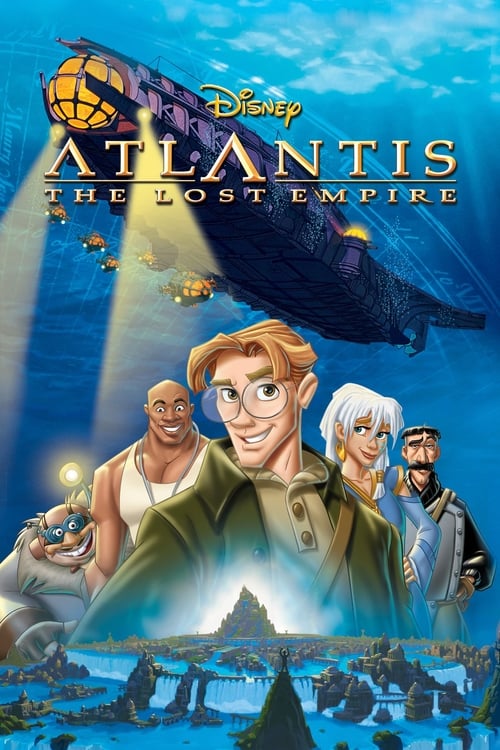
Walt Disney's action-adventure epic follows Milo Thatch, a young linguist and cartographer at the Smithsonian who joins a privately funded expedition to find the lost continent of Atlantis, only to discover a living civilization that has forgotten its own history and a crew with motives far more complicated than he was told. Directed by Gary Trousdale and Kirk Wise, the film drew visually from Hellboy creator Mike Mignola's angular, high-contrast graphic style and was produced with the energy of an adventure serial, with submarine sequences and underground exploration sequences that bristle with kinetic design. Kida, the Atlantean princess, is one of the studio's strongest female supporting characters, and the world-building is unusually ambitious for a Disney feature of its period. Underseen and underappreciated on release, Atlantis remains one of the studio's most visually distinctive productions — a rare experiment in stripped-down, dialogue-driven adventure that deserves reappraisal.
Watch for
- Mike Mignola's visual influence on the production design throughout — watch how the angular, high-contrast character outlines, the thick shadows, and the architectural geometry of the underground world all reflect a graphic novel aesthetic rather than a conventional Disney visual language, creating an environment with the weight and spatial specificity of a printed page.
- The submarine dive sequence as a sustained piece of action direction — unlike most Disney action sequences that build toward a single climactic image, this extended chase uses multiple simultaneous threats, claustrophobic spatial relationships, and continuously varying scale to create a sustained physical tension that rewards attention to the choreography of individual characters within the larger action.
- Kida's design and animation as a figure navigating two visual languages — she is drawn with the angular, high-contrast Mignola-influenced line quality of Atlantis's aesthetic but moves with the physical warmth and specificity of a character the film wants audiences to trust emotionally. Watch how that dual quality is sustained throughout her scenes.
- The Atlantean language created by Marc Okrand and how it is used in the film — rather than subtitling, the film uses contextual visual information to allow audiences to understand Kida and the Atlanteans before Milo's translation activates, treating the audience as capable of reading meaning from behavior rather than requiring verbal exposition.
Production notes
Atlantis: The Lost Empire was Disney's deliberate attempt to break from the musical Renaissance template. Co-directors Gary Trousdale and Kirk Wise (Beauty and the Beast, The Hunchback of Notre Dame) pitched the project as a Jules Verne-style steampunk action-adventure with no songs, no anthropomorphic animal sidekicks, and explicit pulp-adventure visual influences. The studio brought in comic artist Mike Mignola (creator of Hellboy) as production designer, giving the film a heavily inked, angular, graphic-novel aesthetic. Linguist Marc Okrand — who had created Klingon for Star Trek — was hired to invent an Atlantean language complete with grammar and writing system. Michael J. Fox voiced Milo, James Garner played Rourke, Cree Summer voiced Kida, and the eclectic crew included Don Novello, Florence Stanley, Phil Morris, and the late Jim Varney in his last film role.
Trivia
- Mike Mignola's design influence is direct and visible — characters are constructed from sharp geometric shapes with heavy black inking, environments use stark architectural angles, and the look is closer to Hellboy than to anything Disney had previously produced.
- Marc Okrand's invented Atlantean language has a complete grammar, vocabulary, and writing system; fans have used it to translate texts and create supplementary materials for years after the film's release.
- Jim Varney completed his vocal recording for the demolitions expert Vinny Santorini before his death from lung cancer in February 2000; Steven Barr was brought in to dub a few remaining lines.
- Atlantis was originally planned to launch a full multimedia franchise — including a television series, a theatrical sequel, and a Disneyland attraction; the underwhelming box office cancelled most of these plans, and only a direct-to-video sequel emerged.
- The film's similarities to the 1989 anime Nadia: The Secret of Blue Water (about a young woman with an Atlantean-derived crystal pendant pursued by adventurers) prompted online accusations of plagiarism; Disney has consistently denied the comparison.
Legacy
Atlantis: The Lost Empire grossed about $186 million worldwide on a $100 million budget — a financial disappointment that contributed to Disney's growing crisis of confidence in hand-drawn animation as the early 2000s shifted toward CGI. Its cult following has only grown over time. Among Disney animated features, Atlantis is one of the most thoroughly rediscovered as adults — viewers who were too young to fully grasp it in 2001 frequently return to it as a stylish, unusually thoughtful action-adventure that took risks the studio rarely allowed itself. Mike Mignola's heavily inked, angular comic-book design approach is unique in Disney's catalog. Marc Okrand's invented Atlantean language has a complete grammar and writing system, with fans creating supplementary materials for years. A direct-to-video sequel, Atlantis: Milo's Return, followed in 2003. The film stands as a fascinating record of what Disney was willing to attempt when it tried, however briefly, to make something other than the Renaissance formula.