Bambi
Vibe
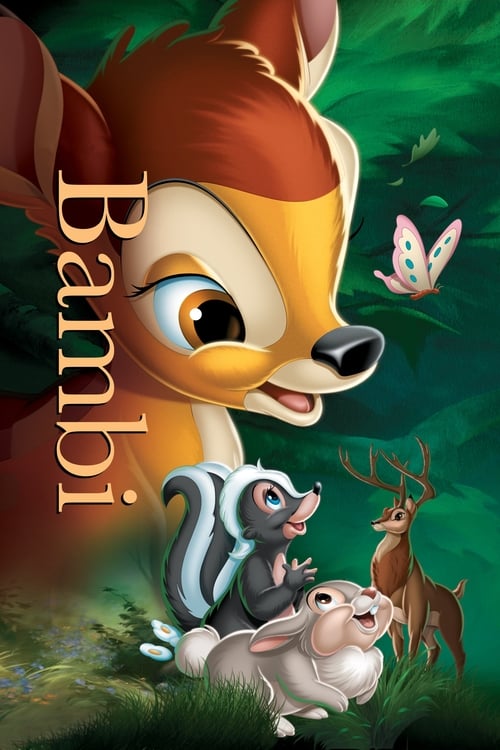
Walt Disney's lyrical nature film follows Bambi, a white-tailed deer born into a sun-dappled forest, through the seasons of early life — from his first unsteady steps and playful encounters with other animals to the harder lessons brought by winter, loss, and the looming presence of Man. Directed by David Hand, the film is built less around plot than around mood, texture, and the rhythms of the natural world, using fluid animation and delicate watercolor backgrounds to make the forest feel like a living, breathing environment. Its celebrated mid-film tragedy is rendered with a restraint that makes it all the more powerful, treating grief not as spectacle but as something quiet and irrevocable. As a meditation on growth, loss, and the cycles of nature, Bambi stands as one of the most poetic and visually distinctive films in the Disney catalog.
Watch for
- The backgrounds created by Chinese-American artist Tyrus Wong, whose Song dynasty-inspired watercolor technique produces impressionistic environments where detail fades to suggestion at the edges, allowing the precisely animated deer to pop from a deliberately atmospheric world — a solution that was both beautiful and pragmatic.
- The April Showers sequence as a master class in synchronized music and animation — watch how the rainfall moves from light drops accompanied by flute to a thunderstorm of cymbals and brass, with each visual element precisely timed to the musical score in a way that recalls Fantasia but embedded within a naturalistic narrative.
- The film's remarkable restraint around Bambi's mother's death — she disappears behind a hillside, we hear a shot, and Bambi calls into the silence. No body. No spectacle. The absence is the horror. Compare this to how the same theme is handled in The Lion King fifty-two years later, where the death is staged as spectacle.
- How the animators solved the specific physical challenge of a fawn's gait and movement — months of observing live white-tailed fawns brought to the studio produced a rendering of four-legged animal locomotion so accurate that biologists have cited it, combined with the expressiveness of rounded, large-eyed character design that keeps the naturalism from becoming clinical.
Production notes
Bambi was in development at Disney for over five years — longer than any film the studio had ever attempted — based on Felix Salten's 1923 Austrian novel. Director David Hand assembled a team that approached realism with new seriousness: animators studied live deer that the studio kept in a small zoo on the lot, watched extensive documentary footage, and trained under Chinese-American artist Tyrus Wong, whose impressionistic concept paintings reshaped the film's entire visual approach away from traditional Disney detail and toward suggestive watercolor atmosphere. Frank Thomas and Milt Kahl led key character animation. The film cost roughly $1.7 million, came in well over schedule, and was released in August 1942 into a country at war and a market still recovering from Fantasia's losses.
Trivia
- Tyrus Wong, the Chinese-American artist whose backgrounds defined Bambi's look, was eventually fired from Disney during the 1941 strike and went on to design Hollmark Christmas cards and storyboard for Warner Bros.; he was inducted as a Disney Legend in 2001 and lived to age 106.
- The animators studied a pair of live fawns named Bambi and Faline that were brought to the studio, observing how their bodies moved through every stage of growth.
- Bambi is one of only a handful of Disney features in which the protagonist's mother dies on screen — though the death itself happens off camera, the moment has become a cultural shorthand for childhood trauma.
- Sterling Holloway, who would later voice Winnie the Pooh and the Cheshire Cat, makes his Disney feature debut as the adult voice of the Stork.
- Bambi was a financial disappointment on its initial release because of wartime market disruptions, and like several other Disney features of the era, only became broadly profitable through repeated theatrical reissues.
Legacy
Bambi's environmental sensibility was decades ahead of mainstream animation, and its quiet pacing, painterly look, and willingness to confront mortality without softening have kept it perennially modern. The film was nominated for three Academy Awards (Best Score, Best Original Song for 'Love Is a Song,' and Best Sound) and entered the National Film Registry in 2011. It has been credited by figures from Paul McCartney to wildlife biologists with shifting public attitudes toward hunting and the natural world; the 'Bambi effect' — the term coined for emotional resistance to harming wildlife — entered the lexicon as direct cultural fallout. Hayao Miyazaki has cited Bambi's atmospheric backgrounds as a touchstone, and Tyrus Wong's Chinese-influenced watercolor concept work continues to be studied as one of the most important visual contributions to American animation. Animators continue to study the film as an example of how to convey large emotional events through small, true behavior.