Big Hero 6
Vibe
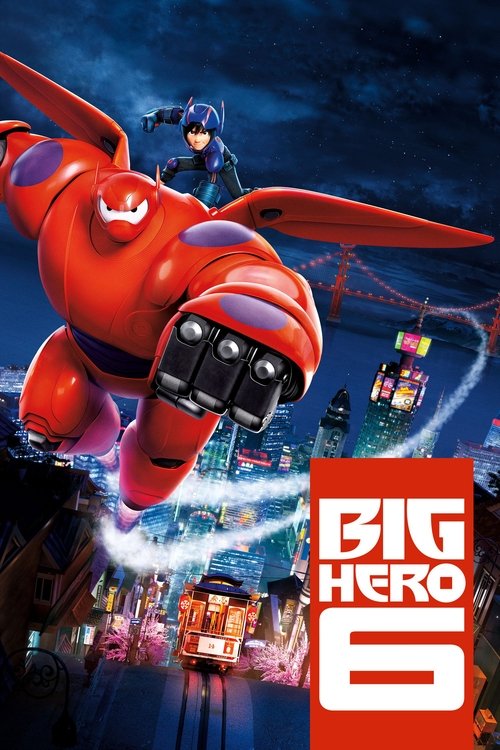
Walt Disney's superhero action film follows Hiro Hamada, a teenage robotics prodigy in the futuristic city of San Fransokyo, who loses his older brother in a suspicious explosion and channels his grief into assembling a team of friends and a lovable inflatable healthcare robot named Baymax to uncover the truth behind the attack. Directed by Don Hall and Chris Williams, the film is the studio's most Marvel-influenced production — structurally an origin story, emotionally a film about grief, loss, and the slow work of healing — and it manages to hold both registers without sacrificing one for the other. Baymax, designed as a nurturing companion rather than a fighting machine, is one of the most genuinely beloved character creations in the studio's recent history, his gentle competence providing both comedy and unexpected emotional depth. As a story about loss, friendship, and the choice between vengeance and healing, Big Hero 6 is one of the most emotionally mature animated superhero films ever made.
Watch for
- Baymax's movement design as a deliberate rejection of robot-animation convention — rather than giving the inflatable healthcare robot angular, mechanical movement, the animators designed his locomotion around the physics of a body filled with air, and watch how the specific wobble of his torso, the way his arms settle when he stops, and his tendency to maintain distance from objects all reflect the actual physical properties of an inflatable vinyl form.
- San Fransokyo's visual construction as an architectural thought experiment — watch how the city's design combines San Francisco's topography and building typologies with Japanese signage, architectural details, and urban density patterns, creating an alternate history city that functions as a real urban environment rather than a thematic gesture toward cultural fusion.
- The action choreography during the Hiro and Baymax flight sequences and how the film uses Baymax's inexperience as a pilot as a comic and emotional resource — watch how the animators calibrate the specific quality of Baymax's flight errors so that they are simultaneously funny and legible as the behavior of a healthcare robot learning to be a superhero.
- Tadashi's presence throughout the film despite his absence — watch how the animators keep him alive through Baymax's behavioral programming, how specific phrases and responses Baymax produces directly recall Tadashi's voice and manner, and how the film's emotional arc around grief is tracked through Hiro's relationship with those moments of accidental Tadashi-in-Baymax rather than through explicit mourning scenes.
Production notes
Big Hero 6 was Disney's first animated feature based on Marvel Comics property — Disney had acquired Marvel in 2009, and Big Hero 6 was a relatively obscure title from the comics line that the studio could reshape with relatively little fan-base baggage. Co-directors Don Hall and Chris Williams (the latter having co-directed Bolt) led production. The film transposes its action to 'San Fransokyo,' a fictional fusion city that combined San Francisco architecture with Tokyo signage and density, requiring extensive custom modeling for streets, transit, and skyline. Baymax — a pillowy white inflatable healthcare robot — was redesigned from the comics' more militaristic original to be primarily a soft, warm, caregiving figure. Scott Adsit voiced Baymax, Ryan Potter played Hiro, T.J. Miller voiced Fred, and Damon Wayans Jr. played Wasabi. The film cost roughly $165 million.
Trivia
- Big Hero 6 was the first non-Pixar Marvel-derived animated feature, but its Marvel connection has been deliberately kept understated in marketing — most casual audiences don't realize the film originated in a Marvel comics title.
- San Fransokyo was built using over 250,000 custom-modeled buildings and required Disney to develop new rendering software (Hyperion) capable of handling that level of geometric complexity; Hyperion has been used on every Disney animated feature since.
- Stan Lee makes a brief vocal cameo as Fred's father in the post-credits scene — one of his many film cameos before his death in 2018, and the only time he appeared in a Walt Disney Animation Studios feature.
- The film's emotional core — a young boy processing the loss of an older brother through his bond with the inflatable robot his brother had built — gave Big Hero 6 a grief-and-recovery tone that distinguished it from typical superhero fare.
- Big Hero 6 won the Academy Award for Best Animated Feature, defeating How to Train Your Dragon 2 and The Lego Movie in a competitive year.
Legacy
Big Hero 6 grossed about $657 million worldwide and won the Academy Award for Best Animated Feature, establishing Disney Animation's confidence to engage with superhero genre material outside Marvel Studios' live-action work. As Disney's first Marvel-derived animated feature — and one of the most emotionally grounded superhero stories of the 2010s — it occupies a unique position straddling Disney Animation, Marvel Studios, and the post-MCU superhero zeitgeist that surrounded it. Baymax became one of Disney Animation's most genuinely beloved breakout characters; the inflatable nurse-bot has anchored multiple Disney+ short-form spinoffs (Baymax!), theme park presence, and substantial merchandising. The film's emotional core — a young boy processing the loss of an older brother through his bond with the inflatable robot his brother had built — gave it a grief-and-recovery tone that distinguished it from typical superhero fare. The film's San Fransokyo setting has become a fan-favorite imagined location, and Disney has returned to it for short films and Disney+ specials. The Hyperion rendering system that the film required has shaped every subsequent Disney Animation feature's visual approach.