Bolt
Vibe
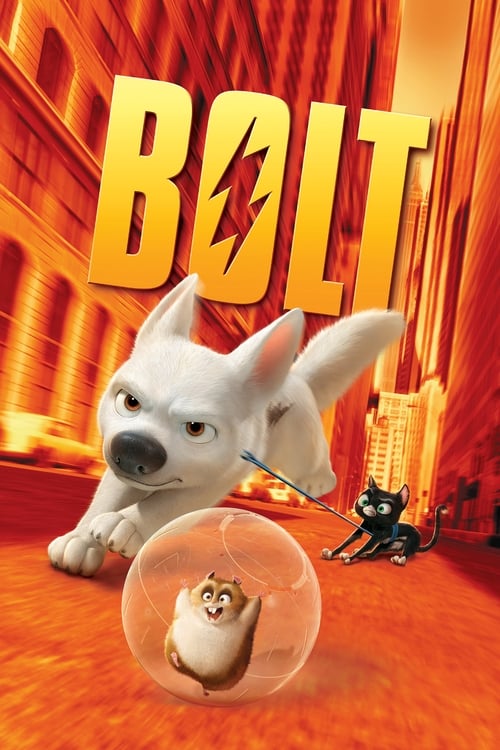
Walt Disney's action-comedy follows Bolt, a dog who has spent his entire life on a television set playing a superhero, who becomes separated from his owner Penny and must cross the country to find her — gradually coming to terms with the discovery that his powers were never real and that the love connecting him to Penny always was. Directed by Byron Howard and Chris Williams, the film is a warm and witty story about the gap between performance and reality, structured as a road movie that becomes, unexpectedly, one of the studio's more genuinely moving films of the late 2000s. Rhino the hamster — a fanatical fan of Bolt's TV show who believes every bit of it — becomes the film's most joyful character, and his uncomplicated enthusiasm for the adventure around him provides a kind of comic counterweight to the film's deeper anxieties about identity and worth. Unpretentious and sincere, Bolt is a film that earns its emotions through simplicity rather than spectacle.
Watch for
- The television show within the film's opening as a statement of visual contrast — the Bolt TV show uses a different animation register from the film itself, slightly more stylized and action-hero inflected, and watch how this distinction is maintained consistently so that Bolt's return to 'real' environments always carries the visual texture of the ordinary world against the heightened language of his imagined one.
- Rhino the hamster as the film's most purely comedic character and a study in the comedy of belief — his complete, unironic conviction that Bolt's powers are real creates comedy not through disillusionment but through the sustained consistency of his faith, and watch how the animators give him physical gestures of absolute certainty that require no explanation from the dialogue.
- The gradual erosion of Bolt's TV-instilled behavioral patterns throughout the film's second act — watch specifically how the character animation tracks his physical responses to threats that would have triggered superpowered reactions in his imagined world, and how his confusion, adjustment, and acceptance of his own ordinariness is expressed through the precise modulation of those trained reflexes.
- Penny and Bolt's reunion sequence and how it withholds and then delivers emotional payoff — the film stages the reunion in a burning building, and watch how the animators calibrate the specific quality of Bolt's determination — no longer superpowered, now simply desperate — to make the reunion's emotional payoff feel earned rather than sentimental.
Production notes
Bolt was the first Disney animated feature substantially shaped by John Lasseter from start to finish. The project began as American Dog under director Chris Sanders (Lilo & Stitch, the future co-director of How to Train Your Dragon), but Lasseter found the original concept too eccentric and removed Sanders from the project — Sanders left Disney for DreamWorks shortly after. New directors Chris Williams and Byron Howard took over and reconceived the film as a tighter buddy-comedy adventure: a TV-show dog who believes he has superpowers learns that his entire world is a sound stage. John Travolta voiced Bolt; Miley Cyrus, then at the peak of her Hannah Montana fame, voiced Penny; Susie Essman played Mittens; and Mark Walton voiced Rhino, the wide-eyed celebrity-obsessed hamster. The film was Disney's first animated feature with credited supervision from Lasseter throughout.
Trivia
- Chris Sanders was removed from the project that became Bolt; he subsequently moved to DreamWorks Animation, where he co-directed How to Train Your Dragon (2010) — one of the most acclaimed animated films of the 2010s — making the talent loss a meaningful one for Disney.
- Mark Walton, who voiced Rhino the hamster, was a Disney story artist rather than an actor; his enthusiastic scratch-recording of the character was so beloved by the directors that they kept him in the role through the final film.
- Bolt was Disney Animation's first feature with John Lasseter in creative oversight throughout the entire production — the first 'pure' post-Pixar-acquisition Disney animated film.
- Miley Cyrus's pop song 'I Thought I Lost You,' co-written and performed with John Travolta over the closing credits, was nominated for the Academy Award for Best Original Song; it was Cyrus's first Academy Award nomination.
- The film was nominated for the Academy Award for Best Animated Feature — Disney Animation's first nomination in that category for an in-house production since the category's creation, beaten by Pixar's WALL-E.
Legacy
Bolt grossed about $310 million worldwide and received generally warm reviews, marking the first clear sign that Disney Animation Studios could produce competitive computer-animated features under the new leadership. As the first Disney Animation feature with John Lasseter in creative oversight from start to finish, it represented a real test of the post-Pixar-acquisition direction. The film's gentle, character-driven tone — closer in spirit to a Pixar narrative than to Chicken Little or Meet the Robinsons — was a deliberate signal of where Disney Animation was headed. It was nominated for the Academy Award for Best Animated Feature (Disney Animation's first nomination in that category for an in-house production since the category's creation), and Miley Cyrus and John Travolta's 'I Thought I Lost You' was nominated for Best Original Song. Rhino the hamster became a minor breakout character; Bolt himself entered the Disney parks character roster. The film hasn't generated direct sequels or a major merchandising line, but its quiet success was institutionally crucial — it proved Disney Animation could reorganize around story-driven production and set the stage for the breakouts that followed: Tangled, Wreck-It Ralph, and Frozen.