Brother Bear
Vibe
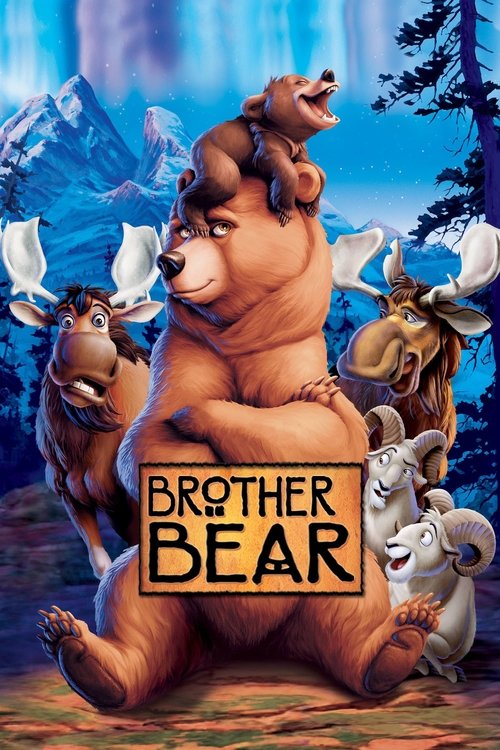
Walt Disney's emotional wilderness adventure follows Kenai, a young Inuit man who is transformed into a bear after killing the animal in anger and must journey northward in bear form to reach the lights in the sky and reclaim his human shape, accompanied along the way by Koda, a small and talkative cub searching for his mother. Directed by Aaron Blaise and Robert Walker, the film draws on Pacific Northwest Native American visual traditions for its totem-inspired imagery and pairs them with a story about empathy, perspective, and the moral weight of violence. The relationship between Kenai and Koda is the film's emotional heart — developing slowly and naturally until the truth about what connects them arrives with the force of genuine reckoning. Gentler and more traditionally structured than some of its early 2000s peers, Brother Bear is a sincere and affecting film about what it means to truly understand another life — and the cost and gift of seeing the world from someone else's eyes.
Watch for
- The aspect ratio change at the moment of Kenai's transformation — the film's human sequences are presented in a conventional widescreen ratio that expands to a fuller, wider format when Kenai becomes a bear, a formal device that externalizes the widening of perspective the transformation is supposed to represent.
- The background style and how it shifts between the human and bear sequences — the angular, totem-inspired graphic style of the film's opening gives way to more rounded, naturalistic shapes when Kenai enters the bear world, and that visual distinction creates a literal environment that looks different depending on whose eyes you inhabit.
- The waterfall sequence with Kenai and Koda as the film's most technically complex piece of environment animation — watch the water physics, the play of light through spray, and the specific way that two large mammals interact with a genuinely simulated water environment.
- Koda's performance as the film's emotional mechanism — watch how the character's unconditional affection for Kenai creates the dramatic pressure that gradually dissolves Kenai's hostility, and how the animators calibrate the specific quality of bear-cub behavior — playful, persistent, physically clinging — to make the attachment feel genuinely earned rather than sentimentally imposed.
Production notes
Brother Bear was the final feature produced primarily at Disney's Florida animation studio before its 2004 closure. Co-directors Aaron Blaise and Robert Walker led production. The film told the story of Kenai, a young Inuit hunter transformed into a bear as cosmic punishment for taking revenge on a mother bear who had killed his older brother. The visual approach was painterly and naturalistic, with mid-Pleistocene Alaska as the primary setting. Phil Collins, fresh off his Tarzan success, returned to write and perform the songs, with score by Mark Mancina. Joaquin Phoenix voiced Kenai, Jeremy Suarez played Koda, Jason Raize was Sitka, and the film famously paired Rick Moranis and Dave Thomas as moose brothers Rutt and Tuke — extending their longstanding SCTV 'Bob and Doug McKenzie' chemistry into an animated context.
Trivia
- Rick Moranis came out of his late-career semi-retirement specifically to voice Rutt the moose alongside Dave Thomas; the two had originated their 'Bob and Doug McKenzie' Canadian-brothers characters on SCTV in 1981, and Brother Bear extended that 22-year comic partnership.
- Joaquin Phoenix's older brother River Phoenix had been a beloved actor before his death in 1993; the film's plot — a young man whose older brother is killed and who is then transformed into something other — has been read by some critics as resonating with Joaquin's own biography.
- The film deliberately shifts aspect ratio when Kenai transforms into a bear: it begins in 1.75:1 widescreen and expands to 2.35:1 anamorphic widescreen for the bear sections, reflecting the character's expanded perception of the world.
- Inuit cultural advisors were brought into the production; Brother Bear was Disney's most extensive consultation with Indigenous communities in animated feature form to that point.
- The film was nominated for the Academy Award for Best Animated Feature, losing to Pixar's Finding Nemo — the second consecutive year a Disney 2D animated feature lost to a Pixar film in that category.
Legacy
Brother Bear earned about $250 million worldwide on a $46 million budget — quietly one of the most profitable animated features of its year, though dwarfed in cultural attention by Finding Nemo. The film was nominated for the Academy Award for Best Animated Feature, the second consecutive year a Disney 2D feature lost to a Pixar film in the category. It has retained a steady following among viewers who appreciate its quieter emotional tone, its environmental and Indigenous-respectful sensibility, and its strong original songs. A direct-to-video sequel, Brother Bear 2, was released in 2006. As the final feature produced primarily at Disney's Florida animation studio before its 2004 closure, the film carries a transitional poignancy. Among the post-Renaissance Disney animated features, it is one of the most explicitly spiritual, dealing seriously with grief, transformation, and the natural world without the comic deflection that defines much of the era's other output.