Cinderella
Vibe
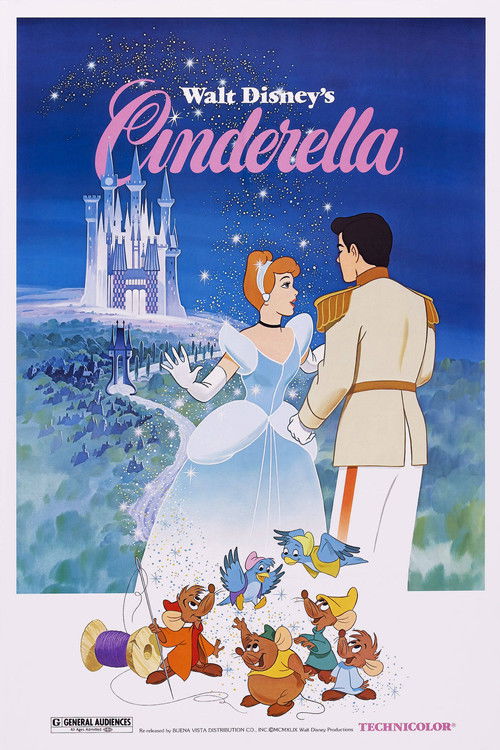
Walt Disney's postwar return to the fairy-tale form follows Cinderella, a kind and dreaming young woman kept in servitude by a cold stepmother and two jealous stepsisters, who gets one magical night at the royal ball with the help of her fairy godmother and a pair of glass slippers. Directed by Clyde Geronimi, Hamilton Luske, and Wilfred Jackson, the film rescued the studio from its wartime anthology period and restored its belief in the full-length fairy tale as its signature form. The animation is warm and graceful, the pacing confident, and the comic relief provided by Gus and Jaq the mice genuinely funny and inventive. Beneath its romantic surface, Cinderella is a story about patience, dignity, and the belief that goodness will eventually find its reward — and as the film that revived the studio's fortunes after years of difficulty, it carries a kind of institutional optimism that feels entirely earned.
Watch for
- The mice Gus and Jaq as the film's most fully realized comic characters — their animation is looser, more physical, and more broadly expressive than the human characters, and the sequence where they work to make Cinderella's dress demonstrates the studio's ability to sustain comic tension through pure character behavior.
- How the film's light design functions as an emotional indicator — the warm golden light of Cinderella's attic, the cold blue of midnight, the magical luminescence of the Fairy Godmother sequence — and how Frank Thomas and Ollie Johnston's animation of the Fairy Godmother gives the transformation scene its sense of joyful spontaneity.
- The glass slipper sequence and its restraint — the film builds to a confrontation that depends entirely on a single piece of footwear, and watch how the animators manage audience expectation through staging and timing, particularly the moment the slipper breaks and Cinderella reveals the other.
- The Evil Stepmother's physicality as a study in controlled threat — where Cruella De Vil and Maleficent externalize their villainy operatically, Lady Tremaine's menace is entirely interior, expressed through posture, gaze, and the precision of her stillness in a film where most characters are in constant motion.
Production notes
Cinderella was a make-or-break gamble for the studio. After a decade of war-era package films, Walt Disney needed a critical and commercial hit on the scale of Snow White, and the Disney company's financial survival depended on it. Directors Wilfred Jackson, Hamilton Luske, and Clyde Geronimi led production, with Eric Larson, Marc Davis, Frank Thomas, Ollie Johnston, Milt Kahl, John Lounsbery, Wolfgang Reitherman, and Ward Kimball — most of the Nine Old Men — animating key characters. To control costs, the studio shot extensive live-action reference footage with actress Helene Stanley as Cinderella, then largely traced and stylized that footage into animation; this hybrid approach saved enormous time and money. Ilene Woods voiced Cinderella from over 400 actresses who auditioned. The film cost roughly $2.2 million.
Trivia
- Ilene Woods recorded a demo of 'A Dream Is a Wish Your Heart Makes' as a favor for songwriter friends without knowing it would be played for Walt Disney; he heard it and cast her on the spot.
- Songwriters Mack David, Al Hoffman, and Jerry Livingston came from a Tin Pan Alley pop-music background rather than the studio system, and 'Bibbidi-Bobbidi-Boo' was nominated for the Academy Award for Best Original Song.
- Lucifer the cat was modeled after a real calico cat owned by story artist Bill Peet, who suggested Walt Disney himself when asked what the villain cat should look like.
- Cinderella's transformation scene from rags to gown was Walt Disney's personal favorite piece of animation in any of his films — animated by Marc Davis with extraordinary delicacy as light spirals around the figure.
- If Cinderella had failed at the box office, Walt Disney has said the studio would have shut down its feature animation division entirely — its success enabled the immediate green-lights of Alice in Wonderland and Peter Pan.
Legacy
Cinderella's massive 1950 success — earning more than four times its budget — saved Walt Disney Animation from possible shutdown after a decade of war-era package films, and reopened the door to ambitious feature storytelling. Walt himself later said the studio's feature animation division would have closed if the film had failed; its triumph enabled the immediate green-lights of Alice in Wonderland and Peter Pan. The film won three Academy Award nominations (Best Original Score, Best Original Song for 'Bibbidi-Bobbidi-Boo,' and Best Sound) and was selected for the National Film Registry in 2018. The character became the second pillar of the Disney Princess line after Snow White and gave the company an iconic image — the gown, the slipper, the castle — that has continued to anchor branding, theme parks (the Magic Kingdom's central spire is Cinderella Castle), and merchandise. The film established the template for the postwar Disney fairy tale and influenced everything from Sleeping Beauty to Beauty and the Beast. Live-action remakes in 1997 and 2015 attest to the story's endurance in Disney's reinvention machine.