Dinosaur
Vibe
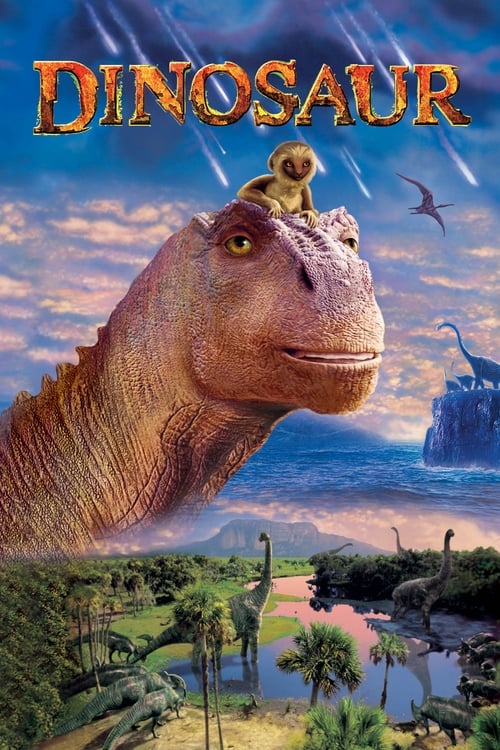
Walt Disney's prehistoric adventure follows Aladar, an Iguanodon raised by a family of lemurs on an isolated island, who finds his world destroyed by a meteor shower and must lead a herd of survivors across a barren landscape to reach the nesting grounds before the predators that pursue them close in. Directed by Eric Leighton and Ralph Zondag, the film was technically ambitious — blending computer-generated dinosaurs with photorealistic live-action backgrounds — but more conservative in its storytelling, drawing on a familiar survival narrative structure that offered few surprises. Its best moments are visual, capturing the scale and variety of Cretaceous life with genuine awe, and the opening sequence before dialogue begins is one of the most wordless and atmospheric the studio produced in the era. More spectacle than story, Dinosaur is a film that impresses most when it trusts its images and slows down enough to let the world it has built simply breathe.
Watch for
- The film's opening ten minutes before dialogue begins — a wordless tracking shot following Aladar's egg from nest to river to sea to island, using photorealistic CGI environments with full atmospheric haze, directional lighting, and ambient sound design to create an immersive natural world that operates entirely through visual and sonic information.
- The compositional tension in every frame between the CGI dinosaurs and the live-action photographic environments — watch how the production team used color grading and lighting matching to integrate digital characters into real Jordanian desert, Hawaiian forest, and Venezuelan tepui locations, and how the visual seams between them create a productive cognitive tension between the fantastical and the photographed.
- Aladar's design as a deliberate balance between scientific accuracy and emotional readability — the animators worked from paleontological consultants on the proportions, skin texture, and locomotion of Iguanodons, while also giving Aladar proportionally larger eyes and a more flexible face than strict accuracy would allow, maintaining the visual contract with audiences that requires characters to be readable.
- The herd migration sequences and their CGI crowd simulation — each dinosaur in the herd has individually programmed locomotion and behavioral responses, and the resulting movement of hundreds of distinct individuals creates a visual density and unpredictability that is both a technical demonstration and a narrative argument about collective survival.
Production notes
Dinosaur was Disney's first fully computer-animated feature film, produced by The Secret Lab, the studio's specialty CGI division (formed from the merger of Disney's CGI department and the Dream Quest Images visual effects house). Co-directors Eric Leighton and Ralph Zondag led the production. The film's animation pipeline was unusual: photorealistic CGI dinosaurs and lemurs were composited onto live-action photographic plates of real environments shot in Australia, Venezuela, Africa, Hawaii, and the American Southwest. The result was meant to feel like a documentary version of a dinosaur world. The film cost an estimated $127.5 million, making it the most expensive movie ever produced at the time. D.B. Sweeney voiced the iguanodon Aladar, with Julianna Margulies, Joan Plowright, and Samuel E. Wright among the supporting cast.
Trivia
- Dinosaur was originally developed without dialogue — the project's earliest concept was a National Geographic-style nature documentary in CGI — but Disney executives reversed the decision late in production and added voice acting throughout.
- Filming the live-action environmental plates required expeditions to remote locations on five continents; the production team has compared the photographic side of the film's making to a globe-spanning nature documentary in its own right.
- Disney has at various points listed Dinosaur as an official entry in the animated canon and at other points excluded it; its computer-animated nature and live-action environments made it an awkward fit alongside the studio's hand-drawn tradition.
- The Secret Lab division that made Dinosaur was shut down in 2002 after the film and a few others; its talent largely dispersed, with some moving to Walt Disney Feature Animation's nascent CGI capabilities.
- The film grossed roughly $349 million worldwide, recouping its costs but disappointing relative to the budget and the huge marketing push behind its release.
Legacy
Dinosaur's mixed critical and commercial reception, combined with the dissolution of The Secret Lab division that produced it, made it a closed chapter rather than a foundation. Disney's serious investment in CGI animation would come a few years later through Pixar's increasing influence and eventually through the studio's own re-formation under John Lasseter. As Disney's first fully computer-animated feature film — produced on a $127.5 million budget that briefly made it the most expensive movie ever produced — it represented an enormous bet that ultimately did not pay off in the way the studio hoped. The film has not generated lasting cultural footprint comparable to its budget, and many casual Disney fans don't even remember it as part of the canon. Its photorealistic ambitions, however, anticipated the visual approach Jon Favreau would take with The Jungle Book (2016) and The Lion King (2019). For its specific niche — viewers who saw it as children and remember the opening egg-journey sequence as one of the great animated set pieces — Dinosaur remains a loved if commercially modest entry.