Dumbo
Vibe
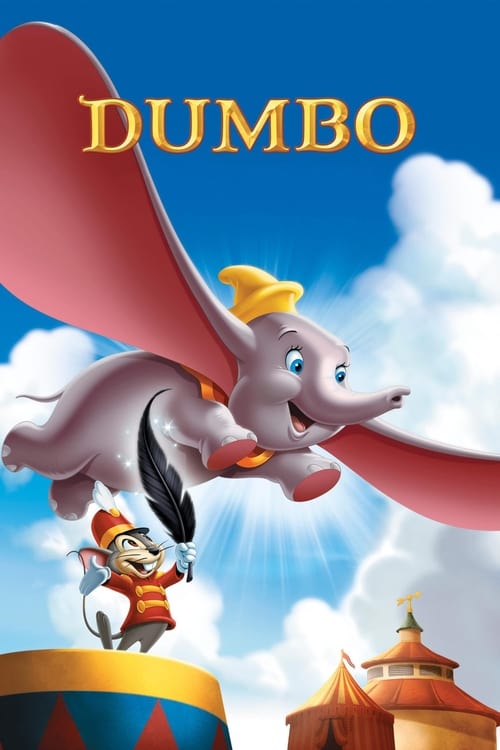
Walt Disney's Depression-era fable follows Dumbo, a young elephant born with enormous ears who is mocked and separated from his devoted mother at a traveling circus. With only a small, fast-talking mouse named Timothy as his ally, Dumbo gradually discovers that the very quality that made him a target of ridicule may be the thing that sets him apart. Directed by Ben Sharpsteen, the film is one of Disney's shortest and most emotionally economical features, built around two or three sequences of such concentrated feeling that they remain among the studio's most affecting work. Stripped of ornamentation and driven by empathy, Dumbo becomes a quiet story about the cruelty of social rejection, the loyalty of unlikely friendship, and the surprising power that grows from learning to embrace what makes you different.
Watch for
- The Pink Elephants on Parade sequence — a psychedelic animation tour de force in which elephants morph, multiply, and transform through pure visual free association, representing Disney's most experimental and abstract filmmaking outside of Fantasia.
- The scene of Dumbo visiting his imprisoned mother — watch how the animators convey both characters' emotions entirely through physical gesture and touch, with the trunk reaching through the bars and the gentle rocking achieving a level of pantomimic emotional expression that rivals anything in silent cinema.
- How the film uses color and light to encode emotional register — the warm amber of Dumbo's circus world, the cold blue of isolation and cruelty, and the sudden riot of color in the Pink Elephants sequence — creating a color grammar that tells emotional story independently of the narrative.
- Timothy Mouse's scale and confidence as a counterpoint to Dumbo's vulnerability — the film's comedy largely derives from the gap between Timothy's boldness and his physical insignificance, and the animators exploit that gap with timing and staging precision that elevates simple comic-relief material into something genuinely inventive.
Production notes
After the financial setbacks of Pinocchio and Fantasia, Walt Disney commissioned Dumbo as a deliberately modest production — short, inexpensive, and turned around quickly. Supervising director Ben Sharpsteen led the team, with sequence directors Norman Ferguson, Wilfred Jackson, Jack Kinney, Bill Roberts, and Sam Armstrong each handling segments. The studio leaned on simpler character designs and watercolor backgrounds (rare in Disney features) to keep costs around $950,000 — less than half of Pinocchio's budget. Production was famously interrupted by the May 1941 Disney animators' strike, which left lasting bitterness within the studio and is satirized directly in the film's drunken-clowns sequence. The original story by Helen Aberson and Harold Pearl was a 'Roll-A-Book,' a small prototype book read on a roller; Disney bought the rights for around $1,000.
Trivia
- Dumbo was the first Disney animated feature to turn a clear profit, recouping its modest budget within months and giving the studio desperately needed cash flow during the war years.
- Dumbo never speaks a single word in the entire film — a deliberate creative choice that sets him apart from virtually every Disney protagonist before or since.
- The 'Pink Elephants on Parade' sequence was animated by Howard Swift and Hicks Lokey and is widely considered one of the great surrealist passages in commercial animation, with no narrative function beyond pure visual delirium.
- The 1941 strike that paused production resulted in many of the era's most talented animators leaving Disney for good — including Art Babbitt and a young Bill Melendez, who would later helm the Peanuts specials.
- Time magazine planned to put Dumbo on its December 8, 1941 cover; the Pearl Harbor attack on December 7 bumped him for war coverage, in what would have been the first animated character ever featured on the magazine's front.
Legacy
Dumbo's enormous emotional efficiency — only 64 minutes long, yet capable of devastating audiences with the 'Baby Mine' scene — has made it a perennial point of reference for animation directors. Made deliberately small and inexpensive after Pinocchio's and Fantasia's losses, it became the studio's first clear theatrical profit and gave Disney desperately needed cash flow during the war years. It won the 1941 Academy Award for Best Original Score and earned a nomination for Best Original Song, and entered the National Film Registry in 2017. Modern reception has grown more complicated: the crow sequence, with its racially-coded character designs, remains a flashpoint, and Disney+ now restricts the film to mature accounts with a content advisory. But the emotional core — a small, mocked outsider lifted by love and against-the-odds flight — has been remade, restaged, and re-spun continuously, including a 2019 Tim Burton live-action adaptation. Time magazine had planned to put Dumbo on its December 8, 1941 cover before Pearl Harbor pre-empted him.