Encanto
Vibe
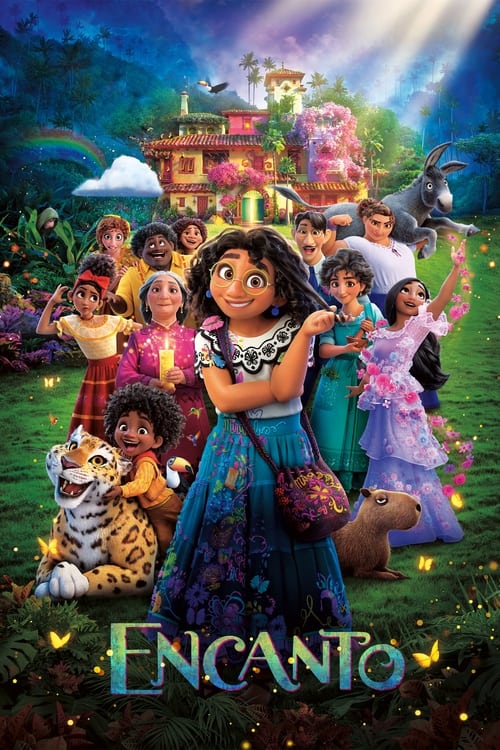
Walt Disney's vibrant Colombian fantasy follows Mirabel Madrigal, the only member of a magical family who was not gifted with a special power, as cracks begin to appear in the enchanted Casita that houses her family and she sets out to discover what is quietly fracturing the miracle that has sustained them all. Directed by Jared Bush and Byron Howard, the film is built around themes of family pressure, perfectionism, generational trauma, and the invisible toll of being the one who keeps everyone together — and it approaches these themes with a directness unusual for a Disney feature. Lin-Manuel Miranda's score is one of the most musically diverse and lyrically sophisticated the studio has commissioned, with We Don't Talk About Bruno becoming one of the best-performing Disney songs in chart history. As a story about the family member who falls through the cracks and yet holds the family together, Encanto is the studio's warmest, most emotionally specific, and most culturally grounded film in recent memory.
Watch for
- Casita's animation as a fully realized non-humanoid character — the house's ability to communicate, assist, and ultimately mourn is expressed entirely through architectural behavior: tiles rearranging themselves, stairs shifting angle, windows shuttering or opening, furniture repositioning with apparent awareness. Watch how the animators give Casita consistent emotional responses that create a personality without ever giving it a face.
- Bruno's vision cave and the green sand animation as a visual problem-solver — the prophecy sequences required a way to render supernatural foresight as a tangible physical phenomenon, and watch how the green sand's behavior — falling, catching the light, settling into images — creates both a visual spectacle and an internally consistent representation of how Madrigal magic interacts with the physical world.
- Lin-Manuel Miranda's song structure and how it embeds exposition — watch how Surface Pressure uses the visual metaphor of Luisa's physical feats to make an argument about anxiety and emotional labor, how What Else Can I Do visualizes Isabela's suppressed identity through botanical transformation, and how We Don't Talk About Bruno constructs Bruno's myth through seven characters' overlapping accounts in a single number.
- The Encanto's cracking as a visual metaphor that runs throughout the second act — watch how the fissures in the casa spread in precise spatial relationship to the emotional suppression of Mirabel's family members, creating a visual argument that the house's physical integrity is directly tied to the family's psychological honesty, and how the animation of the cracks' progress tracks the escalation of the emotional crisis beneath the magical surface.
Production notes
Encanto was the first Disney animated feature set in Colombia and the first to make a Latin American extended family the dramatic core of the story. Co-directors Byron Howard, Jared Bush, and Charise Castro Smith led production. Lin-Manuel Miranda wrote eight original songs blending Latin pop, salsa, vallenato, hip-hop, and Broadway-musical idioms; this represented a substantial departure from his more traditional Hamilton/Moana register. Cultural advisors helped shape the depiction of Colombian regional traditions, food, dress, and family dynamics. Stephanie Beatriz voiced Mirabel, John Leguizamo played Bruno, and the extensive Madrigal family ensemble required Disney to develop a large cast of distinct character designs. The magical 'casita' (the family house, itself essentially a character) required custom animation systems to express its emotional reactions. The film cost roughly $150 million.
Trivia
- Lin-Manuel Miranda's 'We Don't Talk About Bruno' became Disney's first song to top the Billboard Hot 100 chart since 1995's 'A Whole New World' from Aladdin — and the first ever to reach #1 in the United Kingdom.
- The 'magical casita' — the Madrigals' sentient family house — was animated with subtle expressive gestures (window-shutters as eyebrows, tile-floors that ripple) that required custom rigging; the house essentially functions as a non-speaking ensemble character.
- Stephanie Beatriz, who voiced Mirabel, recorded much of her dialogue and singing while pregnant; her daughter was born in August 2021, three months before the film's November release.
- Encanto was nominated for three Academy Awards (Best Animated Feature, Best Original Score, and Best Original Song for 'Dos Oruguitas'); it won Best Animated Feature, defeating Disney's own Raya and the Last Dragon and Sony's The Mitchells vs. the Machines.
- The film's title means 'enchantment' in Spanish; the phrase 'el encanto' (the enchantment) is used throughout the story to refer to the family's magical gift, which has been mistranslated in some marketing as the proper noun 'Encanto.'
Legacy
Encanto grossed about $256 million theatrically — modest by major Disney standards because of continued pandemic disruption — but became one of Disney+'s most-streamed launches ever. Its musical and cultural footprint vastly outpaced its theatrical performance: 'We Don't Talk About Bruno' became Disney's first song to top the Billboard Hot 100 chart since 1995's 'A Whole New World' and the first ever to reach number one in the United Kingdom. The soundtrack went multi-platinum, and the film became one of the most-quoted Disney releases of the 2020s. It won the Academy Award for Best Animated Feature, defeating Disney's own Raya and the Last Dragon. Encanto has become a touchstone for Latine/Latinx representation in mainstream American animation, and Mirabel — notably the first Disney lead in a musical not to receive a romantic plot — has been celebrated for centering family and self-acceptance over romance. The film established Lin-Manuel Miranda as Disney's premier songwriter of the era, alongside the Lopez team.