Fantasia
Vibe
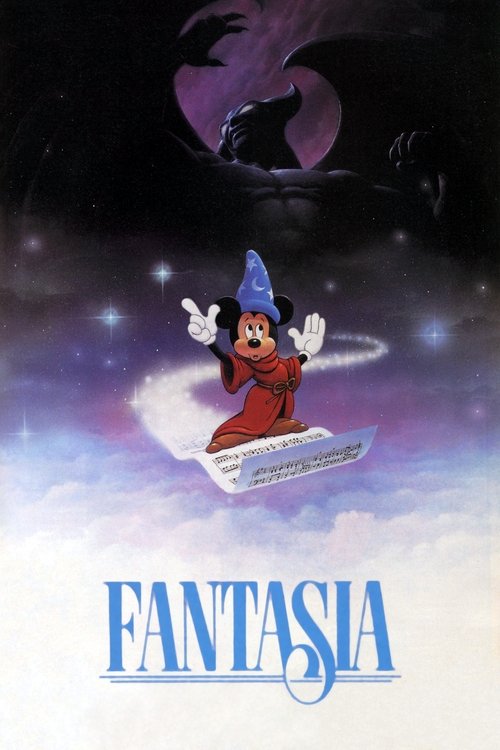
Walt Disney's bold artistic experiment abandons narrative entirely, pairing eight pieces of classical music with animated sequences that range from cosmic abstraction to mythological comedy to pure visual poetry. Conceived in collaboration with conductor Leopold Stokowski and introduced by musicologist Deems Taylor, the film treats animation as a form of visual music, allowing Mickey Mouse, dancing hippos, sorcerers, and ancient gods to inhabit the same imaginative universe as Bach, Beethoven, and Stravinsky. Directed by a team of animators under Disney's supervision, Fantasia challenged assumptions about what an animated film could be and who it was for. As a sustained experiment in the relationship between sound and image, it remains one of the most ambitious and singular works ever attempted in the history of American animation.
Watch for
- The Sorcerer's Apprentice segment as the centerpiece and emotional anchor of the film — watch how Mickey's expressions and physical comedy carry the sequence's entire dramatic arc without a single word of dialogue, demonstrating the full range of what expressive character animation can achieve.
- The Night on Bald Mountain / Ave Maria sequence at the film's end, where Chernabog unfolds from the mountain — animator Vladimir Tytla's draftsmanship in giving the demon weight, mass, and terrifying charisma is arguably the single greatest example of character animation in Disney's golden age.
- How Oskar Fischinger's abstract visual music influences the Bach Toccata and Fugue segment — pure non-representational animation responding directly to musical structure, an avant-garde experiment that has no precedent in mainstream American cinema before or since.
- The Pastoral Symphony sequence and its complex relationship to the music — watch how the animation's rhythm, mood, and pacing are determined entirely by Beethoven's dynamic variations, with the storm sequence as its most technically intricate demonstration.
Production notes
Fantasia began as 'The Concert Feature,' a one-shot Mickey Mouse short of 'The Sorcerer's Apprentice' meant to revive the character's flagging popularity. As the budget swelled, Walt Disney reconceived it as a feature anthology pairing animated sequences to classical works conducted by Leopold Stokowski with the Philadelphia Orchestra. Music critic Deems Taylor served as on-screen narrator. Production supervisor Ben Sharpsteen oversaw eight distinct sequences, each developed by a different team — including Wilfred Jackson on 'The Rite of Spring,' James Algar on 'The Sorcerer's Apprentice,' and T. Hee on the 'Dance of the Hours.' The studio simultaneously developed Fantasound, a multi-channel stereophonic sound system requiring custom speaker arrays installed in only a handful of theaters that hosted the film's roadshow release. The total cost ran north of $2.2 million.
Trivia
- Fantasound made Fantasia the first commercial film released in stereophonic sound, predating the standardization of multichannel theatrical audio by nearly two decades.
- Walt Disney originally envisioned Fantasia as an evolving repertory work — sequences would be retired and replaced over time, keeping the program fresh — a vision that finally bore fruit 60 years later with Fantasia 2000.
- The 'Pastoral Symphony' segment originally featured a Black centaurette named Sunflower who served the white centaurettes; she was edited out of all post-1969 prints and the studio has never officially released the original cut.
- Bela Lugosi was hired as live-action reference for the demon Chernabog in 'Night on Bald Mountain' but Bill Tytla, who animated the sequence, ultimately found Lugosi too theatrical and used art director Wilfred Jackson posing in the studio instead.
- The film was a financial disaster on first release, in part because the war closed European markets and in part because the Fantasound roadshow could only book a limited number of equipped theaters; it took multiple reissues for Fantasia to break even.
Legacy
Fantasia was Walt Disney's most experimentally ambitious project — animation in genuine dialogue with classical music, abstraction sitting beside narrative, popular entertainment aspiring to high art — and no mainstream studio has matched its reach in the decades since. Its commercial failure in 1940 was a deep blow, but its critical and artistic reputation has only grown over time. The film has been reissued repeatedly — 1942, 1946, 1956, 1963, 1969, 1977, 1982, 1990 — each generation rediscovering it. It earned honorary Academy Awards for Stokowski and the studio, was added to the National Film Registry in 1990, and remains a fixture of any serious discussion of animation as an art form. Its Fantasound multichannel system predated standardized stereo theatrical audio by nearly two decades. Fantasia is the film that proves animation can be philosophy, not just storytelling, and its reach extends from music education to psychedelic counterculture to the IMAX-era spectacle film.