Fantasia 2000
Vibe
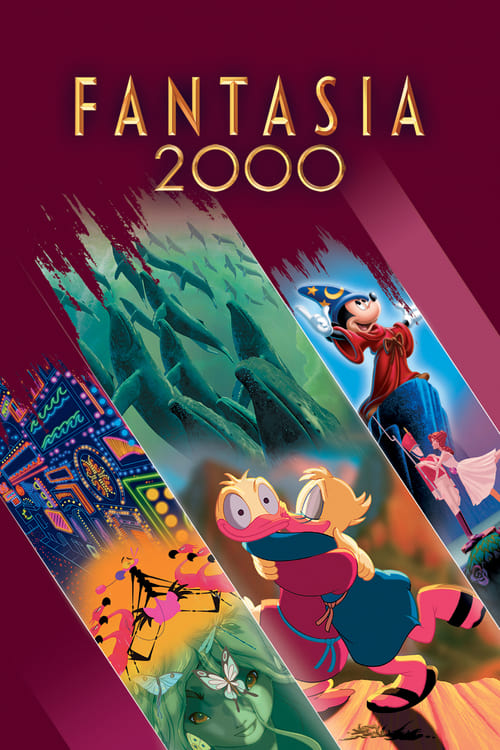
Walt Disney's long-awaited successor to its 1940 predecessor returns to the original's concept of pairing classical music with animated sequences, updating the format with eight new segments while retaining The Sorcerer's Apprentice as a bridge to the original. Directed by various animators and introduced by a roster of celebrity hosts, the film moves from the abstract beauty of flying humpback whales to a buoyant retelling of Hans Christian Andersen's The Steadfast Tin Soldier to a moving depiction of Stravinsky's Firebird as a cycle of destruction and renewal. While none of its sequences quite reaches the iconic status of Fantasia's best, the film succeeds as a genuine tribute — bringing the concert-film format into a new era without abandoning the ambition and visual imagination that made the original so remarkable. As a meditation on the relationship between music and image, Fantasia 2000 reminds audiences that animation, at its most ambitious, can reach for something close to pure visual music.
Watch for
- The Firebird Suite as the film's most visually ambitious sequence — watch how the animation renders fire as a destructive force with genuinely terrifying physical mass, and how the forest spirit's re-emergence and the gradual restoration of the landscape is timed precisely to Stravinsky's musical arc, making the ecological cycle of destruction and renewal the film's most fully realized visual-musical argument.
- The Rhapsody in Blue segment and its direct dialogue with Al Hirschfeld's caricature illustration style — Eric Goldberg's animation uses flat color and the specific proportions of Hirschfeld's pen line to create an animated New York that feels genuinely constructed from a visual tradition rather than invented from scratch, making it the most graphically committed and visually unified segment in the film.
- How the Sorcerer's Apprentice bridges the two films — watch how its visual and musical familiarity creates a nostalgic anchor within the new film, and how the framing of Roy E. Disney's introduction acknowledges the act of institutional memory the inclusion represents, turning a simple re-presentation into a statement about continuity between eras of Disney animation.
- The Pines of Rome whales sequence and how its choice of animal — humpback whales flying through clouds — creates a sense of scale that has no equivalent in animation outside of this film. The spatial relationship between the whales and the surrounding cloudscape required the digital tools to express physical weight at a dimension that would have been unachievable through any other means.
Production notes
Fantasia 2000 was Roy E. Disney's passion project — Walt's nephew had championed the original Fantasia for decades and worked tirelessly to fulfill Walt's vision of an evolving repertory work that would refresh its sequences over time. Production began in earnest in 1991 and stretched across nearly a decade. Roy Disney executive-produced; James Levine conducted the Chicago Symphony Orchestra. Eight new sequences set to classical works were paired with a single returning segment — the original 'Sorcerer's Apprentice' — preserving the tradition while marking the new vintage. Sequence directors included Pixote Hunt, Hendel Butoy, Eric Goldberg (whose 'Rhapsody in Blue' segment styled in Al Hirschfeld's caricatures became the film's most-praised piece), Francis Glebas, and Don Hahn. The film opened in IMAX theaters in January 2000 — the first commercial feature animation released in the large-format giant-screen medium.
Trivia
- Fantasia 2000 was the first feature-length animated film released in IMAX format; its initial 1999–2000 theatrical run was exclusively in IMAX theaters before a wider 35mm release in June 2000.
- Eric Goldberg's 'Rhapsody in Blue' segment — designed in Al Hirschfeld's flowing caricature style and following four New Yorkers' interconnected days — is widely cited as one of the great animated sequences of the modern Disney era.
- Several celebrity hosts introduce the segments: Steve Martin, Bette Midler, James Earl Jones, Penn & Teller, Quincy Jones, Itzhak Perlman, James Levine, and Angela Lansbury — a higher-wattage lineup than Deems Taylor's lone hosting in the original.
- Roy E. Disney's role in finally completing Fantasia 2000 was deeply personal — he had been advocating for the project since the 1970s and had used his board position at the company to ensure it would actually be made.
- Salvador Dalí's lost 1946 short Destino was completed in 2003 partly using Fantasia 2000-era techniques and finished with the involvement of Roy E. Disney; in some prints of Fantasia 2000 it has been screened as a coda.
Legacy
Fantasia 2000 finally fulfilled Walt's vision of an evolving Fantasia after 60 years and proved the format could still find an audience — though its theatrical performance was modest at about $90 million worldwide. Its IMAX release was a milestone in large-format theatrical animation, the first feature animation released in giant-screen exclusivity. The 'Rhapsody in Blue' segment, designed in Al Hirschfeld's flowing caricature style, has had a long afterlife as a standalone piece referenced in animation history courses and is widely cited as one of the great animated sequences of the modern Disney era. The film remains, alongside the original Fantasia, the only major commercial animated feature deliberately structured as orchestral concert; the genre simply has not become a viable theatrical model. As a tribute to Roy E. Disney's decades of perseverance in bringing the project to the screen, and as a continuation of the Disney studio's most genuinely experimental tradition, Fantasia 2000 occupies a beloved if commercially modest place in the canon.