Fun and Fancy Free
Vibe
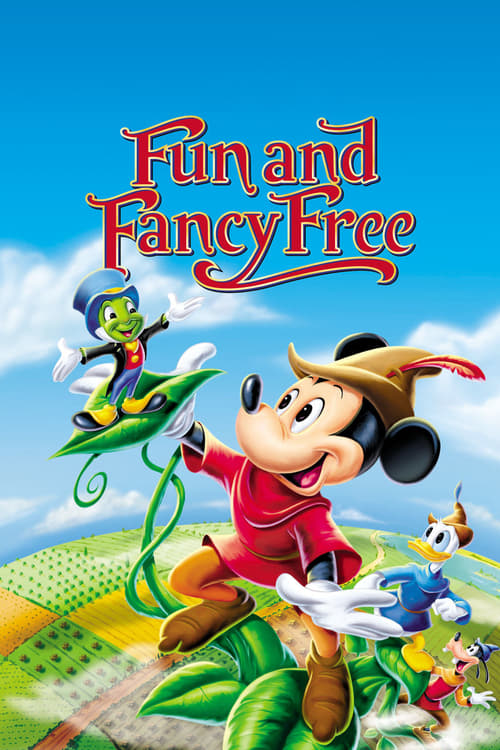
Walt Disney's cheerful postwar anthology pairs two short features — Bongo, a circus bear who escapes to the wilderness and discovers that a slap is how bears say they love you, and Mickey and the Beanstalk, a retelling of the classic fairy tale with Mickey, Donald, and Goofy climbing into the clouds to reclaim a stolen harp from a bumbling giant. Hosted in part by ventriloquist Edgar Bergen and his puppet Charlie McCarthy, the film blends live-action framing with animation in ways that feel casual and pleasantly off-format. Directed by William Morgan and Jack Kinney, it represents a transitional moment at the studio, maintaining the anthology approach of the wartime years while returning to beloved classic characters with a looser, more relaxed energy. Light, funny, and genuinely inventive in its better moments, Fun and Fancy Free holds the easy warmth of an afternoon special stretched into something a little larger.
Watch for
- The Edgar Bergen live-action framing sequences and how they interact with the animated world — particularly the sequence where the giant from Mickey and the Beanstalk reaches out of the storybook and into the live-action party, a fourth-wall break that treats the boundary between animation and reality as genuinely permeable.
- Mickey Mouse's portrayal in Mickey and the Beanstalk as a character quietly diminished from his earlier screen presence — this is one of Mickey's final leading roles in a theatrical feature before he became primarily a brand icon, and there is a melancholy in his underdog sweetness that makes the segment a valedictory portrait.
- Goofy's Bongo segment and its remarkably compressed emotional storytelling — the bears-communicate-through-slapping premise is played both for comedy and genuine romance, and the animation of Goofy's falling-in-love pantomime is as expressive as anything in the longer features of the period.
- The contrast between the two films' visual approaches — Bongo's warm pastel naturalism against Mickey and the Beanstalk's more theatrical staging — and how each reflects a different production team's aesthetic sensibility at a studio searching for visual coherence after the disruption of the wartime years.
Production notes
Fun and Fancy Free combined two unfinished projects from the studio's mothballed feature pipeline: 'Bongo,' adapted from a Sinclair Lewis story about a circus bear, and 'Mickey and the Beanstalk,' which had been developed during the early 1940s as a potential Mickey Mouse feature. Linking them was a live-action wraparound starring ventriloquist Edgar Bergen, his dummies Charlie McCarthy and Mortimer Snerd, and child actress Luana Patten. Ben Sharpsteen supervised, with directors Jack Kinney, Hamilton Luske, William Morgan, and Bill Roberts handling segments. Most notably, this film contains the last performance of Mickey Mouse voiced by Walt Disney himself — Walt had grown too busy and his voice too rough by the late 1940s, and Jimmy MacDonald took over as the official voice afterward.
Trivia
- Fun and Fancy Free contains Walt Disney's last regular performance as the voice of Mickey Mouse; he had originated the role in 1928 and continued voicing the character for nearly two decades.
- Edgar Bergen's daughter Candice Bergen — the future Murphy Brown star — was a young child during production and visited the set of the live-action wraparound segments.
- The 'Mickey and the Beanstalk' segment was originally developed as a stand-alone feature in the early 1940s; budget pressures during the war led to it being shelved, and it was finally finished as half of this package film.
- Willie the Giant — voiced by Billy Gilbert with his trademark sneeze — became one of the more durable side characters from the package-film era, returning in television specials and the Disney parks.
- The film's framing device, with Jiminy Cricket reading children's stories from a bookshelf, was a story structure the studio would re-use repeatedly through the package-film era and television specials.
Legacy
Fun and Fancy Free is best remembered today for 'Mickey and the Beanstalk,' which has been extracted for innumerable holiday and Sunday-afternoon television airings and has likely been seen by far more people than the full feature. The film carries archival importance as the work containing Walt Disney's last regular performance as the voice of Mickey Mouse — a role he had originated in 1928 and continued for nearly two decades. Jimmy MacDonald took over as the official voice afterward. The 'Bongo' segment, by contrast, has largely faded from public memory. As a record of mid-1940s Disney transition — Walt stepping back from Mickey, the package-film era nearly over, the studio gathering itself for a return to feature storytelling — the film is a quiet hinge in studio history. Its genial, low-key tone, narrated by Cliff Edwards's Jiminy Cricket and by Edgar Bergen, captures a moment when Disney's storytelling ambitions were temporarily smaller and more domestic than what was about to come.