Home on the Range
Vibe
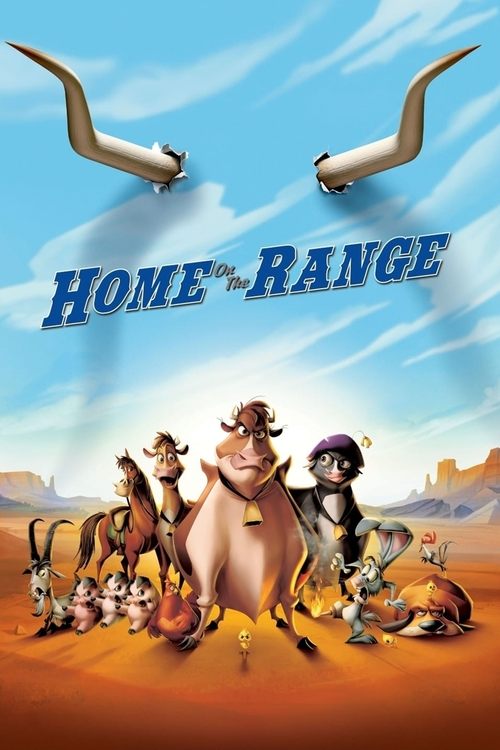
Walt Disney's playful western comedy follows three mismatched dairy cows — the refined Maggie, the maternal Mrs. Calloway, and the eager Grace — who set out to capture the notorious cattle rustler Alameda Slim and claim the reward money that would save their beloved farm from foreclosure. Directed by Will Finn and John Sanford, the film is a breezy, self-aware comedic exercise that draws on the western genre with affectionate irreverence, pairing yodeling cattle hypnosis and slapstick chases with a bouncy Alan Menken score. Though not a critical or commercial success on its original release, it has been appreciated in retrospect as a final expression of the studio's traditional hand-drawn animation before the transition to CGI that would define the decade to follow. Light on its feet, cheerfully unpretentious, and genuinely funny in its better moments, Home on the Range closes a chapter in the studio's history with a shrug and a grin rather than a grand finale.
Watch for
- The cartoon physics vocabulary throughout as a deliberate return to pre-realistic Disney convention — the exaggerated squash-and-stretch, the impossibly timed double-takes, the gag-driven action choreography all reference the rubber-hose animation tradition the studio had largely abandoned decades earlier, creating a film that reads as an affectionate citation of a stylistic history.
- The yodeling hypnosis sequences and their visual design — Alameda Slim's yodeling spirals represent one of the more formally inventive animation concepts in the film, and watch how the design of the hypnotic effect differs between the three cows, whose individual resistances create variations on the same visual motif that track each character's psychology.
- The background color design and how it handles the specific quality of American Southwest light — the warm oranges and dusty yellows of the landscape are rendered with an economy that reads as both stylized and geographically specific, and the contrast between the sun-bleached exteriors and the warmer, shadowed interiors of the farm creates a visual temperature map that tracks the narrative's emotional movement.
- Maggie's body language as the film's central comedic resource — her exasperated reactions, the specific quality of her long-suffering patience, and the way her large body is consistently used as the physical anchor for the trio's increasingly improbable adventures are the primary vehicle for the film's humor.
Production notes
Home on the Range was, when released, intended as Disney's final hand-drawn animated theatrical feature. The studio had announced in 2003 that it would be exiting traditional 2D animation in favor of computer animation, and Home on the Range became the marker of that transition. Co-directors Will Finn and John Sanford led the production with a deliberately old-fashioned cartoon-comedy approach — bold caricatured designs, broad slapstick, country-western settings, and a comic-bovine ensemble of bounty-hunting cattle. The voice cast leaned heavily on comic actors: Roseanne Barr, Judi Dench, and Jennifer Tilly as the main bovine trio; Cuba Gooding Jr. as a horse; Steve Buscemi as a goat; Randy Quaid as the villain Alameda Slim; and Bonnie Raitt singing on the soundtrack alongside k.d. lang and Tim McGraw. The film cost approximately $110 million.
Trivia
- Home on the Range was originally announced as Disney's final 2D theatrical animated feature — the studio's intent at the time was to discontinue traditional cel-and-paint animation entirely after this film.
- The film is one of only two Disney animated features set primarily in the American Old West (alongside Melody Time's 'Pecos Bill' segment), and the only one fully committed to Western genre conventions.
- Roseanne Barr's voice performance as Maggie was widely panned in reviews — some critics blamed her casting for the film's tonal mismatch with traditional Disney warmth — but Roseanne herself defended her involvement, noting that she'd been hired specifically for her edge.
- The film's title sequence styles itself as a vintage country-western LP album cover, complete with hand-lettered typography and color-print-era halftone — one of the more visually committed retro-design touches in any Disney feature.
- After Home on the Range underperformed and shut down 2D theatrical production, John Lasseter (who joined Disney in 2006 when the studio acquired Pixar) reversed course and ordered the resumption of hand-drawn animation, leading directly to The Princess and the Frog in 2009.
Legacy
Home on the Range earned about $103 million worldwide on a $110 million budget — a clear financial disappointment that confirmed Disney executives' decision to end 2D theatrical production. The film has remained one of the lowest-profile entries in the modern Disney canon, rarely revisited and seldom referenced. Its true historical importance lies in what it represents: the last gasp of an animation tradition that began in 1937 with Snow White, before John Lasseter's 2006 arrival reinstated 2D as a viable Disney option. The Princess and the Frog (2009) would be the studio's resurrected hand-drawn film, but no sustained 2D production has followed it. Home on the Range thus marks the closing parenthesis on an era — even though, technically, that era was only paused rather than ended. As one of only two Disney animated features set primarily in the American Old West, the film holds a unique geographic position in the canon, even as its reputation remains modest.