Lady and the Tramp
Vibe
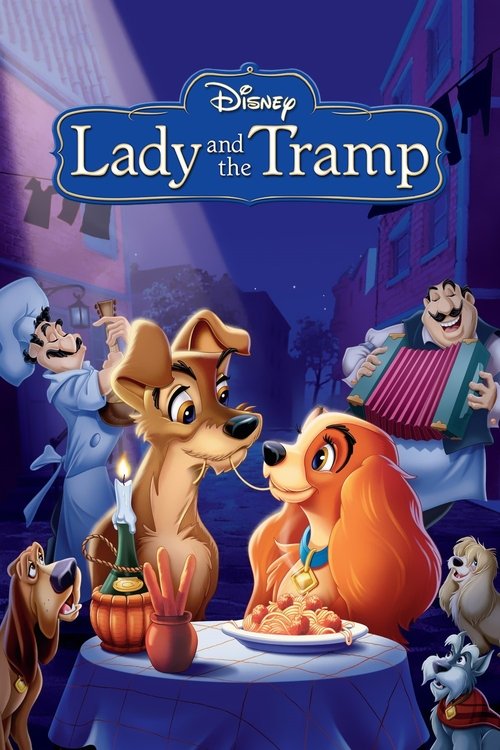
Walt Disney's romantic comedy follows Lady, a refined cocker spaniel living a comfortable life in a turn-of-the-century American household, whose world is upended by the arrival of a baby and the charming intrusion of Tramp, a streetwise mongrel with a taste for adventure and a soft heart he'd rather not show. Directed by Clyde Geronimi, Hamilton Luske, and Wilfred Jackson, the film is notable as Disney's first widescreen animated feature, using CinemaScope to give its world an unusually intimate, domestic scale. Its most famous sequence — two dogs sharing a strand of spaghetti by candlelight in an Italian restaurant — became one of the most iconic images in animation history. A story about class, trust, and the way love crosses the boundaries we use to sort the world, Lady and the Tramp is warm, funny, and quietly romantic in all the right ways.
Watch for
- The spaghetti dinner sequence at Tony's restaurant as a study in staging and screen direction — watch the spatial geometry of the shot choices as the strand of spaghetti draws the two characters toward each other, with the famous kiss achieved through the most economical possible means: a single noodle and two characters eating in the same direction.
- The film's use of CinemaScope's 2.55:1 aspect ratio to create domestic intimacy rather than epic scale — where most widescreen films of the era used the format for grandeur, the directors use it to show spatial relationships within rooms and yards, making the home environment feel genuinely inhabited.
- Tramp's animation by Eric Larson as a character study in confident ease — watch how Tramp's body language communicates class consciousness, street wisdom, and genuine tenderness toward Lady, all without explicit statement, creating the convincing impression of a character with a complete life beyond the film's events.
- The Siamese Cat sequence and its function as a structural pivot — the cats' malice is both funny and genuinely unsettling, and the sequence's tonal specificity marks the moment the film shifts from domestic comedy to a more threatening world, with the baby's vulnerability making the danger feel real rather than merely narrative.
Production notes
Lady and the Tramp was the first Disney animated feature to be produced in CinemaScope, the new 2.55:1 widescreen format that Hollywood was rolling out to compete with television. The wider aspect ratio required animators to rethink staging — characters needed to share the frame more often, and large empty spaces had to be filled with environmental detail. Directors Clyde Geronimi, Wilfred Jackson, and Hamilton Luske led the production; Frank Thomas, Ollie Johnston, Milt Kahl, John Lounsbery, and Eric Larson worked on the principal animation. Peggy Lee co-wrote six songs and voiced four characters including Si and Am the Siamese cats and the human character Darling. The story originated with a 1937 Cosmopolitan magazine piece by Ward Greene, which Walt Disney had personally optioned and then asked Greene to expand into a novelization.
Trivia
- Lady and the Tramp was the first Disney animated film original to the studio rather than adapted from a pre-existing fairy tale or novel.
- The CinemaScope production was so expensive and risky that the studio also produced a parallel set of animation in standard Academy ratio for theaters that hadn't installed widescreen equipment — essentially making each scene twice.
- The famous spaghetti scene was nearly cut from the film — Walt Disney initially thought two dogs sharing pasta would look ridiculous; animator Frank Thomas's test reel changed his mind.
- Peggy Lee's contractual rights to her songs and voice work became the basis of a 1991 lawsuit when she sued Disney for unpaid home video royalties — she won, receiving $2.3 million in a settlement that helped reshape industry standards on residuals.
- Tony's Town Square Restaurant at Walt Disney World's Magic Kingdom is themed entirely around the spaghetti scene — meatballs and all.
Legacy
Lady and the Tramp was the first Disney feature original to the studio rather than adapted from a pre-existing fairy tale or novel, and the first Disney animated feature produced in CinemaScope — making it a structural and technical milestone in the canon. It earned around $7.5 million on first release, the first Disney feature to truly live up to the box-office promise of Snow White and Cinderella, and entered the National Film Registry in 2025. The spaghetti scene is one of the most recognizable images in animation history. Tony's Town Square Restaurant at Walt Disney World is themed entirely around the moment. The 2019 live-action remake — released as a Disney+ launch title — used real dogs combined with CGI and established a new model for the studio's hybrid live-action remakes. Among the postwar Disney features, Lady and the Tramp is unusually domestic in scale, and that intimacy has aged well; the film feels almost like a small midcentury short story expanded to feature length, anchored by the warmth of its observation of dogs.