Lilo & Stitch
Vibe
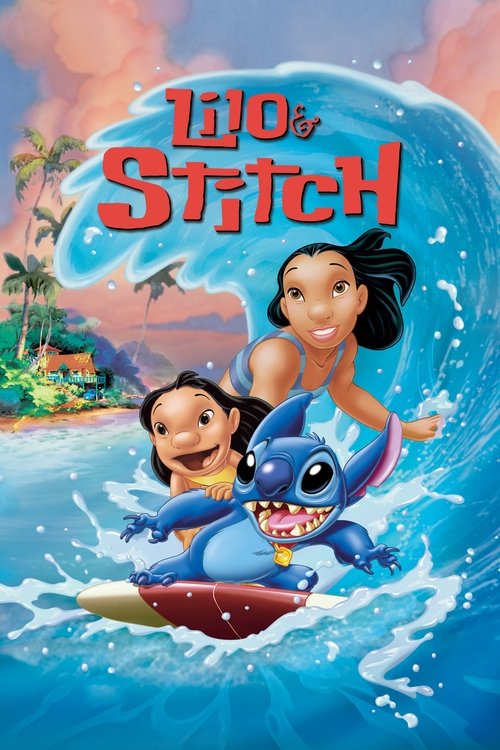
Walt Disney's warm and wildly imaginative comedy follows Lilo, a lonely and eccentric young Hawaiian girl being raised by her older sister, who adopts what she believes is a dog but is in fact Stitch — Experiment 626, a genetically engineered alien creature designed for chaos who is slowly undone by the unexpected force of a family's love. Directed by Chris Sanders and Dean DeBlois, the film is one of the most emotionally genuine and culturally specific films the studio produced in its modern era, grounding its science fiction premise in a story about grief, found family, and the stubborn belief that broken things can be put back together. Its hand-drawn, watercolor-influenced visual style and its use of Elvis Presley's music give it a warm, idiosyncratic texture that feels entirely its own. As a story about outsiders finding belonging in unexpected places, Lilo & Stitch became one of the most quietly beloved films in the Disney catalog — and its central declaration that family means nobody gets left behind has never lost its power.
Watch for
- The watercolor-influenced background art style and how it deliberately departs from Disney's CGI-dominant aesthetic of the period — while contemporaneous films were using photorealistic computer backgrounds, this film's loose, painted backgrounds evoke children's book illustration in a way that softens the science fiction elements and keeps the Hawaiian environment warm and tactile.
- Stitch's animation as a physical problem-solver — watch how the character uses all six limbs interchangeably, how his low center of gravity and wide body make his movement unpredictable, and how the animators give him specific behaviors derived from both dog and cat observation that make him readable as animal-adjacent without committing to any single species vocabulary.
- Lilo's character animation and the specific eccentricities built into her performance — she is drawn with rounder proportions than the idealized Disney child archetype, her movement is frequently awkward, and her emotional reactions are consistently extreme in ways that reflect genuine child behavior rather than the sanitized childhood most animated features depict.
- The Elvis Presley soundtrack as a formal argument rather than a nostalgic gesture — watch how each song is placed to comment on the emotional content of its scene, with Burning Love and Suspicious Minds creating ironic counterpoint between the music's romantic register and the action's comedic or action-based content, turning the soundtrack into a second layer of narrative commentary.
Production notes
Lilo & Stitch was made on a deliberately modest budget — roughly $80 million — by Disney's Florida animation studio while the main Burbank operation was producing Treasure Planet. Writer-directors Chris Sanders and Dean DeBlois (Sanders had voiced Stitch and conceived the character years earlier in a children's book that never published) pitched a story that broke nearly every Disney convention: no princess, no fairy-tale setting, a contemporary Hawaiian setting with a real social-services subplot, an alien protagonist who isn't initially even sympathetic, and a watercolor visual style explicitly modeled on European children's book illustration. The studio's executives were skeptical throughout; the film's success was not anticipated. Daveigh Chase voiced Lilo, Sanders voiced Stitch, Tia Carrere voiced Nani, David Ogden Stiers played Jumba, and Ving Rhames voiced Cobra Bubbles.
Trivia
- Lilo & Stitch was the first Disney animated feature since Dumbo to use watercolor backgrounds for its main interior environments — a deliberate visual return to a more handmade, illustrative tradition.
- Chris Sanders's original concept for Stitch came from a children's book idea he had developed in 1985, with Stitch as a forest sprite; the character was eventually reworked as an alien when the project was greenlit.
- The film's use of Elvis Presley songs — Disney licensed several major recordings, including 'Hound Dog,' 'Burning Love,' and 'Devil in Disguise' — was a significant departure from the studio's tradition of original songs and helped establish Lilo's love of Elvis as a defining personality trait.
- A teaser trailer for the film famously inserted Stitch into iconic moments from Aladdin, Beauty and the Beast, The Lion King, and The Little Mermaid — disrupting the classic scenes with chaotic energy as a meta-introduction to the new character.
- The September 11, 2001 attacks led to the alteration of one sequence: Stitch had been shown commandeering a Boeing 747 and flying it through skyscrapers, which was reanimated to use a smaller spaceship through canyons instead.
Legacy
Lilo & Stitch's cultural footprint massively outgrew its box office: from a $273 million theatrical release on a modest $80 million budget, the film generated one of Disney's most-merchandised character lines, particularly enormous in Japan, where Stitch has anchored marketing campaigns, theme park presence, and a long-running anime series. The 2025 live-action remake grossed over $1 billion globally, becoming Disney's biggest hit of that year and one of the highest-grossing live-action remakes ever made. The film earned an Academy Award nomination for Best Animated Feature (the second film ever to receive the new category award, losing to Spirited Away). It generated three direct-to-video sequels, two animated television series, and the recurring 'ohana means family' line entered general American sentimental vocabulary. Its naturalistic, contemporary, family-oriented storytelling foreshadowed the post-Frozen Disney heroines who would also be more interested in family bonds than romantic resolutions.