Moana
Vibe
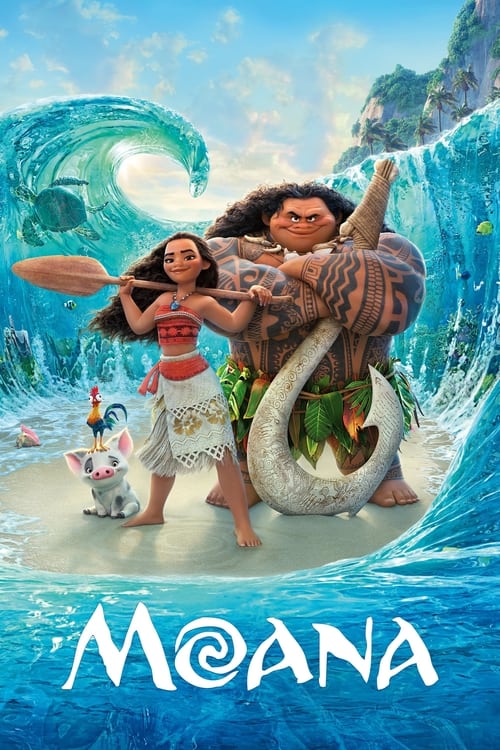
Walt Disney's epic ocean adventure follows Moana, the strong-willed daughter of a Pacific Island chief who hears the sea calling her name and sets out across the open ocean to restore the stolen heart of the goddess Te Fiti — accompanied, reluctantly, by the shape-shifting demigod Maui. Directed by Ron Clements and John Musker, the film is the studio's most expansive celebration of Polynesian culture and mythology, developed in close collaboration with experts in Pacific Island history, navigation, and storytelling and rendered with a visual richness that makes the ocean feel genuinely alive and unpredictable. Lin-Manuel Miranda, Opetaia Foa'i, and Mark Mancina's score weaves together contemporary musical theater with traditional Polynesian forms in ways that feel both modern and rooted. A story about heritage, identity, and the courage to follow the voice inside you even when the world tells you to stay, Moana is one of the studio's most visually ravishing and emotionally confident films.
Watch for
- The ocean animation as the film's most technically demanding achievement — Disney developed entirely new fluid simulation systems for the open water sequences, and watch how the ocean itself is animated with consistent physical personality: the waves that follow Moana, the water hand that returns her shell, the specific quality of open Pacific swell versus reef break, creating an ocean that operates as a character with consistent behavior.
- The Te Ka battle sequences and how they use color as conflict — the lava monster's orange and black palette is set against Moana's greens and blues in a visual opposition that reads as elemental before it resolves into anything else, and watch how the animators sustain the scale difference between Moana and Te Ka throughout the sequence, making her courage visible as a specifically physical challenge.
- Maui's tattoo animations by Eric Goldberg as a film within the film — the traditional 2D animation of mini-Maui on Maui's body operates as a comedic and expressive counterpoint to Maui's own dialogue, with the tattoo's reactions often communicating what the character won't verbally admit, and watch how Goldberg's design deliberately references Hawaiian tapa cloth visual tradition.
- How We Know the Way performs a narrative function beyond its emotional content — the song establishes the wayfinding tradition that the entire film is built around, and watch how its visual sequence of island navigation, star reading, and wave pattern recognition creates a compressed teaching moment that makes the film's central action legible as a practice with genuine cultural roots rather than a magical ability.
Production notes
Moana brought Ron Clements and John Musker — directors of The Little Mermaid, Aladdin, Hercules, Treasure Planet, and The Princess and the Frog — back together one more time. The directors began researching the project around 2011, with John Musker reading deeply into Polynesian mythology and the demigod Māui's exploits. They formed an Oceanic Story Trust of South Pacific cultural advisors to consult throughout production over the next five years; the Trust's feedback led to substantial revisions, including the rejection of an earlier bald Maui design and a deleted scene of Moana throwing a tantrum with coconuts. Auli'i Cravalho, then 14 years old and from Oahu, was cast as Moana; Dwayne Johnson voiced Maui. Lin-Manuel Miranda — at the peak of his Hamilton fame — co-wrote songs with Mark Mancina and Opetaia Foa'i. The film cost about $150 million.
Trivia
- Auli'i Cravalho, who voiced Moana, was 14 when she auditioned and 16 when the film was released; Disney had auditioned hundreds of young actresses before casting her near the end of the search process.
- Lin-Manuel Miranda was approached for the project at the peak of his Hamilton success; he wrote the songs in collaboration with Polynesian musician Opetaia Foa'i and composer Mark Mancina, who specifically guided the integration of Polynesian musical traditions.
- The Oceanic Story Trust of cultural advisors reviewed nine different versions of the script over the film's development; their feedback substantially reshaped Maui's design (long hair instead of bald), Moana's behavior, and the depiction of Polynesian wayfinding tradition.
- The film's iconic ocean — depicted as a sentient, playful character that interacts directly with Moana — required custom water simulation technology, and the ocean's 'personality' was animated by treating water as a character with intentionality.
- Moana opened the same year as Zootopia and the year after Inside Out, making 2016 one of the strongest years for Walt Disney Animation Studios in the studio's history.
Legacy
Moana grossed about $687 million worldwide on a $150 million budget and earned two Academy Award nominations (Best Animated Feature, Best Original Song for 'How Far I'll Go'). Its streaming life on Disney+ has grown the audience continuously since release. Moana joined the Disney Princess line as the first Polynesian princess and a particularly admired representational milestone for Pacific Islander viewers. The film's careful, consultative approach to Polynesian culture — formalized through the Oceanic Story Trust of cultural advisors — has been widely cited as a model for how mainstream studios can engage with non-Western source material. The film generated a Disney+ short-form series (eventually reworked into Moana 2), the 2024 theatrical sequel Moana 2 which grossed over $1 billion worldwide, and an upcoming live-action remake scheduled for 2026. The Maui character has anchored merchandise and parks presence; Auli'i Cravalho has continued her acting and singing career. Lin-Manuel Miranda's collaboration with Polynesian musicians on the score has held up as one of the most genuine cross-cultural pop scoring achievements of the era.