Mulan
Vibe
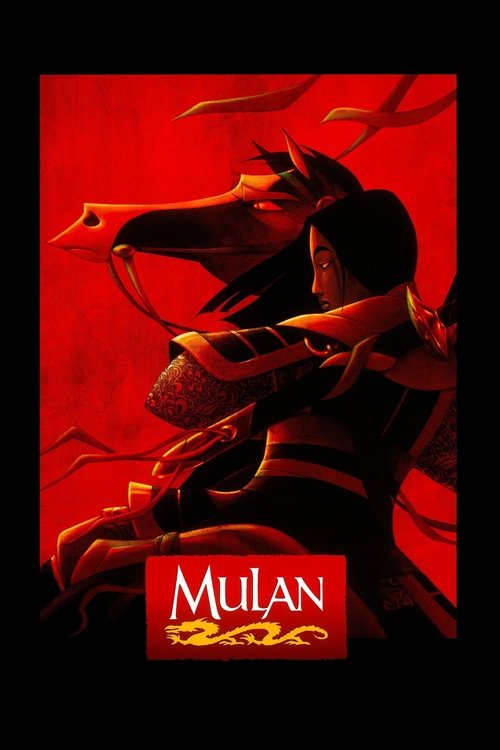
Walt Disney's action-packed historical adventure follows Mulan, the daughter of an aging war veteran in Imperial China, who disguises herself as a man to take her father's place in the army and ends up becoming the hero who saves the empire from an invasion of Huns. Directed by Tony Bancroft and Barry Cook, the film is one of the most kinetically exciting features in the Disney Renaissance, with action sequences — particularly the avalanche on the mountain pass — that rank among the studio's most visually spectacular moments. Mulan herself is one of the most compelling Disney protagonists of the era, driven not by romance or magic but by love, loyalty, and the determination to prove that identity and worth are not determined by gender. A story about courage, identity, and the gap between who the world says you are and who you know yourself to be, Mulan is the Disney Renaissance at its most emotionally and thematically expansive.
Watch for
- The avalanche sequence on the mountain pass as possibly the most technically spectacular action scene in the Disney Renaissance — using a particle system developed for the film to simulate hundreds of thousands of individual snow fragments, the animators created a scale of physical event — snow swallowing an entire army — that no hand-drawn animation could have produced, while keeping Mulan's individual action legible within the chaos.
- Mulan's character animation by Mark Henn and Pres Romanillos as the most physically active female protagonist in the studio's history — watch how her movement is specifically trained and deliberate rather than graceful or domestic, her body expressing the military context rather than conventional Disney femininity, a departure from every preceding princess animation.
- Mushu's design as a small red dragon whose comedy derives entirely from the gap between his grandiose self-image and his actual physical scale — Eddie Murphy's voice performance suggested the character's rhythm and the animation translated it into a physical vocabulary where Mushu's gestures are always oversized relative to his body, creating a persistently funny mismatch between aspiration and reality.
- The training camp montage as a compressive storytelling technique — watch how the sequence uses repetition, failure, and incremental improvement to create a felt sense of time passing without actually spending that time, and how Mulan's disguise is threaded through the comedy as a sustained dramatic irony that the film never over-explains.
Production notes
Mulan was the first Disney animated feature produced primarily at the studio's then-new Florida animation facility (located at Disney-MGM Studios in Orlando), where roughly 600 artists worked on the project from 1994 to 1998. Co-directors Tony Bancroft and Barry Cook adapted the ancient Chinese ballad 'The Ballad of Mulan' into Disney's first feature anchored by an East Asian protagonist. The visual style drew explicitly from Chinese watercolor and ink-wash painting traditions; production designer Hans Bacher pushed for negative space, restrained palettes, and bold compositional simplicity unusual for the studio. Composer Jerry Goldsmith scored the film, with Matthew Wilder writing the songs and David Zippel writing the lyrics. Ming-Na Wen voiced Mulan, Lea Salonga sang her songs, BD Wong played Shang, and Eddie Murphy provided Mushu the dragon — his first major animated voice role and a key forerunner of his Donkey performance in Shrek three years later.
Trivia
- Mulan was the first Disney animated feature with an Asian protagonist and remains a critical entry point for Asian-American representation in mainstream American animation — its cultural significance has been the subject of substantial academic study.
- Lea Salonga, who sang Mulan's vocal performances, had previously sung Princess Jasmine's vocals in Aladdin — making her the singing voice of two consecutive Disney heroines.
- The Huns' charge over the snowy mountain ridge — a sequence depicting roughly 2,000 attacking soldiers — was rendered using custom CGI crowd-simulation software (the 'Attila' system) developed specifically for the film.
- Mulan was filmed in animated 1.85:1 widescreen rather than the studio's standard 1.66:1 — giving it a more cinematic compositional ratio that suited the film's emphasis on landscape and battle staging.
- The 2020 live-action remake directed by Niki Caro deliberately removed Mushu and the musical numbers — a creative choice intended to honor the source ballad more directly that proved divisive among fans of the animated original.
Legacy
Mulan was the first Disney animated feature with an Asian protagonist and remains a critical entry point for Asian-American representation in mainstream American animation — its cultural significance has been the subject of substantial academic study. The film grossed about $304 million worldwide on a $90 million budget and earned a Best Original Score Oscar nomination. Its cultural significance has expanded over time as discussions of representation in Hollywood have evolved; Mulan has become one of the most cited examples of a Disney heroine who breaks the romance-driven princess template. The 2020 live-action remake earned roughly $70 million theatrically (compounded by COVID-era release issues) but was a major Disney+ launch-window event. Mulan herself joined the Disney Princess line as one of its most independent and martially-inclined members. The film's reception in China has been famously complicated — some viewers embraced it as cross-cultural homage, others objected to specific choices, but its very existence opened dialogue about Hollywood adapting Chinese source material. National Film Registry inducted in 2024.