One Hundred and One Dalmatians
Vibe
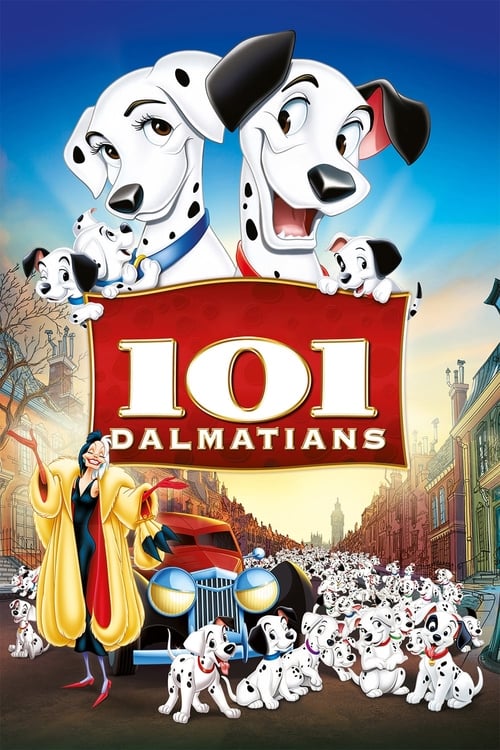
Walt Disney's lively domestic comedy follows Roger and Anita and their dalmatian dogs Pongo and Perdita, whose new litter of puppies is stolen by the magnificently terrible Cruella De Vil, a fur-obsessed villain who wants to make a coat from their spotted coats. Directed by Clyde Geronimi, Hamilton Luske, and Wolfgang Reitherman, the film introduced xerography as an animation technique, giving it a scratchier, more spontaneous visual texture that suited its London setting perfectly and moved the studio away from the lush painted backgrounds of earlier films. Cruella ranks among Disney's most entertaining creations, all angular fury, cigarette smoke, and theatrical evil that tips just enough toward comedy to remain delightful. Energetic, warmly funny, and genuinely suspenseful in its third-act rescue, One Hundred and One Dalmatians marked a clean break from the studio's postwar style and announced a new visual direction that would carry through much of the following decade.
Watch for
- The xerography line quality throughout — because the animators' pencil drawings were transferred directly to cels, every line in the film carries the energy and imperfection of the original drawing. Compare the texture of any character outline here to the smooth, painted lines of Sleeping Beauty to see how drastically the change altered the studio's visual identity.
- Cruella De Vil's animation by Marc Davis as a masterwork of villain character design — she moves in constant diagonal lines, her fur coat creates visual noise that disrupts every frame she enters, and her car is designed as an extension of her personality, all sharp angles and mechanical aggression against the rounded domestic world surrounding her.
- The Twilight Bark sequence and how it solves the storytelling problem of conveying information across long distances in real time — the film's most structurally inventive sequence, building a chain of canine communication from London to the countryside through a series of barks, each dog's personality inflected into their contribution to the relay.
- The television set within the film as both a prop and a formal joke — the dalmatian puppies watching Thunderbolt creates a film-within-a-film that comments on the medium itself, and the quality of the deliberately simplified 'television animation' contrasted with the film's own drawing style is a sophisticated visual gag that rewards close attention.
Production notes
After Sleeping Beauty's financial setback, Walt Disney needed to find a way to make features more cheaply. Ub Iwerks (Disney's original animation partner, who had returned to the studio in a technical role) developed a process using the new Xerox photocopying machine to transfer animator's pencil drawings directly to cels — eliminating the labor-intensive step of inking by hand. The result was a markedly different look: scratchy, vivid, with visible drawing lines kept rather than smoothed. Director Wolfgang Reitherman led production; Bill Peet wrote the screenplay solo (a first for Disney) adapting Dodie Smith's 1956 novel. Marc Davis animated Cruella De Vil, and Betty Lou Gerson supplied her instantly iconic voice. Production cost dropped to around $4 million, half of Sleeping Beauty's, and the film recouped its budget rapidly.
Trivia
- The Xerox process was used to copy the dalmatians' spots, which would have been impossibly labor-intensive to hand-paint frame by frame across hundreds of dogs in motion.
- Cruella De Vil's design was based loosely on actress Tallulah Bankhead, with Marc Davis later acknowledging her glamorous-monstrous quality as a direct influence.
- Bill Peet wrote the entire screenplay himself — the first Disney animated feature with a single credited screenwriter rather than a story committee — and his approach influenced how the studio structured later projects.
- Walt Disney himself was reportedly unhappy with the rough Xerox aesthetic and the visible drawing lines, but the cost savings convinced him to keep using the process; the look would dominate Disney animation for the next two decades.
- The dalmatian puppies number exactly 99 in the film (15 born plus 84 acquired from Cruella's kennel), with Pongo and Perdita making 101.
Legacy
One Hundred and One Dalmatians revived Disney's animation finances after Sleeping Beauty's losses, grossing $14 million on first release — the studio's biggest hit since Cinderella. More importantly, the Xerox process Ub Iwerks pioneered for the film cut animation costs roughly in half and let the studio keep feature production economically viable through the lean 1960s and 1970s. The distinctive Xerographic look defined an entire era of Disney animation and gave the next two decades of features (Sword in the Stone, Jungle Book, Aristocats, Robin Hood) a unified scratchy, sketchy aesthetic. Cruella De Vil joined the upper rank of Disney villains and has anchored multiple live-action treatments — the 1996 film with Glenn Close, the 2000 sequel, and the 2021 origin story Cruella with Emma Stone, which itself earned over $230 million. The dalmatian became a culturally loaded breed almost overnight — animal welfare groups have noted the surge in dalmatian purchases each time the film is re-released, and the breed's later abandonment when the novelty wore off.