Peter Pan
Vibe
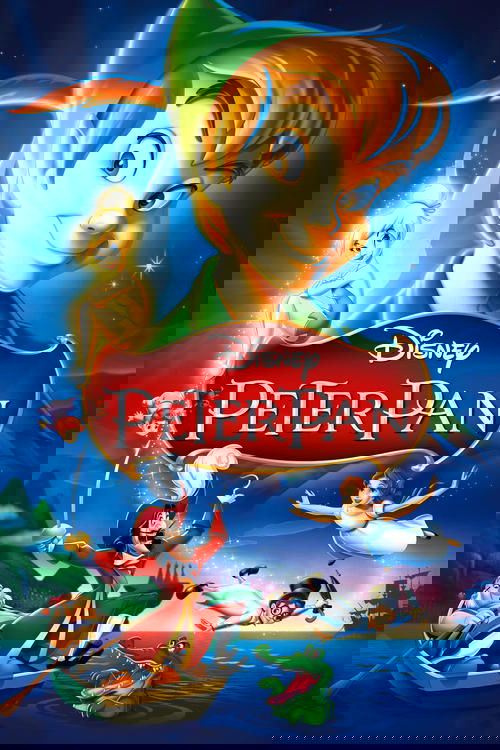
Walt Disney's adaptation of J.M. Barrie's beloved play follows the three Darling children as they are swept away to Neverland by the ageless, crowing Peter Pan, a boy who refuses to grow up and fights pirates with a sword and a laugh. Directed by Clyde Geronimi, Hamilton Luske, and Wilfred Jackson, the film captures the dual nature of childhood imagination — the wonder, the recklessness, and the underlying anxiety about what it means to eventually leave it behind. Captain Hook is one of the studio's most entertaining villains, vain and theatrical enough to be funny without ever losing his threat, while Tinker Bell's jealous loyalty gives the film an emotional edge that complicates its otherwise bright adventure surface. As a story about the pull between growing up and staying forever young, Peter Pan speaks to something persistent and slightly bittersweet in the experience of childhood itself.
Watch for
- The flight to Neverland sequence and its use of the London skyline as both literal setting and emotional threshold — watch how the camera follows the children from the intimate scale of the nursery window to a sweeping aerial perspective over Big Ben and the Thames, marking the psychological transition from the ordinary world to the extraordinary.
- Captain Hook's animation by Frank Thomas as one of the most technically accomplished villain performances in the Disney canon — the character simultaneously reads as genuinely dangerous and secretly ridiculous, and Thomas sustains that dual register through a physical vocabulary of theatrical grandiosity undermined by moments of pathetic vanity.
- Tinker Bell's jealousy as the film's most psychologically complex emotional thread — she has no dialogue, and her entire inner life is expressed through the quality of her light, her wing movement, and the precision of her physical reactions to Peter and Wendy's relationship, making her the film's most communicative character without speech.
- How the film uses Neverland's geography as a psychological map of childhood imagination — the Lost Boys' underground home, the Indian encampment, the Mermaid Lagoon, Hook's ship — each zone represents a different fantasy archetype, and the film's episodic structure mimics the non-linear way children construct imaginary worlds.
Production notes
Peter Pan had been on Walt Disney's wish list since 1935, when he acquired the rights from London's Great Ormond Street Hospital, the children's hospital to which J.M. Barrie had famously donated the rights to his play. Production was repeatedly delayed by the war and the package-film era; it finally went forward in the late 1940s under directors Clyde Geronimi, Wilfred Jackson, and Hamilton Luske. Bobby Driscoll, who had been Disney's marquee young actor in Song of the South and Treasure Island, was cast as Peter — the first male performer to voice the role in any major adaptation. Kathryn Beaumont (Alice) returned as Wendy. Marc Davis animated Tinker Bell, with rumored uncredited live-action reference from actress Margaret Kerry. Mary Blair again provided color styling. The film cost roughly $4 million.
Trivia
- Bobby Driscoll's adult life was tragic — he developed a drug addiction in his teens, struggled to find work after his Disney star faded, and died in obscurity at age 31; his body went unidentified for over a year.
- Tinker Bell's design has been the subject of decades of urban legend that she was modeled on Marilyn Monroe — animator Marc Davis denied this, and her actual reference model was actress and dancer Margaret Kerry.
- Disney retains the U.S. film rights to Peter Pan, but the rights in the United Kingdom remain perpetually with Great Ormond Street Hospital under a 1929 act of Parliament — ensuring the hospital permanently benefits from any UK-based use of the property.
- Hans Conried voiced both Captain Hook and George Darling — a direct nod to the long-standing theatrical tradition (going back to the 1904 stage play) of having the same actor play both roles.
- The film's depiction of Native American characters — particularly the song 'What Made the Red Man Red?' — has been a flashpoint of cultural reassessment for decades; Disney+ now restricts the film to mature accounts with a content advisory.
Legacy
Peter Pan was a major hit on its 1953 release and remains one of the studio's foundational properties. Tinker Bell evolved from a supporting character in the film into a corporate mascot — for years she silently led off the introduction to the Wonderful World of Disney television show, sprinkling pixie dust over the castle. The film generated a 2002 sequel (Return to Never Land), the Peter Pan's Flight attraction at every Disney park, the spinoff Tinker Bell film series, and a 2023 live-action remake (Peter Pan & Wendy). Beyond Disney, the imagery of children flying past Big Ben and the silhouette of Captain Hook on his ship deck have become iconic in popular culture. The film's depiction of Native American characters — particularly the song 'What Made the Red Man Red?' — has been a flashpoint of cultural reassessment for decades, and Disney+ now restricts the film to mature accounts with a content advisory. Critical reassessment has accelerated since the 2010s, and Disney has acknowledged the issues without removing the film from its catalog.