Pinocchio
Vibe
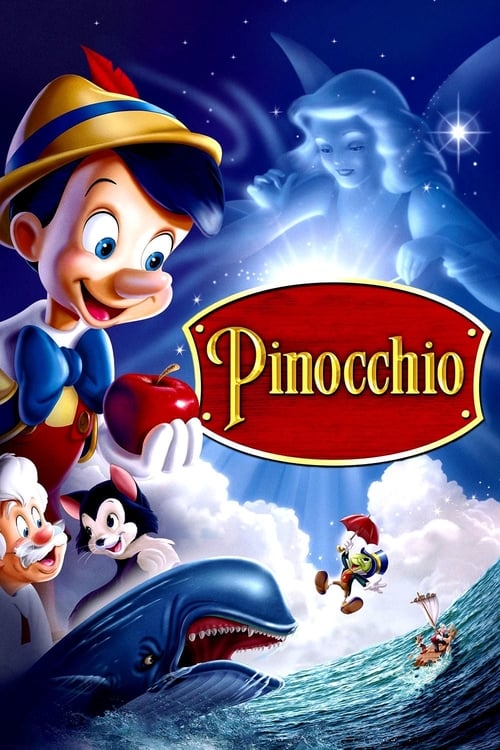
Walt Disney's second animated feature follows a wooden puppet brought to life by a kindly woodworker's wish, who is then set on a journey to prove himself worthy of becoming a real boy. Guided by the small but well-meaning Jiminy Cricket, Pinocchio faces a world of temptations, deceptions, and dangers — from a scheming fox and cat to the terrifying island where bad boys become donkeys. Directed by Ben Sharpsteen and Hamilton Luske, the film deepens the moral world of the original fairy tale while expanding its visual imagination far beyond anything seen in animation before. With its unforgettable villains, heartfelt emotional stakes, and the enduring wisdom that a good conscience is a person's truest guide, Pinocchio remains one of the most technically accomplished and morally resonant films in the Disney canon.
Watch for
- The opening village panorama — a 45-second multiplane camera move that glides over rooftops, turns past archways, and descends to Geppetto's window, achieving a sense of three-dimensional cinematic space that cost $25,000 alone and has never been matched in hand-drawn animation.
- The underwater sequence preceding the Monstro encounter, where patterns of light filter through water onto coral reefs, Pinocchio half-walks and half-floats, streams of bubbles rise with perfect physics, and the entire screen ripples when tuna rush past the camera — a year's worth of water animation effects compressed into something that feels weightless.
- Lampwick's transformation into a donkey, rendered not through full animation but through haunting shadows cast against a wall — the camera literally looks away at the moment of final metamorphosis, making the horror more disturbing for what it withholds than what it shows.
- The way Jiminy Cricket's scale is used as a cinematographic device — several sequences are shot from his tiny perspective, making the human-scale world feel enormous and dangerous, a subjective POV technique rare in animation of any era.
Production notes
Following Snow White's success, Walt Disney pushed his studio toward an even more ambitious second feature based on Carlo Collodi's 1883 Italian novel. Supervising directors Ben Sharpsteen and Hamilton Luske led production, with Bill Tytla animating Stromboli, Fred Moore reworking the title character into a more childlike form, and effects animator Joshua Meador developing the underwater sequences. The studio softened Collodi's harsher original — in which the puppet was a far more troublesome figure — into a story of innocence tested by temptation. Cliff Edwards, a popular vaudeville singer, voiced Jiminy Cricket and recorded 'When You Wish Upon a Star,' which would become Walt Disney Productions' signature song. The film cost roughly $2.6 million, an unprecedented sum that the studio could only justify because Snow White had so resoundingly proven the format. Released in February 1940, just months before the European war shut down most of Disney's overseas markets.
Trivia
- Pinocchio lost money on its initial release because World War II closed off the European theatrical markets the studio had been counting on, and the film didn't turn a profit until its 1945 reissue.
- The 45-second multiplane camera shot opening the film — a continuous descent through the village to Geppetto's window — reportedly cost around $25,000 alone, an extraordinary sum for a single shot in 1940.
- Walt Disney was unhappy with the original design of the puppet, which had been animated for months as a more wooden, marionette-like figure; supervising animator Fred Moore was assigned to redesign the character as softer and more childlike, and significant footage was redrawn.
- Pinocchio won the studio's first competitive Academy Awards: Best Original Score for Leigh Harline, Paul J. Smith, and Ned Washington, and Best Original Song for 'When You Wish Upon a Star.'
- Cliff Edwards, the voice of Jiminy Cricket, was once a major recording star known as 'Ukulele Ike' and had a #1 hit with 'Singin' in the Rain' in 1929 — by the time of his death in 1971 he was largely forgotten outside Disney.
Legacy
Pinocchio is widely regarded as the peak of Disney's early technical ambitions, with effects animation, lighting, and character expressiveness that surpassed anything the studio had achieved in Snow White just two years earlier. Its box-office struggles in 1940 — caused by the closure of European markets to wartime disruption — belied what is now considered a high-water mark of hand-drawn animation. Critics and animators across the decades have returned to the film as a masterclass; Hayao Miyazaki, Brad Bird, and countless others have cited it as definitional. The film's moral seriousness, framing goodness as something earned through genuine conscience rather than wish fulfillment, gave it an emotional weight unusual for mainstream animated entertainment. 'When You Wish Upon a Star' became inseparable from the Disney company itself, playing over the studio's logo and giving generations a sonic shorthand for Disney magic. The film won two Academy Awards (Best Original Score, Best Original Song) and was selected for the National Film Registry in 1994. Its darker imagery — the Pleasure Island donkey transformation, the swallowing by Monstro — has lingered in cultural memory as some of the most affecting and unsettling moments ever produced for a children's film.