Ralph Breaks the Internet
Vibe
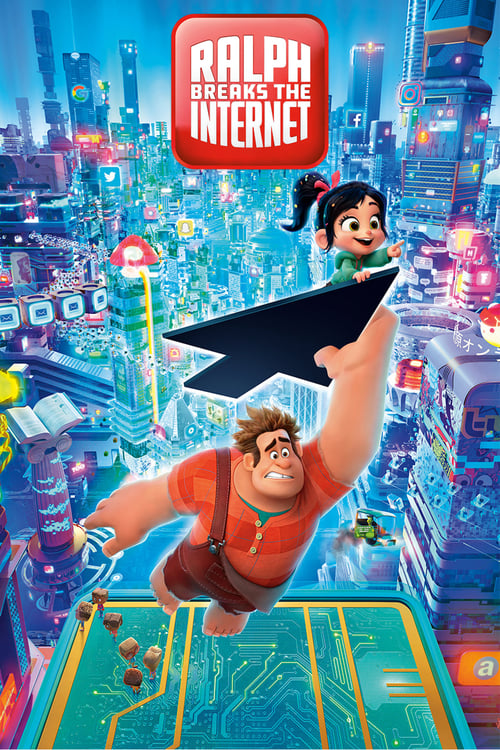
Walt Disney's inventive sequel takes Ralph and Vanellope out of the arcade and into the internet itself, following them on a mission to find a replacement part for Vanellope's game on eBay — only for the trip to uncover a fundamental tension between Ralph's need for things to stay exactly as they are and Vanellope's growing desire for something beyond the life she knows. Directed by Phil Johnston and Rich Moore, the film is at its sharpest in its satirical portrait of internet culture — algorithm-driven virality, clickbait, comment sections, corporate franchise consolidation — and its Disney princess sequence is a moment of gleeful self-awareness that stands as one of the studio's most entertainingly meta sequences. Where it falters slightly is in the resolution of its central emotional conflict, which the film handles earnestly but somewhat abruptly. Nevertheless, Ralph Breaks the Internet is a generous, imaginative, and genuinely thoughtful follow-up that grows more interesting the more it allows itself to sit with the discomfort of change.
Watch for
- The internet's visual architecture as a literal city — watch how the filmmakers translate abstract digital concepts into navigable physical space: websites as buildings, algorithms as street performers, viral content as physical mass that attracts crowds, and the dark web as a literally underground zone with distinct visual grammar. The coherence of this metaphor system rewards close attention to background detail.
- The Disney Princess scene and how its comedy depends on structural deconstruction — watch how each princess's appearance is preceded by a visual cue from her source film, how the group's interaction with Vanellope uses genre awareness rather than satire, and how the sequence's resolution turns the assembled tropes into a mechanism that serves the plot rather than simply commenting on it.
- The algorithm character as a visualization of recommendation systems — watch how the character's behavior of collecting and sorting content based on observed interest patterns creates an unexpected emotional resonance when applied to Ralph's attachment anxiety, turning a technical metaphor for data-driven content delivery into a visual argument about how fear-based attention patterns work.
- The replication of Ralph into thousands of insecure copies as the film's climactic visual statement — watch how the animators design the multiplied Ralphs as a coherent crowd with individual variation, and how the sequence uses the specific visual language of going viral (replication, rapid spread, loss of original context) to externalize Ralph's emotional state in a way that only the internet setting makes possible.
Production notes
Ralph Breaks the Internet — the studio's first theatrical sequel to a Disney Animation feature since The Rescuers Down Under in 1990 — moved Ralph and Vanellope from the arcade into the contemporary internet. Co-directors Rich Moore and Phil Johnston led production, expanding the world from the cabinet-game milieu of the original into a metaphor-rich digital landscape: search engines as helpful information desks, social media as crowded city blocks, the Dark Web as a literally dark alley. The film's most-discussed sequence brought together every Disney Princess voiced by their original actresses (where possible) for an extended self-aware comedy scene at a fictional Disney website. Sarah Silverman, John C. Reilly, Jack McBrayer, and Jane Lynch reprised their roles; new additions included Gal Gadot as Shank and Taraji P. Henson as Yesss. The film cost approximately $175 million.
Trivia
- The Disney Princess summit scene reunited 13 princesses with their original voice actresses where possible — Mandy Moore, Kristen Bell, Idina Menzel, Auli'i Cravalho, Anika Noni Rose, Paige O'Hara, Ming-Na Wen, Linda Larkin, and others all returned for what was effectively the first full assembly of the line in any single Disney production.
- The film features extensive corporate-IP cross-traffic from the Disney universe — Stormtroopers, Iron Man, Eeyore, and dozens of Disney/Marvel/Star Wars characters appear because the entire 'Oh My Disney' website is presented as a literal location within the film.
- Stan Lee made a vocal cameo, recorded before his November 2018 death; Ralph Breaks the Internet was one of his final film appearances.
- The film's emotional core focuses on the friendship between Ralph and Vanellope — specifically the tension created when Vanellope wants to leave for a different game and Ralph struggles to let her go — rather than romantic or villain-driven stakes; the story's exploration of insecurity in friendship was widely praised.
- Ralph Breaks the Internet earned an Academy Award nomination for Best Animated Feature, losing to Spider-Man: Into the Spider-Verse.
Legacy
Ralph Breaks the Internet grossed about $529 million worldwide — comfortably outpacing the original Wreck-It Ralph and confirming that Disney Animation Studios could deliver successful theatrical sequels to its CGI-era hits. As Disney Animation's first theatrical sequel since The Rescuers Down Under in 1990, it marked an important strategic pivot toward the sequel-friendly model the studio would lean into through Frozen 2, Moana 2, and Zootopia 2. The Disney Princess assembly sequence — reuniting voice actresses for a self-aware comedy scene — has become a permanent reference point in fan culture, regularly memed and referenced years after release. The film was nominated for the Academy Award for Best Animated Feature, losing to Spider-Man: Into the Spider-Verse. It captured a specific late-2010s internet aesthetic that has dated quickly, but its emotional storyline about friendship and insecurity remains resonant. Ralph Breaks the Internet was the first major-studio theatrical animated feature to engage seriously with internet culture as setting, and its imagery has influenced subsequent works in that mode.