Raya and the Last Dragon
Vibe
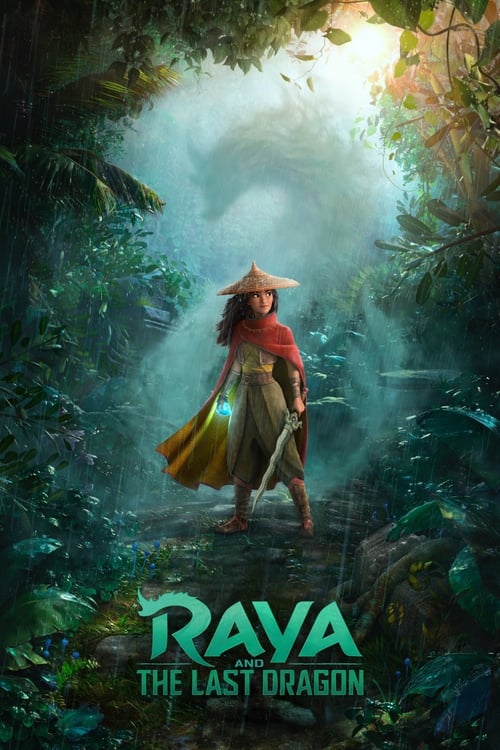
Walt Disney's visually sumptuous action-fantasy follows Raya, a warrior trained since childhood to protect the last dragon gem in a fractured world called Kumandra, who is forced to track down Sisu — the last dragon — to stop the return of the Druun, soul-consuming monsters that have already turned half the world to stone. Directed by Don Hall and Carlos López Estrada, the film draws deeply on the cultures, landscapes, and visual traditions of Southeast Asia to build a world of extraordinary richness and detail, and its action sequences are among the most kinetically inventive the studio has produced in the computer-animated era. Its central question — whether trust can be rebuilt between people who have spent generations hurting each other — carries a political resonance that gives the adventure real moral weight. A story about unity, betrayal, and the radical difficulty of choosing to believe in people again after trust has been broken, Raya and the Last Dragon is the studio's most geopolitically thoughtful animated feature.
Watch for
- The Southeast Asian visual research embedded in every environment — watch how each of Kumandra's five clans has a distinct architectural and visual vocabulary drawn from specific Southeast Asian traditions: Fang's cliff-top structures evoking Vietnamese karst landscapes, Heart's water-influenced design recalling Thai river communities, Spine's bamboo-and-fog aesthetic referencing highland Southeast Asia. The specificity is consistent and researched.
- Sisu's dragon animation as a technical challenge in translating mythology into physics — the designers worked from Southeast Asian dragon iconography (elongated, serpentine, associated with water) rather than Western fire-breathing conventions, and watch how the animators give her movement the specific quality of something aquatic operating in air, with a constant suggestion of fluid displacement around her form.
- The action choreography throughout as a synthesis of multiple Southeast Asian martial arts traditions — Raya's staff fighting draws from Filipino Arnis, her footwork from Indonesian Pencak Silat, and her relationship to her weapon from various Thai fighting traditions. Watch how these different vocabularies are blended into a coherent personal style that feels both genre-familiar and culturally specific.
- Namaari's character arc as the film's most carefully constructed piece of visual storytelling — watch how the animators track her internal conflict through specific expressions, posture changes, and the quality of hesitation in her movements across her appearances, so that her eventual shift from antagonist to ally feels earned through accumulated visual information rather than narrative convenience.
Production notes
Raya and the Last Dragon was the first Disney animated feature substantially inspired by Southeast Asian cultures — the fictional kingdom of Kumandra drew on Vietnamese, Cambodian, Laotian, Thai, Malaysian, Filipino, and Indonesian sources, with cultural advisors representing those regions consulting throughout production. Co-directors Don Hall (Big Hero 6) and Carlos López Estrada led production; Adele Lim (Crazy Rich Asians) and Qui Nguyen co-wrote the screenplay. The film was released simultaneously in theaters and on Disney+ Premier Access in March 2021 — one of the studio's most prominent dual releases during the COVID-19 pandemic, which had upended traditional theatrical distribution. Kelly Marie Tran voiced Raya, replacing the originally cast Cassie Steele in late stages of production. Awkwafina played Sisu, with Gemma Chan, Daniel Dae Kim, Sandra Oh, Benedict Wong, and Izaac Wang in supporting roles.
Trivia
- Raya and the Last Dragon featured Disney's first South-Asian-American Disney Princess (Tran is of Vietnamese heritage), and the production deliberately consulted advisors from across Southeast Asia to inform the depiction of Kumandra's regions.
- The film was released simultaneously in theaters and on Disney+ Premier Access in March 2021 — for an additional $30 fee on top of the streaming subscription, subscribers could watch the film at home; the unusual hybrid release was a direct response to ongoing COVID-19 theatrical disruptions.
- Cassie Steele was originally cast as Raya and recorded most of the dialogue, but production replaced her with Kelly Marie Tran late in the process; Tran re-recorded the role, and the directors adjusted the character's voice and personality somewhat in the transition.
- The film was nominated for the Academy Award for Best Animated Feature, losing to Pixar's Encanto — the second consecutive year a Disney film lost the Animated Feature Oscar to its corporate sibling Pixar.
- James Newton Howard composed the score, integrating instrumentation from across Southeast Asian musical traditions — bamboo flutes, gongs, and stringed instruments characteristic of the regions Kumandra is modeled on.
Legacy
Raya and the Last Dragon's commercial performance is genuinely difficult to assess because of its hybrid pandemic-era release — its theatrical box office (about $130 million worldwide) was modest, but its Premier Access streaming numbers were reported as substantial, though Disney has not disclosed precise figures. Critically, the film was warmly received and earned an Oscar nomination for Best Animated Feature. Raya joined the Disney Princess line as the first Southeast Asian-coded heroine — a representational milestone whose significance for Southeast Asian-American viewers has been substantial. The film's consultative approach to depicting multiple regional cultures (Vietnamese, Cambodian, Laotian, Thai, Malaysian, Filipino, and Indonesian) has been studied as a template for cross-cultural Hollywood representation. Sisu has become a beloved character in her own right. The film's themes of broken trust, factional division, and slow rebuilding of community resonated strongly with pandemic-era audiences seeking stories about reconciliation, and its release pattern presaged the hybrid theatrical/streaming models that would persist for several years.