Robin Hood
Vibe
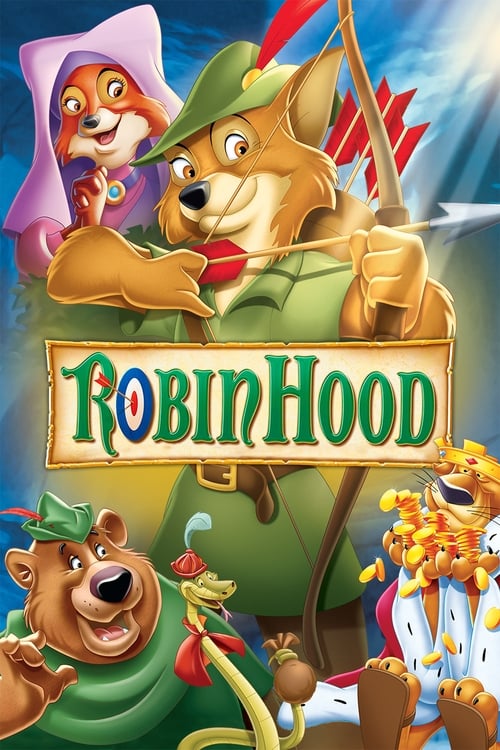
Walt Disney's animated retelling of the Robin Hood legend replaces the traditional cast with anthropomorphic animals — Robin as a fox, Little John as a bear, Prince John as a sniveling lion, and the Sheriff of Nottingham as a wolf — and transplants the familiar tale of rob-from-the-rich justice into a folk-song-inflected medieval world that feels more like a county fair than an epic. Directed by Wolfgang Reitherman, the film is loose, good-humored, and unabashedly charming, built around the easy chemistry between Brian Bedford's voice performance as Robin and Phil Harris reprising his Baloo energy as the lumbering, loyal Little John. Its recycling of animation from earlier Disney films gives it a slightly secondhand texture, but the joy of the cast and the fun of the storytelling more than compensate. Light, funny, and full of irresistible roguish warmth, Robin Hood distills the spirit of the legend into something friendly and uncomplicated — a film that earns its place through sheer likeability.
Watch for
- The animation recycling embedded throughout and what it reveals about the studio's post-Walt production constraints — watch Friar Tuck's crowd scene movements against Baloo's from The Jungle Book, Little John against the same character in an earlier film, creating a kind of animation palimpsest.
- Brian Bedford's vocal characterization of Robin and how the animators translated its specific clipped English precision into physical terms — Robin's body language is notably more contained and deliberate than most Disney heroes, reflecting Bedford's stage-trained delivery in a way that makes the character's acrobatic sequences feel genuinely surprising when they occur.
- The archery tournament as the film's most sustained piece of suspense construction — watch the spatial staging that keeps Robin's disguise simultaneously plausible to the characters within the scene and obviously transparent to the audience, and how that dramatic irony is maintained across a long sequence without losing tension.
- Sheriff of Nottingham's wolf animation as a study in physical menace with comic undertow — his movements are heavy, predatory, and deliberately sized against the smaller animals in every scene, and the animators give him a specific rhythmic swagger that makes his eventual humiliations satisfying precisely because they deflate such deliberate physical authority.
Production notes
Robin Hood originated as a long-aspired Disney project to adapt Reynard the Fox, the medieval European cycle of trickster animal fables; Walt had considered it for decades but never green-lit it because of the source's morally ambiguous protagonist. Director Wolfgang Reitherman reframed the concept by transposing the trickster-animal premise onto the Robin Hood legend instead. Production proceeded on a tight budget under economic pressure across the studio — Disney was in a low-funded period and reused animation aggressively. The voice cast was unusually colorful: Brian Bedford as Robin, Phil Harris yet again (as Little John, recycling his Baloo/O'Malley persona), Peter Ustinov as Prince John, Roger Miller as Alan-a-Dale, Andy Devine as Friar Tuck, and Terry-Thomas as Sir Hiss. Roger Miller's country-folk songs gave the film a distinctively American Southwestern feel for an English forest legend.
Trivia
- Many sequences in Robin Hood are direct frame-for-frame reuses of animation from earlier Disney features; the famous dance sequence in 'The Phony King of England' recycles movement from Snow White, The Jungle Book, and The Aristocats with new characters drawn over the originals.
- Robin Hood the fox has retained an unusually devoted online following — particularly within the 'furry' fan community, where the character is widely cited as a generational awakening.
- Roger Miller, the country songwriter behind 'King of the Road,' wrote and performed the framing songs as Alan-a-Dale, giving the medieval setting an unmistakable American twang.
- Peter Ustinov voiced both Prince John and his brother King Richard — a deliberate piece of double-casting underscoring the family dynamic at the center of the legend.
- Phil Harris's appearance as Little John was so close to his Baloo character from The Jungle Book — even using similar gestures and inflections — that some viewers experienced a kind of déjà vu, which the studio leaned into rather than avoided.
Legacy
Robin Hood was a modest commercial success and critical lukewarm reception in 1973, but its long-tail following has been remarkable. It is one of the most-rewatched Disney features among adults who grew up with it, partly through frequent television airings and partly through home video. The recycled animation that critics noted at the time has become an affectionately discussed quirk rather than a flaw. The film's distinctively earthy, lo-fi 1970s aesthetic — the rough Xerographic line, Roger Miller's country-folk score, the looseness of staging — has made it a touchstone for a particular era of Disney warmth. The film has retained an unusually devoted online following, particularly within the 'furry' fan community, where the fox-Robin character has been widely cited as a generational awakening. A live-action remake has been in development at the studio for years. 'Oo-de-lally' is one of the most quoted opening lines in the Disney songbook, and the film's depiction of Robin and Marian as foxes has become its own cultural reference point.