Sleeping Beauty
Vibe
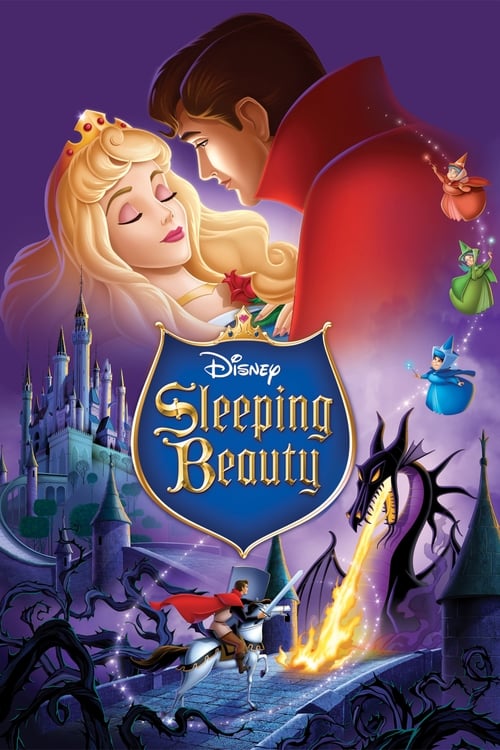
Walt Disney's most visually ambitious fairy-tale film follows Princess Aurora, cursed at birth by the sorceress Maleficent to fall into an eternal sleep before her sixteenth birthday, and the prince who must fight through thorns and darkness to break the spell. Directed by Clyde Geronimi, the film is distinguished above all by its extraordinary visual design — created under Eyvind Earle's direction, every frame is composed like a medieval tapestry, angular and stylized in ways that set it apart from anything else in the Disney catalog. Maleficent is arguably the studio's most visually powerful villain, commanding enough to transform into a dragon in the film's extraordinary climax. With its stained-glass palette, sweeping orchestration of Tchaikovsky's score, and uncompromising artistic vision, Sleeping Beauty is the pinnacle of the studio's hand-crafted aesthetic ambition — a film that sacrificed commercial warmth for visual grandeur and created something genuinely unlike anything else.
Watch for
- Eyvind Earle's backgrounds as a complete artistic statement — take any frame and look at the trees, the foreground flora, the castle stonework, and notice how every element is rendered in the same perfect focus regardless of distance as in Flemish van Eyck painting, creating a 'moving illustration' in which the environment has the same visual authority as the characters.
- The three good fairies as the film's comic and emotional engine — Merryweather, Flora, and Fauna carry nearly all the warmth and humor the film possesses, and their animation is deliberately rounder and more physically expressive than the stylized angularity of the main characters, creating a tonal contrast that keeps the Gothic formalism from becoming cold.
- Maleficent's dragon transformation in the climax — watch the animation of the transformation itself, the sequence of anatomical changes, and particularly the way the dragon's scale grows until it fills the entire frame, establishing spatial dominance over the prince through pure visual mass in a sequence of hand-drawn animation that has no equal for formal grandeur.
- How the Tchaikovsky score is integrated — composer George Bruns spent three years adapting the ballet, and watch how sequences like Aurora and Philip's forest meeting use the waltz theme to choreograph the animation itself, with physical movement timed precisely to musical phrase in a way that transforms the scene into dance.
Production notes
Sleeping Beauty took six years and roughly $6 million to produce — the most expensive animated film ever made at the time. Walt Disney intended it as the studio's ultimate fairy-tale statement: shot in widescreen Technirama 70mm, scored entirely from Tchaikovsky's 1890 ballet, and visually styled by Eyvind Earle, whose stylized, medieval, Gothic-influenced backgrounds gave the film a deliberately formal, tapestry-like look unlike anything else in the canon. Director Clyde Geronimi supervised, with Marc Davis animating the iconic Maleficent. Mary Costa, an opera singer in her early twenties, voiced Aurora and sang her own parts. Eleanor Audley voiced Maleficent (and had also voiced Cinderella's stepmother). The production strained the studio financially — the multiyear schedule meant other features were delayed or cancelled, and Walt Disney was simultaneously pouring resources into building Disneyland.
Trivia
- Sleeping Beauty's $6 million budget was so substantial that the film actually lost money on its initial release, and it took multiple reissues over the following decades for the film to recoup its costs.
- Eyvind Earle's stylized backgrounds were inspired by the Unicorn Tapestries at the Cloisters in New York, medieval Persian and Japanese art, and Pre-Raphaelite painting — he reportedly clashed with other studio veterans who found the style too austere.
- Maleficent's transformation into a dragon was animated primarily by Wolfgang Reitherman and remains widely cited as one of the great single sequences of villain animation; the dragon's coloring is a deliberate green-and-purple inversion of Aurora's pink-and-blue.
- The original Sleeping Beauty Castle at Disneyland (opened 1955) was actually built before the film was finished, based on early concept art — the castle preceded the movie, not the other way around.
- Composer George Bruns adapted Tchaikovsky's ballet score into the film and received an Academy Award nomination for Best Original Score; the song 'Once Upon a Dream' is built directly on the ballet's grand pas de deux.
Legacy
Sleeping Beauty's commercial disappointment in 1959 contributed to Walt Disney's decision to scale back the studio's feature animation ambitions in favor of live-action production and theme park development — a turning point that shadowed the next decade of Disney animation. Its critical reputation has only grown since: animators and directors today routinely cite it as one of the most beautiful films Disney ever made. Eyvind Earle's tapestry-inspired backgrounds, drawn from medieval art and the Unicorn Tapestries at the Cloisters, established a stylistic ambition the studio would not match again for decades. Maleficent has become arguably the most enduringly popular Disney villain, anchoring her own 2014 and 2019 live-action films starring Angelina Jolie. The film entered the National Film Registry in 2019. Its design language — the angular medievalism, the gold-leaf forests, the stylized faces — directly influenced later works including The Sword in the Stone, the Robin Hood backgrounds, and contemporary game-art and animation projects far beyond Disney.