Snow White and the Seven Dwarfs
Vibe
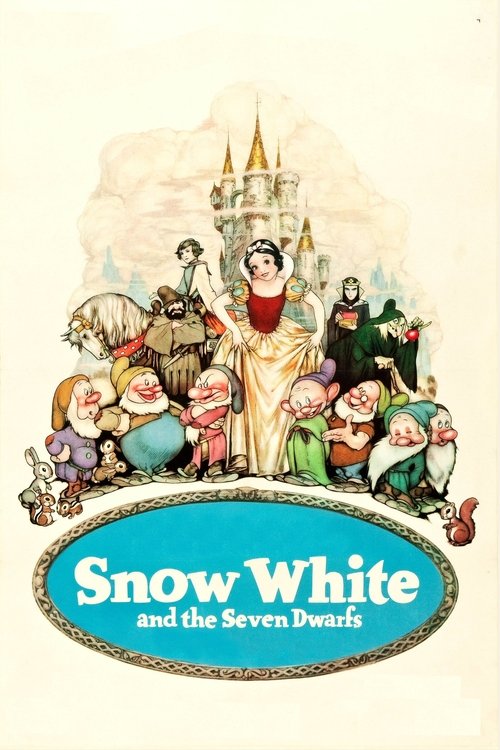
Walt Disney's groundbreaking feature debut follows Snow White, a gentle princess forced to flee the kingdom after her vain and jealous stepmother, the Evil Queen, orders her death. Taking shelter with seven quirky dwarfs in the heart of an enchanted forest, Snow White brings warmth, music, and unexpected joy to their small cottage while the Queen closes in with a poisoned apple and murderous intent. Directed by David Hand, the film moves between fairy-tale darkness and comic lightness with surprising confidence, establishing a visual language for animated storytelling that would shape the medium for decades. With its lush hand-painted imagery, expressive characters, and timeless story of innocence threatened by envy, Snow White and the Seven Dwarfs became the foundation on which the entire Disney legacy was built.
Watch for
- The multiplane camera at work in the opening forest sequence — layers of painted glass moving at different speeds to create genuine depth, a technique so new in 1937 that audiences had never seen dimensional space created through animation before.
- How the animators differentiated the seven dwarfs not just through personality but through body language and movement — each dwarf walks, gestures, and reacts in ways specific to their character, an achievement in expressive individuality that had never been attempted at this scale.
- The contrast between how Snow White and the Evil Queen are animated: Snow White moves with the naturalistic fluidity of rotoscoped live-action reference, while the Queen is deliberately stylized, angular, and theatrical — two different philosophies of character animation occupying the same film.
- The Silly Symphony influence visible throughout — the way music drives action, the synchronization of gesture to melody, and the use of comic animals as emotional punctuation — and how those techniques, refined in shorts for years, were finally deployed in service of a full narrative.
Production notes
Walt Disney began developing Snow White as early as 1934, when a feature-length animated film was an idea most of Hollywood considered a lunatic gamble — the press dubbed the production 'Disney's Folly,' and Walt mortgaged his house to keep it funded. Supervising director David Hand led a team of supervising animators including Hamilton Luske, Norman Ferguson, Bill Tytla, and Fred Moore, who developed new approaches to character believability over three years of production. Live-action footage of dancer Marjorie Belcher (later Marge Champion) was filmed as reference for Snow White's movements, while the dwarfs were built from caricature and personality study. The studio invented and refined dozens of techniques along the way — the multiplane camera, blended cel painting, expressive 'squash and stretch' acting — and trained an entire new generation of animators in the process. Adriana Caselotti, an 18-year-old soprano, voiced Snow White; Lucille La Verne played both the Queen and the Witch.
Trivia
- Walt Disney was awarded an honorary Academy Award for the film in 1939 — a single full-size statuette accompanied by seven miniature ones, presented by Shirley Temple.
- The film's final budget reached around $1.49 million, nearly six times its original projection, and contributed directly to the Hyperion studio outgrowing its facilities, prompting the move to Burbank.
- Adriana Caselotti was paid roughly $970 for her work as Snow White and was later contractually prevented from taking other voice roles so audiences would not associate the character with another film.
- The Queen's transformation into the Witch was animated by Norman Ferguson, who rotoscoped his own face contorting in a mirror as reference for the moment of metamorphosis.
- On its initial 1937 release, Snow White briefly became the highest-grossing film of all time, surpassed soon after only by Gone with the Wind.
Legacy
Snow White and the Seven Dwarfs was a historic gamble that proved a feature-length animated film could sustain a full dramatic narrative — and the synthesis of hand-painted imagery, expressive character animation, and a genuinely affecting story it pioneered established the visual and emotional template Disney would refine for decades. The December 1937 premiere at the Carthay Circle Theatre drew a standing ovation from a Hollywood that had openly doubted the project, and the film's massive commercial success funded the construction of the Burbank studio that produced every Disney feature that followed. It earned an honorary Academy Award and was among the first 25 films selected for the National Film Registry in 1989. Beyond its records, Snow White rewired what audiences expected from animation — that a cartoon could make you cry, hold suspense for 80 minutes, and stand alongside live-action drama as serious storytelling. Virtually every animated feature made since owes something to what it achieved, and its imagery has been continuously reproduced in theme parks, merchandise, and remakes for nearly 90 years.