Strange World
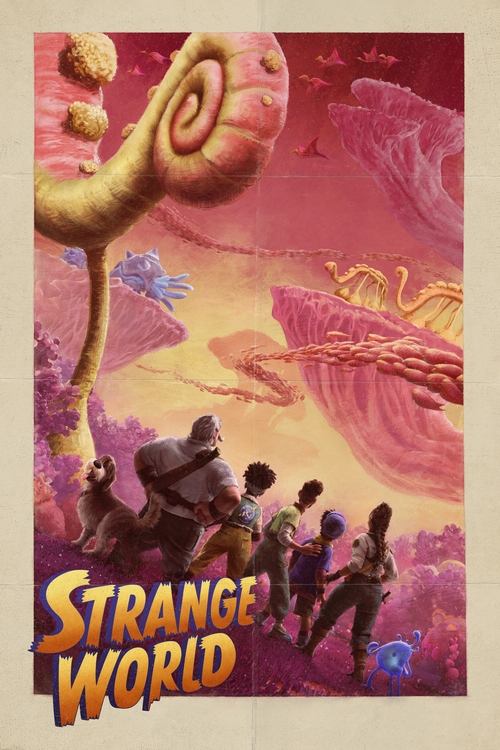
Vibe
Walt Disney's science-fiction adventure follows the Clade family — legendary explorer Jaeger, his farmer son Searcher, and Searcher's own teenage son Ethan — who are reunited on an expedition deep into a strange subterranean world beneath their island homeland when the energy source that powers their civilization begins to die. Directed by Don Hall and Qui Nguyen, the film wears its environmental themes openly, using its fantastical premise to explore the tension between extraction and sustainability in ways that feel urgent rather than didactic. Its visual imagination is genuinely striking — the creatures and terrain of the strange world below are among the most inventive designs the studio has produced in the CGI era. Underperforming significantly on release and somewhat underappreciated, Strange World is a more ambitious and thoughtful film than its reception suggested — a generationally structured story about legacy, knowledge, and the difficult act of unlearning the certainties that were handed down to you.
Watch for
- The creature design of the Strange World itself — watch how the underground ecosystem uses bioluminescent color palettes and organic forms that deliberately evoke deep-sea and cave biology rather than science fiction conventions, grounding the fantastical environment in something that reads as a possible extrapolation of real biological systems rather than pure invention.
- The generational visual vocabulary used to differentiate the three Clade men — Jaeger's movements are larger, more theatrical, and physically dominant; Searcher's are contained, practical, and farm-specific; Ethan's are more fluid and less gendered in their physical expression, and watch how these different movement languages create visible genealogy while establishing each generation's distinct relationship to physical space and risk.
- The Pando organism's visual design and reveal as a narrative structure problem solved through biological metaphor — the gradual understanding that the entire Strange World is a single living system requires the audience to reread everything seen before, and watch how the animation seeds this realization through consistent visual cues about the organism's interconnected nature that become apparent only in retrospect.
- The film's use of the family's flying machine as a spatial and narrative anchor — watch how the Legend keeps returning as a physical reference point that grounds the increasingly strange environments the characters move through, and how its condition at each return visit functions as a status indicator for the family's emotional and narrative situation.
Production notes
Strange World was a deliberate throwback to mid-20th-century pulp adventure stories — Don Hall, who co-directed Big Hero 6, Moana, and Raya and the Last Dragon, conceived the project as Disney's homage to the science-fiction pulps of the 1930s and 1940s, the work of Edgar Rice Burroughs, the Tarzan-style jungle expedition narrative, and the cliffhanger serials Walt Disney himself had grown up on. Qui Nguyen co-directed and wrote the screenplay. The film featured Disney's first openly gay teenage protagonist, Ethan Clade, voiced by Jaboukie Young-White — a representational milestone the studio chose not to emphasize in marketing. Jake Gyllenhaal voiced Searcher Clade, Dennis Quaid played Jaeger Clade, and Lucy Liu was Callisto Mal. The visual design of the alien interior world drew from biology textbooks, deep-sea documentaries, and 1960s science-fiction illustration. Production cost approximately $135 million.
Trivia
- Strange World featured Walt Disney Animation Studios' first openly gay teenage protagonist; Ethan Clade has a same-sex crush that is a casual part of his character rather than a plot point — a representational milestone that Disney chose not to highlight in marketing materials.
- The film was a major commercial disappointment, grossing only about $74 million worldwide on a $135 million production budget; it is considered one of the largest box-office losses in Disney Animation Studios history, with Disney itself reportedly writing down approximately $147 million on the title.
- The visual design of the inner-Earth ecosystem drew explicitly from biology — the 'reapers,' 'transport,' and other creatures were designed to function as analogous body parts of a single planetary-scale organism, a reveal the film delivers in its third act.
- The film was deliberately structured to evoke the Tintin-style adventure comics, the Edgar Rice Burroughs pulp novels, and the Saturday-morning serials of the 1930s; pre-release marketing leaned into the retro-pulp aesthetic.
- Strange World's catastrophic theatrical performance came amid widespread debate about Disney's then-CEO Bob Chapek's handling of the Don't Say Gay legislation in Florida; some commentators speculated that the film's quiet LGBTQ+ representation contributed to its under-marketing.
Legacy
Strange World stands as one of the most discussed commercial failures in modern Disney history — a film that was creatively ambitious, technically polished, and quietly representational, but that found almost no audience in theaters. Its $74 million worldwide gross against a $135 million budget contributed directly to internal soul-searching at the studio about marketing strategy, audience tastes, and the viability of original (non-sequel, non-IP) animated features; Disney itself reportedly wrote down approximately $147 million on the title. The film featured Walt Disney Animation Studios' first openly gay teenage protagonist, with Ethan Clade's same-sex crush treated as a casual part of his character rather than a plot point — a representational milestone that Disney chose not to highlight in marketing materials. The film has accrued a small but devoted following on streaming, particularly among viewers who appreciate its retro-pulp sensibility and its understated treatment of Ethan's sexuality. Among recent Disney animated features, Strange World is the one most often cited as deserving a second look; its cult-rediscovery trajectory has parallels to Atlantis and Treasure Planet. Its commercial failure played a role in Disney Animation's subsequent focus on legacy-IP sequels and adaptations rather than original concepts.