Tangled
Vibe
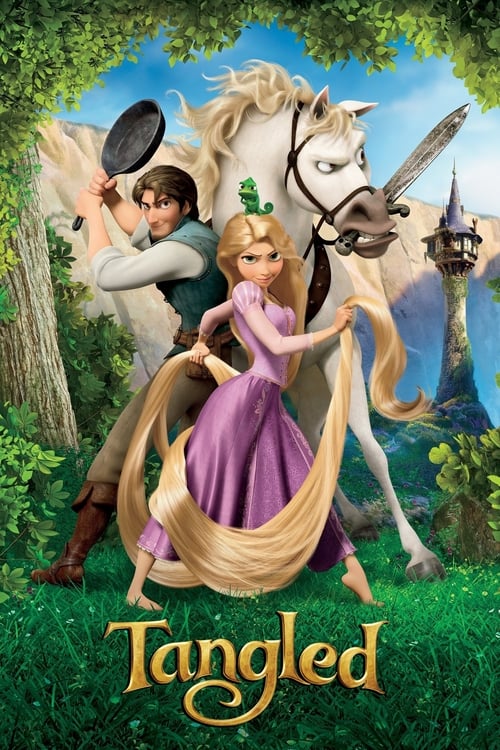
Walt Disney's witty and emotionally generous retelling of Rapunzel follows the golden-haired girl who has spent her entire life in a tower under the manipulative care of Mother Gothel, and whose world suddenly expands when a charming and evasive thief named Flynn Rider climbs through her window and offers her a way out. Directed by Nathan Greno and Byron Howard, the film is the studio's most stylistically polished computer-animated feature of the period — warm, cinematic, and genuinely funny — with a central romance that earns its emotional payoff through character development rather than formula. Alan Menken and Glenn Slater's songs are among the studio's finest of the era, and Mother Gothel ranks as one of the most psychologically nuanced of Disney's modern villains, a portrait of emotional manipulation rendered with uncomfortable accuracy. As a story about awakening, self-determination, and the courage to leave behind the story someone else wrote for you, Tangled is the film that reminded the world what Disney animated features could be.
Watch for
- The hair simulation as both technical challenge and narrative symbol — Rapunzel's 70 feet of blonde hair required new physics simulation software developed specifically for the film, and watch how the hair's constant interaction with the environment — catching on objects, flowing with movement, constraining and revealing — functions as an extension of her character's relationship to freedom and captivity.
- Mother Gothel's animation and how it visualizes psychological manipulation — watch specifically how she uses physical proximity, touch, and the specific timing of affectionate gestures to control Rapunzel, and how the animators give her expressions a fraction of a second's delay that suggests calculation beneath performance, making her manipulation visible to adult viewers without making it legible to children.
- The Snuggly Duckling thug sequence as a masterwork of comedic reversals — watch how the visual design of each thug's dream is precisely calibrated to maximize the comic gap between their intimidating physical design and their secret domestic aspiration, and how the song's structural escalation creates an increasingly implausible but completely satisfying sequence of reveals.
- The lantern sequence's visual development — the shot of thousands of lanterns rising over the water required years of technical development in light simulation and particle systems, and watch how the animators carefully calibrate the distance between Rapunzel and Flynn so that their physical proximity within the lantern's warmth creates the romantic context that makes a technically spectacular sequence feel emotionally intimate.
Production notes
Tangled was developed under the title Rapunzel for nearly a decade, originally directed by Glen Keane (one of the Disney Renaissance's greatest character animators) as his directorial debut. Health issues forced Keane to step back from directing, though he remained as executive producer and supervising animator. Nathan Greno and Byron Howard took over as co-directors and dramatically reshaped the project — making Flynn Rider a true co-protagonist, retitling the film to broaden male audience appeal, and pivoting the visual style from a more painterly approach to a fully CGI-animated rendering using newly developed techniques to make the imagery feel hand-painted. Composer Alan Menken wrote the songs with lyricist Glenn Slater. Mandy Moore voiced Rapunzel, Zachary Levi played Flynn, and Donna Murphy voiced Mother Gothel. The film cost approximately $260 million.
Trivia
- Tangled's $260 million production budget made it briefly the most expensive animated film ever made and one of the most expensive films of any kind ever produced; Disney attached enormous expectations to its commercial performance.
- The film's title was changed from Rapunzel to Tangled late in production over executive concerns that boys would not see a film with a female-coded title; the decision was widely criticized by industry observers and remains a touchstone in conversations about gendered animation marketing.
- Glen Keane developed a new digital painting technique to make the CGI imagery feel like a Jean-Honoré Fragonard painting — particularly the rococo-influenced 'The Swing' as a key inspiration; the result is one of the visually softest CGI features Disney has produced.
- The lantern-launching sequence — when Rapunzel and Flynn watch thousands of paper lanterns rise over the kingdom — required custom CGI lighting solutions and is among the most technically challenging sequences Disney Animation produced in the early CGI era.
- Tangled was Disney's 50th animated feature, and the studio leaned heavily into the milestone in marketing — the achievement marker became a key part of the film's positioning.
Legacy
Tangled grossed about $592 million worldwide and re-established Disney Animation Studios as a top-tier theatrical force after years of softer performance — the film that proved the post-Lasseter Disney could make a princess-led musical at the same level as the Renaissance era. It was Disney's 50th animated feature, and the studio leaned heavily into the milestone in marketing. The film was nominated for the Academy Award for Best Original Song ('I See the Light'). Rapunzel joined the Disney Princess line and has become one of its most enduringly popular members. The film generated a 2017 short film, the long-running animated series Tangled: The Series (2017–2020), and a stand-alone Disney+ short. Glen Keane's Fragonard-inspired digital painting technique gave the CGI imagery a soft, rococo-influenced look unlike any other Disney feature. Beyond box office, Tangled was the first sign that Disney Animation could once again produce princess-led musical adventures at the same level as the Renaissance era — and its commercial success made the green-light of Frozen, three years later, feel like a continuation rather than a gamble.