Tarzan
Vibe
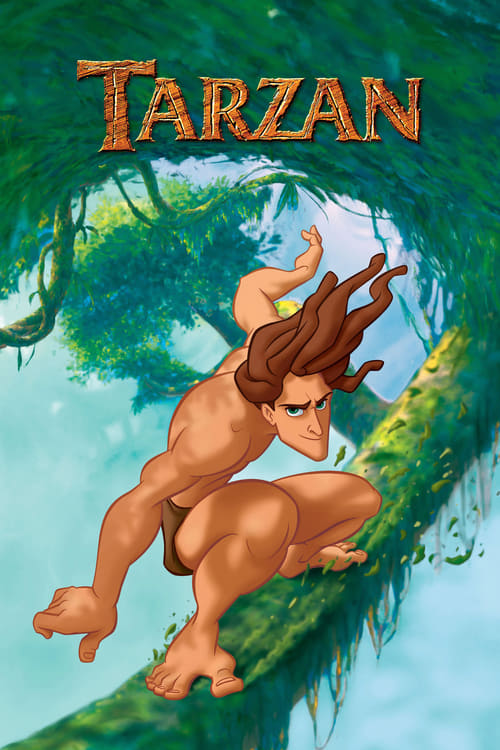
Walt Disney's sweeping jungle adventure follows Tarzan, a young boy raised by gorillas after his parents are killed by a leopard, who must bridge two worlds when a group of human explorers arrives in his forest and he meets Jane — a woman who introduces him to the civilization he never knew he belonged to. Directed by Chris Buck and Kevin Lima, the film is visually remarkable, pioneering a fluid animation technique called Deep Canvas that gives its jungle a genuine sense of three-dimensional depth and allowed for acrobatic chase sequences through the tree canopy that still astonish. Phil Collins's percussive score gave the film a propulsive emotional energy unlike any Disney sound design before it, making the soundtrack feel inseparable from the action. A story about belonging, identity, and the painful question of which world a person calls home when they are claimed by two, Tarzan closed the Disney Renaissance on an expansive and visually breathtaking note.
Watch for
- The Deep Canvas animation technique throughout — watch how the tree environments shift perspective as the characters move through them, with the virtual camera banking and rotating around three-dimensional digital geometry that gives the jungle genuine spatial depth rather than the layered flatness of traditional background painting. Every scene in the canopy is a demonstration of what this system made possible.
- Phil Collins's score as simultaneous emotional narration — rather than using song to externalize characters' thoughts in the theatrical tradition, Collins provides an external observational voice that comments on the action from outside the narrative, and watch how this choice creates a different emotional register than anything in the Broadway-influenced Renaissance films preceding it.
- The baby Tarzan opening sequence and its use of parallel action — the near-wordless sequence cuts between Tarzan's human parents' death and Kala's gorilla infant's death in a way that establishes the film's central argument about biological and chosen family through pure visual parallel, without dialogue or explanation.
- Glen Keane's animation of Tarzan throughout as a study in body language acquired from gorillas rather than humans — watch how Tarzan's weight shifts, his preference for wide-stance grounding, his use of all four limbs, and his specific quality of physical alertness all reflect decades of gorilla movement observation, creating a human character whose kinetic vocabulary has been fundamentally shaped by a non-human model.
Production notes
Tarzan was the most expensive animated film ever made at the time of its release — roughly $130 million — and represented Disney's full technical commitment to its then-new 'Deep Canvas' system, which allowed hand-painted backgrounds to be projected onto 3D geometry that the camera could move through dynamically. Co-directors Chris Buck and Kevin Lima led production. Glen Keane led the animation of Tarzan, drawing on his teenage son Max's skateboarding for movement reference — Tarzan's tree-surfing through the jungle is essentially a primate parkour translated from skate vocabulary. Phil Collins wrote and performed all the songs (a deliberate departure from the in-character singing of Renaissance films) and provided the soundtrack's pop-rock energy. Tony Goldwyn voiced Tarzan, Minnie Driver was Jane, Glenn Close voiced Kala the gorilla, and Brian Blessed played Clayton.
Trivia
- Glen Keane studied his son Max skateboarding for hours to develop Tarzan's distinctive tree-surfing movement; the resulting motion is a direct translation of skate dynamics — knees bent, arms wide, body weight forward — into a primate hero swinging through canopy.
- Phil Collins recorded the songs in five different languages — English, French, German, Spanish, and Italian — performing them himself for international releases, a degree of vocal-localization commitment unusual for any artist.
- The Deep Canvas technique developed for Tarzan won the studio a Scientific and Engineering Academy Award in 2003 and was used in subsequent Disney features including Atlantis and Treasure Planet.
- 'You'll Be in My Heart' won the 1999 Academy Award for Best Original Song, the Golden Globe for Best Original Song, and made Phil Collins the first Disney songwriter to win the Oscar for a popular-music-style song without it being performed by the characters in-narrative.
- Tarzan was the last Disney animated feature of the 20th century — released in June 1999 — and is widely regarded as the closing chapter of the Disney Renaissance era that began with The Little Mermaid.
Legacy
Tarzan grossed roughly $448 million worldwide and was the studio's highest-grossing animated film since The Lion King — a major commercial success that closed the 20th century on a high note for Disney Animation. It is widely regarded as the closing chapter of the Disney Renaissance era that began with The Little Mermaid. The film's commercial success masked the financial pressure that the next several films would expose: animated features were getting more expensive, and audience expectations were shifting toward computer animation in the wake of Toy Story. The Phil Collins soundtrack went multi-platinum and 'You'll Be in My Heart' won the Academy Award for Best Original Song, making Collins the first Disney songwriter to win the Oscar for a popular-music-style song without it being performed by the characters in-narrative. The Deep Canvas technique developed for the film won the studio a Scientific and Engineering Academy Award in 2003. A 2006 Broadway adaptation ran for over a year. The film generated a direct-to-video sequel and a television series. Among the Renaissance films, Tarzan is the most musically pop-driven, and that approach foreshadowed the way subsequent post-Renaissance films would try to integrate popular music with animated storytelling.