The Adventures of Ichabod and Mr. Toad
Vibe
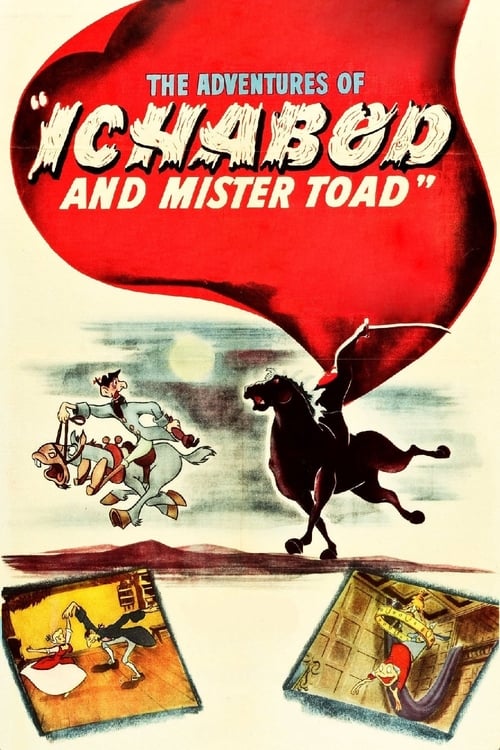
Walt Disney's double-feature anthology presents two beloved literary characters in back-to-back short films that stand among the strongest individual works in the studio's postwar catalog. The first segment follows the roguish, irrepressible Mr. Toad of Wind in the Willows fame as his obsession with motorcars lands him in court, prison, and eventually a slapstick showdown to reclaim Toad Hall. The second and more enduring segment adapts Washington Irving's The Legend of Sleepy Hollow, building to one of the studio's most genuinely unnerving sequences as the gawky schoolmaster Ichabod Crane rides home through the dark on a moonlit night pursued by something that may or may not be the Headless Horseman. Together and apart, both stories showcase the studio's mastery of comic timing, atmospheric animation, and the ability to shift tonal register — from the broadly farcical to the unexpectedly chilling — within a single entertainingly structured package.
Watch for
- The Sleepy Hollow segment's Headless Horseman sequence as perhaps the single most genuinely frightening piece of animation Disney ever produced — watch how lighting, sound design, and pacing conspire to escalate Ichabod's terror, with the Horseman's laughter a more unnerving presence than any explicitly depicted monster.
- Bing Crosby's narration in the Sleepy Hollow segment and how it functions as a tonal instrument — his warmth during the comic early sequences gives way to a hushed, conspiratorial quality during the Hollow itself, and the transition between registers shapes how the animation lands.
- The Toad segment's staging of the courtroom sequence — watch how the animators manage the spatial relationships between a very large cast of characters in a single room, using camera angles, staging, and timing to keep the comic chaos organized and legible.
- How both segments use a single narrator as the primary storytelling mechanism, and how differently each exploits that device — Basil Rathbone's patrician dryness in Mr. Toad vs. Crosby's folksy warmth in Sleepy Hollow — demonstrating the degree to which vocal performance shapes the tonal experience of animated narrative.
Production notes
The Adventures of Ichabod and Mr. Toad was the last and most fully realized of Disney's package films, pairing two literary adaptations into a single feature: Kenneth Grahame's The Wind in the Willows and Washington Irving's The Legend of Sleepy Hollow. The studio brought star power to each segment — Basil Rathbone narrated and voiced the Wind in the Willows portion, while Bing Crosby narrated, sang, and voiced multiple characters in the Sleepy Hollow segment. Directors Jack Kinney, Clyde Geronimi, and James Algar oversaw the production. Unlike earlier packages assembled from short, varied bits, each half here is a sustained narrative roughly half an hour long, giving the film a stronger structural shape and pointing the way toward a return to fully unified features.
Trivia
- Bing Crosby's casting in the Sleepy Hollow segment was a genuine coup — at the time he was one of the biggest entertainment figures in the world, and his vocal performance carries virtually the entire 33-minute sequence.
- The film's two halves were eventually separated and re-released as standalone shorts: The Wind in the Willows (1955) and The Legend of Sleepy Hollow (1958), with Disney distributing them through the educational and television markets.
- The Headless Horseman chase sequence is widely cited by animators as one of the most kinetic and atmospheric set pieces ever produced at the studio — Frank Thomas and Ollie Johnston, two of the Nine Old Men, did much of its character work.
- Mr. Toad of Toad Hall's reputation has lasted in part because of the long-running Mr. Toad's Wild Ride attraction, which opened with Disneyland in 1955 and remains there to this day, though its Walt Disney World counterpart closed in 1998.
- The film is technically the 11th Disney animated feature and the studio's last release of the 1940s, marking the definitive end of the package-film era.
Legacy
The Adventures of Ichabod and Mr. Toad has had an unusual second life: while the full feature is rarely revived, its Sleepy Hollow segment has become a perennial Halloween classic, broadcast and streamed every October across multiple generations. The Headless Horseman chase remains one of the most-quoted set pieces in studio history. As the bridge between the wartime package era and the renewed feature ambition of Cinderella, the film occupies a transitional position — but unlike its more fragmented predecessors, it stands up as two coherent literary adaptations, each roughly half an hour long, suggesting how the studio was already moving back toward unified narrative. Bing Crosby's casting in the Sleepy Hollow segment was a genuine coup of the era. The Mr. Toad of Toad Hall ride at Disneyland, opened in 1955 and still operating, has carried a piece of the film into theme park history, and the Headless Horseman has been folded into Disney's autumn marketing for decades.