The Great Mouse Detective
Vibe
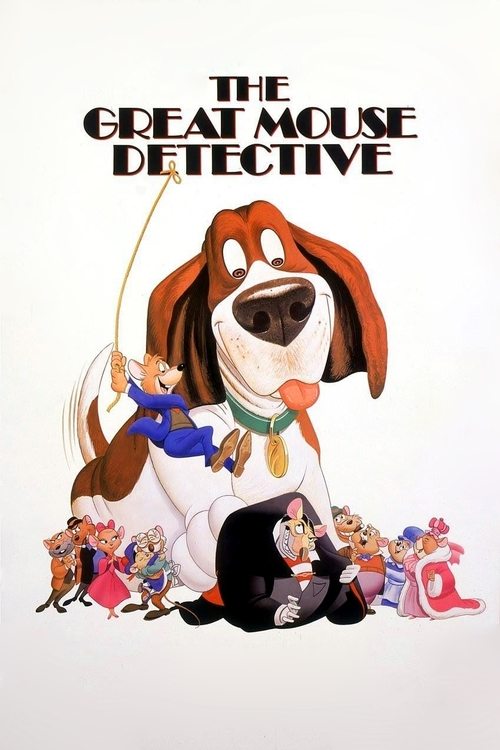
Walt Disney's energetic mystery comedy follows Basil of Baker Street, the most brilliant detective in the mouse world, as he races to stop the villainous Professor Ratigan from seizing control of the British monarchy on the eve of the Queen's Diamond Jubilee. Directed by Ron Clements, Burny Mattinson, Dave Michener, and John Musker, the film is often credited as the beginning of the studio's creative revival, bringing back a sense of theatrical storytelling energy and confident pacing that had been absent for years. Ratigan, voiced with theatrical relish by Vincent Price, is one of the studio's most entertaining antagonists — vain, cultured, and capable of sudden terrifying violence — and the climactic sequence inside Big Ben still ranks among the studio's most dynamically animated action scenes. Fast, funny, and genuinely exciting, The Great Mouse Detective announced that the studio had rediscovered its ability to craft a great animated adventure.
Watch for
- The Big Ben clock mechanism sequence as a landmark moment in the use of computer-generated imagery in Disney animation — watch how the CGI gears create genuine three-dimensional spatial complexity that hand-drawn animation of the period could not have produced, and how seamlessly the hand-drawn characters move through the CGI environment.
- Vincent Price's Ratigan performance and how the animators translate his theatrical extravagance into physical terms — the character's movements are large, sweeping, and deliberately stagey, and the contrast between his cultural pretensions and his predatory violence is entirely a function of character animation.
- Basil's detective methodology as storytelling structure — the film borrows the Sherlock Holmes procedural template and translates it into animation terms, with several scenes where Basil's deductive reasoning is externalized through physical action and spatial exploration rather than verbal exposition, creating a rare animated detective sequence that actually works as mystery.
- The musical number The World's Greatest Criminal Mind as a formal experiment — watch how Ratigan conducts his own tribute sequence, how the staging emphasizes his narcissism through camera placement and character positioning, and how the number's structure as a villain's self-glorification sets up the particular quality of his eventual defeat.
Production notes
The Great Mouse Detective was made on a deliberately tight budget after the Black Cauldron disaster — about $14 million, a fraction of its predecessor's spend — and on an aggressive schedule to prove the animation department could still produce hits. Co-directors Ron Clements, Burny Mattinson, Dave Michener, and John Musker (their first feature directing credits) adapted Eve Titus's children's books about Basil of Baker Street, a mouse Sherlock Holmes operating in the floor-level London beneath Conan Doyle's. Vincent Price voiced Ratigan in what he later called one of his favorite roles — bringing decades of horror-icon energy to a children's villain. The Big Ben climax used early CGI to animate the gears of the clock tower, with the wireframe animation hand-rendered onto cels — one of the studio's most ambitious computer-assisted sequences to date.
Trivia
- Vincent Price was 75 years old when he recorded Ratigan and personally insisted that the climactic 'Goodbye, So Soon' song be reorchestrated to better suit his vocal range — he wanted to deliver the villain's musical farewell properly.
- The Big Ben gear sequence was animated using a custom CGI system that generated wireframe gear renders, which animators then hand-traced onto cels frame by frame — making it both a CGI sequence and a hand-drawn one.
- Basil's character design was shaped in part by Conan Doyle's original Sidney Paget illustrations of Sherlock Holmes — the deerstalker cap, magnifying glass, and aquiline profile are direct visual quotes.
- Eve Titus's source novel Basil of Baker Street was published in 1958, decades before this adaptation; the film helped renew interest in the books and led to several reprints.
- The studio was so uncertain about the film's commercial prospects that it was renamed several times during marketing — including The Great Mouse Detective, Basil of Baker Street, and finally The Adventures of the Great Mouse Detective on some prints — to find a title that tested better.
Legacy
The Great Mouse Detective's modest commercial success — earning roughly $39 million on a $14 million budget — was crucial to Disney animation's survival and morale after the Black Cauldron disaster. It demonstrated that smaller, character-driven films could be hits if executed well, and reset expectations within the studio about what the animation department could deliver. More importantly, it gave Ron Clements and John Musker their first directing credits; they would go on to direct The Little Mermaid, Aladdin, Hercules, Treasure Planet, The Princess and the Frog, and Moana, becoming arguably the most important director duo of the modern Disney era. The Big Ben gear sequence is regularly cited in animation history as a turning point in the integration of CGI into traditional Disney workflows. Vincent Price's Ratigan remains one of the more under-celebrated Disney villains, and the film holds up as a tightly-paced, atmosphere-rich entry. Its successful release was an essential bridge from the studio's lowest point to the Renaissance that would follow three years later.