The Hunchback of Notre Dame
Vibe
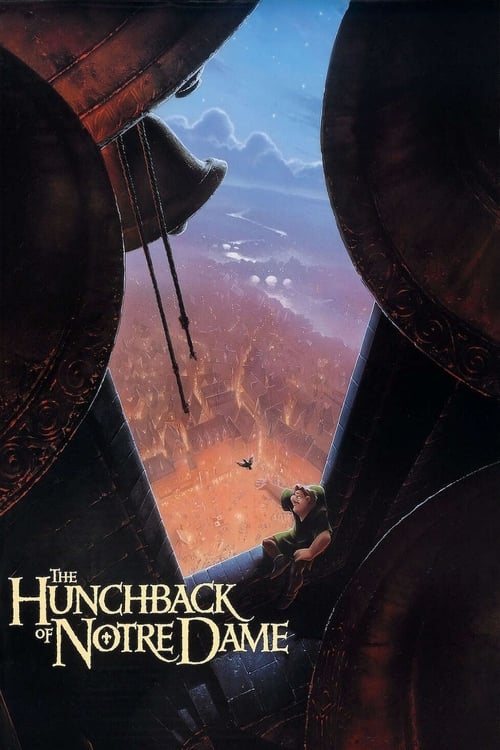
Walt Disney's most tonally daring Renaissance film follows Quasimodo, the isolated bell-ringer of Notre Dame Cathedral in medieval Paris, who secretly longs to be part of the world below while the powerful Judge Frollo — his cruel guardian — uses religion to justify persecution, desire, and violence. Directed by Gary Trousdale and Kirk Wise, the film is unlike anything else in the studio's catalog — genuinely dark in places, built around themes of lust, fanaticism, and systemic cruelty that most animated features for children would never approach. Alan Menken and Stephen Schwartz's score is among their most operatically ambitious, and the animation of the cathedral and the Parisian streets is stunning. Uneven in tone and imperfect in resolution, The Hunchback of Notre Dame nonetheless contains some of the most bold and emotionally complex filmmaking the studio ever attempted, and its willingness to look directly at the ugliest expressions of human power remains remarkable.
Watch for
- The opening Bells of Notre Dame sequence as a structural and visual statement — Clopin's narration sets up the film's moral argument in the form of a question (what makes a monster and what makes a man?), the animation of the bells creates a literal foundation for the film's themes of entrapment and yearning, and the visual scale of the cathedral is established as a character as much as a setting.
- Frollo's Hellfire as the most psychologically complex musical number in the Disney canon — watch how the sequence uses light as moral geography, with the red firelight of lust and shame alternating with the cold blue of the Virgin's judgment, and how the animation externalizes Frollo's divided psychology through the literal appearance of his hooded form multiplied across the cathedral walls.
- The animation of Notre Dame Cathedral itself as architectural photography — the film's visual designers visited Paris specifically to document the cathedral's architectural details, and the backgrounds achieve a quality of gothic specificity — the specific proportion of flying buttresses, the grain of stone, the quality of candlelight through stained glass — that grounds the fantasy in genuine architectural history.
- Quasimodo's animation by James Baxter as a study in physical constraint expressing emotional life — watch how Baxter gives Quasimodo's movements the specific qualities of a body that has never known free horizontal space, with a reach and crouch that speaks to decades of vertical climbing, and how the character's expressiveness accumulates through the gap between physical limitation and interior feeling.
Production notes
The Hunchback of Notre Dame was Disney's most thematically ambitious Renaissance film — adapting Victor Hugo's 1831 novel about lust, religious hypocrisy, and societal cruelty into a PG-rated animated musical. Co-directors Gary Trousdale and Kirk Wise (Beauty and the Beast) led production. Alan Menken and Stephen Schwartz wrote the songs, with Schwartz pushing for darker, more theologically charged material than Disney had previously approached. The 'Hellfire' sequence — Frollo's lust-driven hymn to Esmeralda interspersed with a chorus singing the Confiteor — is among the most adult moments in any Disney animated feature. Tom Hulce voiced Quasimodo, Demi Moore was Esmeralda (with Heidi Mollenhauer singing), Tony Jay was Frollo, and Kevin Kline played Phoebus. The Notre Dame cathedral itself was modeled with extensive CGI to allow sweeping camera moves through its interior architecture.
Trivia
- Stephen Schwartz pushed Disney to retain the explicitly religious framing of Hugo's novel — Frollo as a pious judge tormented by lust, the cathedral as sanctuary, the choral Latin Confiteor — over executive resistance; the result is the most theologically sophisticated film in the Disney canon.
- Tony Jay's recording of 'Hellfire' is widely considered one of the most powerful villain performances in any animated film; he reportedly performed the song in a single full take with the orchestra, never dropping the character.
- Disney executives were reportedly nervous about the film's tone throughout production — they pushed for the comic-relief gargoyles (Laverne, Hugo, and Victor) to soften the material, a creative compromise the directors have publicly second-guessed in the years since.
- The film's CGI cathedral allowed the directors to stage scenes with dramatic camera movement around and through Notre Dame — including the climactic battle on the cathedral's facade — that would have been impossible with hand-painted backgrounds.
- The Hunchback of Notre Dame has been performed as a live stage musical multiple times — most prominently in a 1999 German production and in a 2014 American adaptation that restored some of Schwartz's cut songs and darker material.
Legacy
The Hunchback of Notre Dame earned about $325 million worldwide — strong, though softer than the Renaissance peak — and was nominated for the Academy Award for Best Original Score. Its critical reputation has steadily climbed as the film's adult ambition has become more apparent in retrospect. Stephen Schwartz's decision to retain the explicitly religious framing of Hugo's novel — Frollo as a pious judge tormented by lust, the cathedral as sanctuary, the choral Latin Confiteor — produced what is widely considered the most theologically sophisticated film in the Disney canon. The 'Hellfire' sequence stands among the most adult moments in any Disney animated feature. The 2019 fire at Notre Dame Cathedral prompted a massive surge in viewing of the film, and Disney donated to the cathedral's restoration. A live-action remake has been in active development for years. Frollo is widely regarded as one of Disney's most genuinely menacing villains — not a magical evildoer but a recognizable ideological one. Among Disney Renaissance films, Hunchback is the one viewers most often discover later in life, finding more in it as adults than they could as children.