The Jungle Book
Vibe
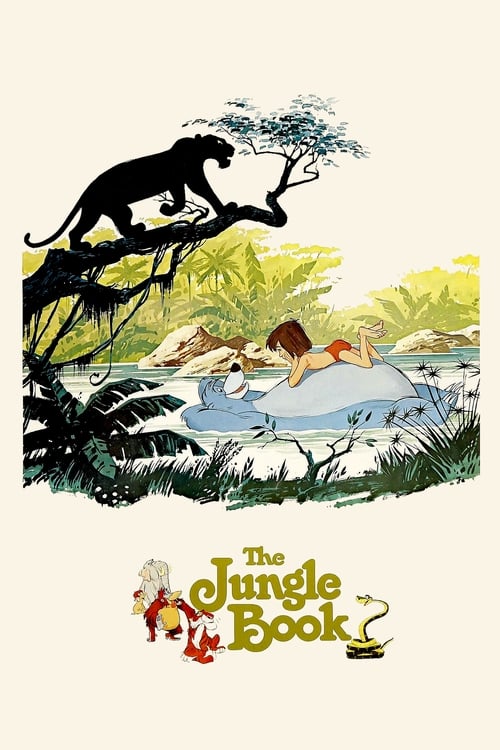
Walt Disney's final animated feature personally supervised by Walt Disney himself follows Mowgli, a boy raised by wolves in the Indian jungle who must be guided back to the man-village before the fearsome tiger Shere Khan returns to hunt him down. Directed by Wolfgang Reitherman, the film wisely leaned into the musical talents of its voice cast and the loose, episodic charm of Kipling's original stories rather than conventional dramatic structure, and the result is one of the most purely enjoyable films the studio ever made. Baloo the bear, voiced by Phil Harris, became an immediate cultural institution with his laid-back philosophy and irresistible musical numbers, while the snake Kaa and King Louie are among the studio's most memorably eccentric creations. Warm, funny, and brimming with good spirits, The Jungle Book marked the end of the studio's golden-age sensibility and remains one of the most effortlessly entertaining animated films ever made.
Watch for
- Phil Harris's Baloo animation by Ollie Johnston as the most personality-driven performance in the film — Johnston animated Baloo directly to Harris's vocal delivery, and the result is a character whose physical looseness, specific rhythmic timing, and gestural vocabulary feel genuinely improvised in a way that no written characterization could have produced.
- The King Louie sequence and its use of jazz performance principles in animation — watch how the character's physical movement is structured around musical phrasing rather than plot logic, with Louis Prima's vocal improvisations directly shaping the timing and energy of the animation, turning what could have been a conventional villain scene into something closer to a concert performance.
- Kaa the snake's hypnosis sequences and the specific technique of spiral-eye animation used to depict entrancement — the effect is both silly and genuinely unsettling, and Sterling Holloway's voice performance creates a comic menace whose physical form, all coiling length and impossible reach, is one of the studio's most spatially imaginative character designs.
- The film's decision not to animate Mowgli through rotoscoping as was done with Snow White, and what difference that makes — Mowgli's movement is drawn rather than traced, giving him a physical stylization that makes him compatible with the animal world while still reading as distinctly human, a carefully calibrated middle ground between naturalism and cartoon.
Production notes
The Jungle Book was the last Disney animated feature Walt Disney personally oversaw before his death in December 1966 — it was released the following October. Walt was famously dissatisfied with an early dark, faithful adaptation of Rudyard Kipling's stories developed by Bill Peet, and ordered the film fundamentally rebooted with a lighter tone and a music-driven structure. Peet left the studio over the disagreement. Director Wolfgang Reitherman steered the new direction, and casting drove much of the result: Phil Harris brought his loose, jazz-inflected charm to Baloo; Sebastian Cabot played Bagheera; George Sanders voiced the silken menace of Shere Khan; and Louis Prima was hired specifically because Walt wanted King Louie to sound and move like Prima's stage act. The Sherman Brothers wrote most of the songs, with 'The Bare Necessities' contributed by Terry Gilkyson from the original, abandoned darker version.
Trivia
- Disney offered the role of King Louie to Louis Armstrong before Louis Prima — the studio worried about the optics of casting Armstrong as an ape, particularly during the civil rights era, and pivoted to Prima.
- 'The Bare Necessities' was the only song retained from Bill Peet's original darker treatment; it was nominated for the Academy Award for Best Original Song.
- Disney died on December 15, 1966, ten months before the film's release; its considerable success became part of the studio's emotional public mourning and reassurance.
- The Jungle Book's animators reused some character animation directly from The Sword in the Stone and would reuse Jungle Book animation in turn in later features like Robin Hood — a cost-saving practice common in the Reitherman era.
- Bruce Reitherman (the director's son) voiced Mowgli; he was the third Reitherman child cast in a Disney animated feature, following his brother Richard's work on Sword in the Stone.
Legacy
The Jungle Book was a massive hit on its 1967 release, grossing roughly $73 million worldwide on a $4 million budget, and became the studio's most successful animated feature since Snow White. The film's songs — 'The Bare Necessities,' 'I Wan'na Be Like You,' 'Trust in Me' — entered the standard Disney songbook permanently, and 'The Bare Necessities' was nominated for the Academy Award for Best Original Song. As the last Disney animated feature Walt personally oversaw before his death in December 1966, it carries an unusual emotional weight in studio history; its considerable success ten months after his death became part of the studio's emotional public mourning and reassurance. The film generated a 2003 direct-to-video sequel, a 1994 live-action film, and Jon Favreau's 2016 photorealistic CGI/live-action hybrid which itself grossed nearly $1 billion. Mowgli, Baloo, and Bagheera are perpetual fixtures of Disney parks and merchandise. Among generations who grew up on it, The Jungle Book occupies a particular nostalgia position — warm, jazzy, sun-warmed, and unmistakably the moment Disney animation closed one chapter and opened another.