The Little Mermaid
Vibe
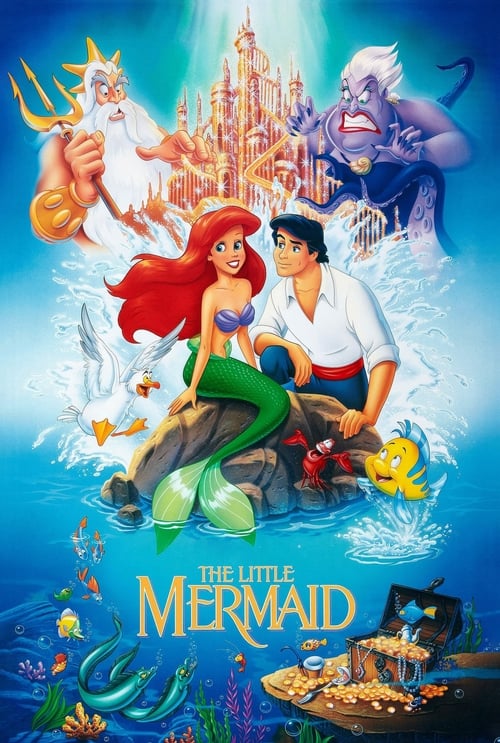
Walt Disney's landmark musical follows Ariel, a sixteen-year-old mermaid with an all-consuming fascination with the human world, who strikes a dangerous bargain with the sea witch Ursula — trading her voice for legs and a chance at the surface world and the prince she has fallen for at a distance. Directed by Ron Clements and John Musker, the film launched the Disney Renaissance, restoring the studio's confidence in the fully sung musical feature and setting the template — lush animation, Broadway-caliber songs, emotionally driven characters — that would define its peak output for the following decade. Howard Ashman and Alan Menken's score is one of the great achievements in animated film music, and Ursula remains one of the studio's most deliciously theatrical villains. As a story about longing, identity, and the cost of transforming yourself to belong, The Little Mermaid is both a foundational entertainment and a film that carries real emotional weight beneath its dazzling surface.
Watch for
- Ariel's animation by Glen Keane as one of the defining performances in the Disney Renaissance — watch particularly the sequence where she sings Part of Your World alone in her grotto, and observe how Keane gives her a physical specificity of longing, her arms reaching toward the human objects around her, that communicates the character's emotional interiority without any assistance from the lyric.
- Howard Ashman and Alan Menken's integration of song into character and narrative — watch how Under the Sea uses Sebastian's Caribbean persona to make a thematic argument about contentment, how Part of Your World uses spatial staging to express desire, and how Poor Unfortunate Souls uses Ursula's theatrical malice to normalize manipulation, each song doing dramatic work no dialogue scene could accomplish.
- Ursula's animation by Ruben Aquino as a study in theatrical female menace — the character is deliberately modeled on drag performer Divine, and her physical largeness, the way she fills the frame and displaces air around her, creates a presence that overwhelms every scene she enters without resorting to the angular, inhuman designs of earlier Disney villains.
- The underwater environment's light physics — watch how the animators use shafts of filtered light, suspended particles, and the constant ambient motion of water to create an environment that feels genuinely aquatic in its visual texture, a technical achievement that required new approaches to how light behaves in the CAPS digital system.
Production notes
The Little Mermaid is widely regarded as the start of the Disney Renaissance. Directed by Ron Clements and John Musker (their second feature after The Great Mouse Detective), the film married a return to the studio's fairy-tale roots with the new energy of Broadway musical theater. Composer Alan Menken and lyricist Howard Ashman, fresh from their Off-Broadway hit Little Shop of Horrors, brought a structural musical-theater sensibility — every song advances character and plot in the way a Broadway book musical demands. Glen Keane animated Ariel, drawing on his daughter Claire as physical reference; Ruben Aquino animated King Triton; and the iconic Ursula was animated by Ruben Aquino and Mark Henn, voiced by Pat Carroll, with a design Howard Ashman described to artists as 'Joan Collins crossed with a drag queen.' The film cost about $40 million.
Trivia
- Howard Ashman's Off-Broadway sensibility transformed the structural approach to Disney songs; his work on this film and Beauty and the Beast established the 'I Want' song template (Ariel's 'Part of Your World') that would define Disney heroines for decades afterward.
- Ursula's design was directly inspired by drag performer Divine; Howard Ashman, who was openly gay, drew on Divine's stage presence as a defining reference and animators built the character around that model.
- Ariel's hair was animated using new effects techniques to capture how it would actually move underwater; reference footage was shot of astronaut Sally Ride underwater and of Olympic-level synchronized swimmers.
- Pat Carroll, who voiced Ursula, was 62 at the time of recording and received the role after Bea Arthur, Charlotte Rae, Nancy Marchand, and others were considered; she described it as 'the role of my life.'
- The film was Disney's first animated feature based on a fairy tale since Sleeping Beauty thirty years earlier — the studio had explicitly avoided the format during the post-Walt era.
Legacy
The Little Mermaid is widely regarded as the start of the Disney Renaissance — the film that revived the studio's commercial fortunes and reestablished the Broadway-musical fairy-tale template that would dominate Disney animation for the next decade. It earned roughly $235 million worldwide on initial release, won two Academy Awards (Best Original Song for 'Under the Sea' and Best Original Score), and ignited the Renaissance that would continue through Beauty and the Beast, Aladdin, The Lion King, and beyond. Howard Ashman's Off-Broadway sensibility transformed the structural approach to Disney songs; his work on this film and Beauty and the Beast established the 'I Want' song template (Ariel's 'Part of Your World') that would define Disney heroines for decades afterward. Ariel became the third pillar of the Disney Princess line after Snow White and Cinderella. The film entered the National Film Registry in 2008. Its 2023 live-action remake starring Halle Bailey grossed nearly $570 million globally. Every animated musical Disney has produced since owes structural debts to The Little Mermaid.