The Princess and the Frog
Vibe
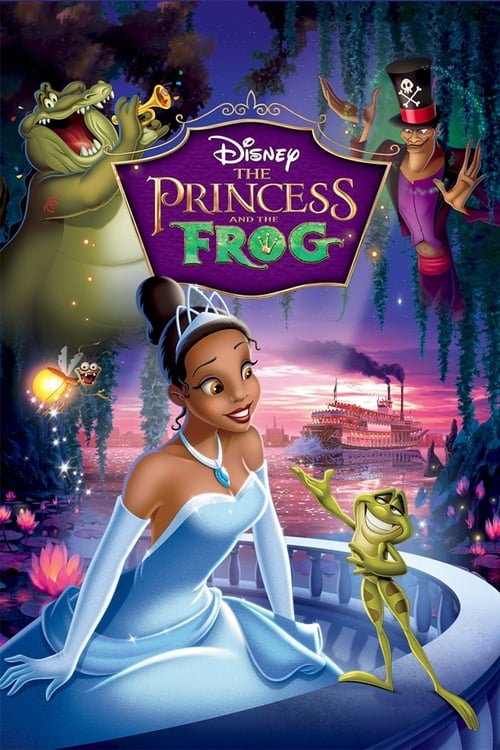
Walt Disney's celebrated return to hand-drawn animation follows Tiana, a hardworking young woman in 1920s New Orleans who dreams of opening her own restaurant and accidentally gets pulled into an enchantment that turns both her and a spoiled prince into frogs, sending them on a journey through the Louisiana bayou to break the spell before the shadow man's deal comes due. Directed by Ron Clements and John Musker, the film is a joyful love letter to New Orleans — its jazz, its food, its light, and its magic — anchored by one of the studio's most grounded and admirable protagonists, a woman defined entirely by her own ambition rather than the desire for rescue. Randy Newman's score weaves original songs into the fabric of the city with real affection, and Dr. Facilier — the Shadow Man — is one of the studio's most stylishly menacing villains. As a story about work, dreams, and the things that matter most when you get what you wished for, The Princess and the Frog is a rich, warm, and deeply satisfying film.
Watch for
- The New Orleans environment as the film's most fully realized achievement — watch how the visual design moves between the ornate, sun-warmed detail of the French Quarter's architecture and the dense, atmospheric mystery of the bayou, with each environment creating a distinct visual grammar for the story's two modes of experience: urban aspiration and natural enchantment.
- Dr. Facilier's Shadow Man sequence as a set piece of villain animation and design — Keith David's voice and the animation of Facilier's shadow as a separate, more powerful entity create a doubled character presence, and watch how the shadows on the wall operate independently of their caster, taking on threatening shapes and movements that reveal what Facilier's smooth surface conceals.
- The hand-drawn animation's return to principles established in the Renaissance but with specific adjustments for the post-digital era — watch the line quality, the color saturation, and the character animation of Tiana and Naveen, and observe how the animators integrate CAPS's color range with traditional character performance techniques.
- Randy Newman's score as geographic characterization — listen for how the musical language shifts between the New Orleans jazz tradition, the Cajun bayou sound, and Facilier's blues-tinged villain material, with each genre functioning as a sonic map of the film's different emotional and geographic territories, making the city itself audible as a character.
Production notes
The Princess and the Frog was Disney's deliberate return to traditional hand-drawn animation, ordered personally by John Lasseter after the Pixar acquisition. He recruited directors Ron Clements and John Musker — the duo behind The Little Mermaid, Aladdin, Hercules, and Treasure Planet — out of effective forced retirement (they had been pushed out during the all-CGI pivot) and gave them carte blanche on a return-to-form 2D musical. Composer Randy Newman wrote the songs, drawing on jazz, gospel, blues, and zydeco for the New Orleans 1920s setting. The film featured Disney's first African-American princess — Tiana, voiced by Anika Noni Rose — and the studio brought in extensive cultural advisors including Oprah Winfrey (who voiced Tiana's mother) to help shape the depiction of African-American culture. Tony Bancroft was animation director; Mark Henn animated Tiana, having animated multiple previous Disney heroines.
Trivia
- Tiana was Disney's first African-American princess and the first Disney princess in over a decade; her introduction was one of the most-anticipated representational milestones in the studio's modern history.
- Anika Noni Rose, who voices Tiana, is a Tony Award-winning Broadway performer (Caroline, or Change) — Disney specifically wanted a singer with stage-musical training to anchor the return to fully sung-through musical numbers.
- The film was originally titled The Frog Princess and was set to feature a maid named Maddy — both choices generated criticism in pre-production from Black writers and bloggers concerned about racial caricature; Disney changed the title and the character's name and profession in response.
- Randy Newman's score and songs received Academy Award nominations for Best Original Score and twice for Best Original Song ('Almost There' and 'Down in New Orleans') — Disney's strongest Oscar showing for an animated feature in years.
- The film's production reportedly required the studio to bring back retired ink-and-paint specialists and to retrain artists in hand-drawn techniques that hadn't been used at Disney for years — a deliberate institutional revival of skills that had nearly been lost.
Legacy
The Princess and the Frog grossed about $271 million worldwide on a $105 million budget — financially solid but underperforming relative to the prestige Disney had attached to its return-to-2D ambitions. Tiana entered the Disney Princess line as its first African-American member, anchoring representation milestones for Black audiences that have only grown more important over time. The film has been celebrated for its New Orleans setting, its jazz score, its serious treatment of work and ambition (Tiana's defining trait is wanting to own her own restaurant), and its rich villain Dr. Facilier. Randy Newman's score and songs received Academy Award nominations for Best Original Score and twice for Best Original Song — Disney's strongest Oscar showing for an animated feature in years. A 2024 attraction at Walt Disney World replaced the historic Splash Mountain with a Princess and the Frog ride — Tiana's Bayou Adventure — bringing the character into theme park central status. The film's softer-than-expected box office contributed to Disney's decision to discontinue 2D theatrical production again after Winnie the Pooh in 2011, leaving its return-to-form ambitions only partially fulfilled.