The Rescuers
Vibe
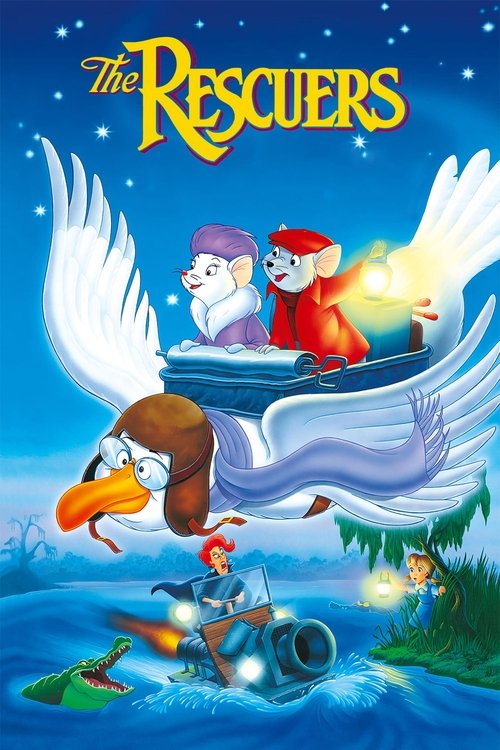
Walt Disney's adventure follows Bernard and Bianca, two mice who serve as agents of the Rescue Aid Society at the United Nations, as they embark on a mission to find Penny, a young orphan girl who has sent a desperate message for help in a bottle. Directed by Wolfgang Reitherman, John Lounsbery, and Art Stevens, the film marked a renewed dramatic confidence at the studio, pairing genuine suspense and emotional stakes with comic warmth in ways that pointed toward the stronger features to come. The villainous Madame Medusa — big-haired, greedy, and volatile — is one of the era's most entertainingly unhinged Disney antagonists, and the swamp setting gives the film a moody, textured atmosphere that sets it apart from many of its contemporaries. Small in scale but emotionally sincere, The Rescuers is a story about courage, compassion, and the unexpected places from which help can come when the need is great enough.
Watch for
- The swamp setting's visual atmosphere as a character in its own right — animators spent considerable effort differentiating the flat Louisiana bayou environment through lighting conditions, time of day, and weather, and the result is one of the more geographically specific Disney environments of the post-Walt era.
- Madame Medusa's animation by Milt Kahl as his last major performance at the studio and arguably his most uninhibited — watch the extreme facial expressions, the physical largeness of her gestures, the speed and specificity of her emotional transitions. Kahl described her as a conscious distillation of everything he'd learned about animating human villainy across four decades.
- The Albatross Orville's flight sequences as a showcase for what comic physics can accomplish — his labored takeoffs, wobbly cruising altitude, and crash landings are animated with a specificity about large bird aerodynamics that makes the impossibility of his scale feel not just funny but systematically coherent.
- How the film constructs Penny's vulnerability — she is never shown in danger in graphic terms, but the film builds dread through staging, through the knowledge of what Medusa intends, and through the careful withholding of explicit threat, demonstrating the studio's matured understanding of how to create suspense for young audiences without traumatizing them.
Production notes
The Rescuers was based on Margery Sharp's 1959 children's novels and represented the first major work of a transitional generation at Disney — the bridge between the original Nine Old Men and the young animators who would lead the renaissance of the late 1980s. Don Bluth, Glen Keane, Andy Gaskill, and Ron Clements all worked on the film, learning under veterans like Ollie Johnston, Frank Thomas, Milt Kahl, and John Lounsbery. Wolfgang Reitherman, John Lounsbery, and Art Stevens co-directed. Bob Newhart voiced Bernard with his trademark deadpan understatement, and Eva Gabor returned (after The Aristocats) as Bianca. Madame Medusa was animated primarily by Milt Kahl — his last major character animation work before retirement, and widely considered one of his finest — and voiced by Geraldine Page. The film cost roughly $7.5 million.
Trivia
- Madame Medusa was Milt Kahl's farewell character; he came out of retirement specifically to animate her, and reportedly insisted on doing nearly every shot of her himself.
- Bob Newhart was cast based on his stand-up persona; the script was adapted in places to accommodate his particular cadence of nervous, hesitant delivery, and his improvisations made it into the final film.
- The Rescuers was one of the highest-grossing animated features of the 1970s, taking in over $48 million worldwide on initial release and outperforming Star Wars in some international markets during its specific weeks.
- A 1999 home video release of The Rescuers was recalled because animators in the original 1977 film had inserted two single-frame photographs of a topless woman as a prank — the images had gone unnoticed for over two decades.
- Don Bluth was a key animator on the film and would lead a famous 1979 walkout from Disney with several colleagues, founding his own studio and becoming, for nearly a decade, Disney's most direct competition in animated features.
Legacy
The Rescuers was the studio's biggest hit of the 1970s, grossing over $48 million worldwide, and proved that Disney could still make commercially viable animated features without Walt at the helm. It generated the studio's first true sequel, The Rescuers Down Under (1990) — Disney's first sequel in any animated format. More important historically, it served as the training ground for the team that would lead the late-1980s renaissance: Glen Keane, Ron Clements, John Musker, Don Hahn, Don Bluth, and others all developed their craft under the Nine Old Men during this production. The film's gentle, melancholy tone — particularly the song 'Someone's Waiting for You' — gave it an emotional register unusual for late-1970s family entertainment. The 1999 home video recall over the topless-photograph prank discovered in the original 1977 footage remains an embarrassing chapter in the studio's history and led to tightened pre-release content reviews thereafter. Madame Medusa, animated by Milt Kahl in his last major role before retirement, stands as one of his finest performances.