The Rescuers Down Under
Vibe
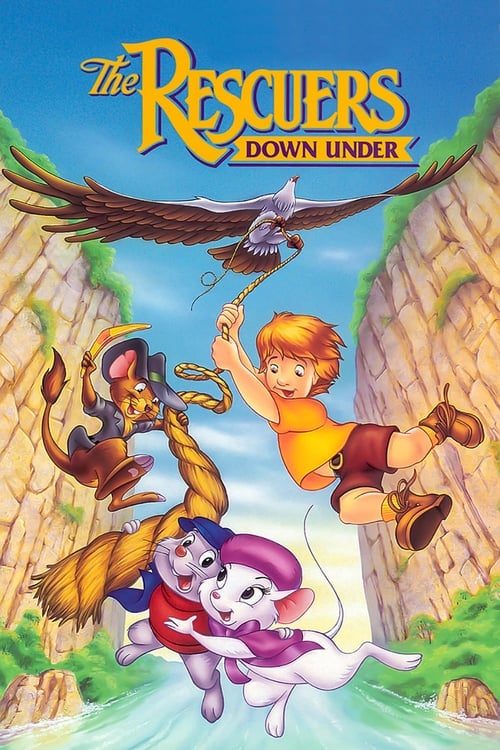
Walt Disney's rare animated sequel follows Bernard and Bianca of the Rescue Aid Society on a new mission, this time to the Australian outback, where they race to free Cody, a young boy who has been captured by Percival McLeish, a poacher with designs on a magnificent golden eagle named Marahute. Directed by Hendel Butoy and Mike Gabriel, the film was the first Disney animated feature to be made entirely digitally, and its opening sequence — in which Cody soars through the outback skies on Marahute's back — remains one of the most thrilling pieces of animation the studio ever produced. John Candy's turn as Wilbur the albatross provides comic relief with real wit and timing, while the film's adventure-forward storytelling gives it a propulsive energy distinct from most of its contemporaries. Underappreciated on release, The Rescuers Down Under is a genuinely exciting animated adventure that rewards rediscovery.
Watch for
- The opening flight sequence on Marahute's back — watch the camera movement as it dips, soars, and banks through the Australian landscape, using the freedom of the new CAPS digital system to create aerial choreography that would have been mechanically impossible with traditional multiplane photography, establishing in the film's first ten minutes what was now possible.
- Marahute's animation and how the animators solved the problem of making a giant eagle both realistically avian and emotionally expressive — the solution is in scale: she is so much larger than Cody that her expressions are readable at the same scale as the human characters, and her physical interaction with him creates the film's warmest emotional relationship.
- John Candy's Wilbur as a study in comic timing divorced from conventional plot function — his scenes exist largely outside the main narrative, and the animators embraced that freedom to create character-comedy sequences structured entirely around the rhythms of Candy's voice performance, producing what are arguably the most purely funny scenes in any Disney film between The Jungle Book and The Little Mermaid.
- The contrast between the Australian wilderness's visual expansiveness and the cramped interiors of McLeach's lair — the film consistently uses spatial openness as a visual equivalent of freedom and spatial constriction as threat, and the color palette follows this logic with the bright naturalism of the outback against the dark, metallic compression of captivity.
Production notes
The Rescuers Down Under was the first Disney animated feature produced entirely using CAPS — the Computer Animation Production System co-developed with Pixar — eliminating the traditional ink-and-paint cel process for the first time in studio history. The shift was both technical and economic: digital ink-and-paint allowed for more sophisticated camera moves, layered effects, and color choices. Co-directors Hendel Butoy and Mike Gabriel led the production. The film was Disney's first true animated theatrical sequel — to 1977's The Rescuers — and it took the characters from urban Manhattan to the Australian Outback for a wildlife-rescue adventure inspired by the studio's interest in environmental themes. Bob Newhart and Eva Gabor reprised their roles; George C. Scott voiced the villain McLeach; and a new young protagonist Cody was introduced, voiced by Adam Ryen.
Trivia
- The Rescuers Down Under was the first major animated film made entirely without traditional cel animation — every frame was scanned, colored, and composited digitally using the CAPS system Disney had developed in partnership with Pixar.
- Eva Gabor's recordings as Bianca were among her last major performances; she died in 1995, and her warm, lightly-accented voice work on this film and The Aristocats remains her most enduring screen legacy.
- George C. Scott — best known for Patton — voiced the poacher McLeach with relish, and the film's writers gave the character extensive monologues specifically to take advantage of Scott's gravitas.
- The film opened against Home Alone in November 1990 and was crushed at the box office by Macaulay Culkin's juggernaut — Home Alone took the entire Thanksgiving and Christmas family-audience corridor.
- The Rescuers Down Under is the only Disney animated theatrical sequel that received no further sequel of its own — and the underwhelming box office reportedly made the studio more cautious about animated theatrical sequels for years afterward.
Legacy
The Rescuers Down Under has been historically overlooked partly because it was crushed at the box office by Home Alone and partly because The Little Mermaid had reset expectations for what a Disney animated feature should look and feel like — a Broadway musical with a princess. The Rescuers Down Under is, by contrast, an action-adventure with no songs, a male child protagonist, and a wilderness setting. Its eagle-flight sequence, animated by Glen Keane, is considered one of the most sweepingly cinematic uses of digital camera movement in any Disney feature. The film's commercial disappointment scared the studio off animated theatrical sequels for over a decade — until the early-2000s direct-to-video boom — but its technical achievements with CAPS, Disney's first fully digital ink-and-paint pipeline, opened the door to the visual ambitions of Beauty and the Beast and everything after. As the only Disney animated theatrical sequel to receive no further sequel of its own, it occupies a unique position in studio history.