The Sword in the Stone
Vibe
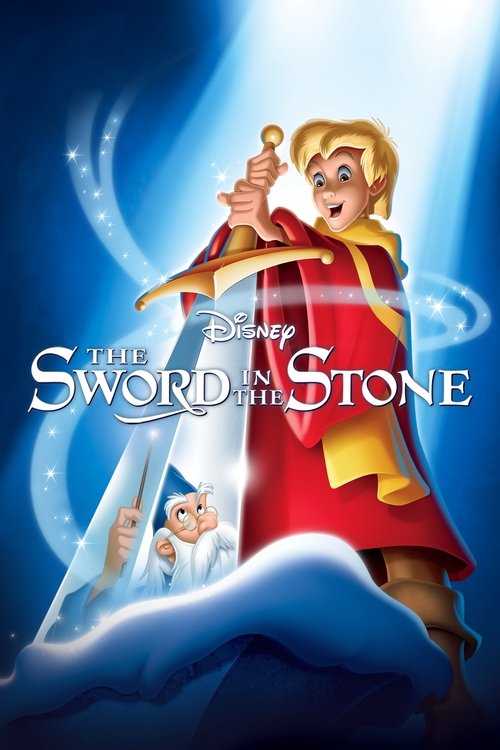
Walt Disney's Arthurian comedy follows the young boy Wart, future King Arthur, as he receives an unexpected education from the eccentric and forward-thinking wizard Merlin, whose unconventional lessons involve being transformed into a fish, a squirrel, and a sparrow. Directed by Wolfgang Reitherman and based loosely on T.H. White's novel The Once and Future King, the film is less interested in heroic myth than in the pleasures of wit, learning, and the comic collision between Merlin's modern sensibility and the medieval world he inhabits. The transformation sequences are inventive and funny, and the bond between Wart and Merlin gives the film a quiet warmth beneath its slapstick surface. More a coming-of-age comedy than an epic, The Sword in the Stone asks what it means to prepare someone for greatness — and suggests that wisdom, curiosity, and the ability to see the world from new perspectives may matter more than strength or destiny.
Watch for
- The transformation sequences and how each animal shape teaches a different intellectual lesson — Wart as a fish learns about natural law and predation, as a squirrel learns about social feeling and empathy, as a bird learns about perspective — with the animation of each form requiring completely different movement principles from the animators.
- Merlin's magic as a character expression rather than a narrative device — watch how his conjuring is always specifically eccentric, his household objects acquiring personalities that reflect his own impatient, clutter-minded sensibility, and how that visual chaos of self-willed objects tells us more about the wizard than any amount of dialogue.
- The wizard duel between Merlin and Madam Mim as an animation tour de force — watch the speed and specificity of the transformation gags, the way each creature choice is both comedically surprising and strategically logical within the scene's internal rules, and the precision of timing that keeps the rapid-fire sequence readable despite its velocity.
- How Wart's smallness is used as a consistent staging element — most scenes are composed from a low angle that emphasizes his diminutive presence within environments built for adults, and that consistent physical perspective reinforces the story's central argument about the gap between a person's circumstances and their potential.
Production notes
The Sword in the Stone adapted the first volume of T.H. White's 1958 omnibus The Once and Future King, which itself had been published in serial parts beginning in 1938. Director Wolfgang Reitherman led production with Bill Peet again writing the screenplay solo. The Xerographic look pioneered on 101 Dalmatians continued, with even rougher line work. The Sherman Brothers (Robert and Richard) — who had been brought into the studio for songwriting after their work on the Annette Funicello film The Parent Trap — wrote their first full Disney animated feature score here. Karl Swenson voiced Merlin with a gentle, distractible warmth, and Sebastian Cabot took on the dual narrator/Sir Ector role. The young Wart was voiced by three different boys (Rickie Sorensen, Richard Reitherman — the director's son — and Robert Reitherman) because their voices were changing during production.
Trivia
- Three different actors voiced the Wart in the same film because each boy's voice changed during production — no single performer could carry the character through to completion.
- The Sherman Brothers wrote 'The Most Befuddling Thing,' 'Higitus Figitus,' and 'That's What Makes the World Go Round' for the film, but it would be Mary Poppins and The Jungle Book that would cement them as Disney's premier songwriting team.
- Madam Mim's wizard duel with Merlin — a shape-shifting battle that escalates from squirrels to dragons — was animated primarily by Milt Kahl and is widely considered one of the great animated sequences of the decade.
- Author T.H. White was reportedly disappointed with the adaptation, finding it too slapstick for his more philosophically textured novel; the film leans heavily into Merlin's eccentricity at the expense of the source's deeper themes about education and power.
- The film was the last Disney animated feature released during Walt Disney's lifetime in which he was substantively involved — though he would oversee development on The Jungle Book, his health declined sharply during its production.
Legacy
The Sword in the Stone is one of the lower-profile features of the 1960s Disney canon — sandwiched between the cultural touchstones of 101 Dalmatians and The Jungle Book — but it has its own dedicated audience. Merlin's catchphrase 'Higitus Figitus,' the squirrel-courtship sequence, and the wizard duel with Madam Mim are perennial favorites. The film's frothy, low-stakes tone foreshadowed the looser, more comedic register that would define Disney animation through the 1970s. It received a Best Score nomination at the Academy Awards. Among Arthurian adaptations, it remains the most-seen by general audiences, and many viewers' first exposure to the boy-king mythology came through Wart pulling that sword from the anvil. The Sherman Brothers' work on the film — their first full Disney animated feature score — set the stage for their breakthrough on Mary Poppins and The Jungle Book. Its influence on later 'plucky young hero finds destiny' Disney narratives — from Hercules to Tangled — is direct and traceable.