The Three Caballeros
Vibe
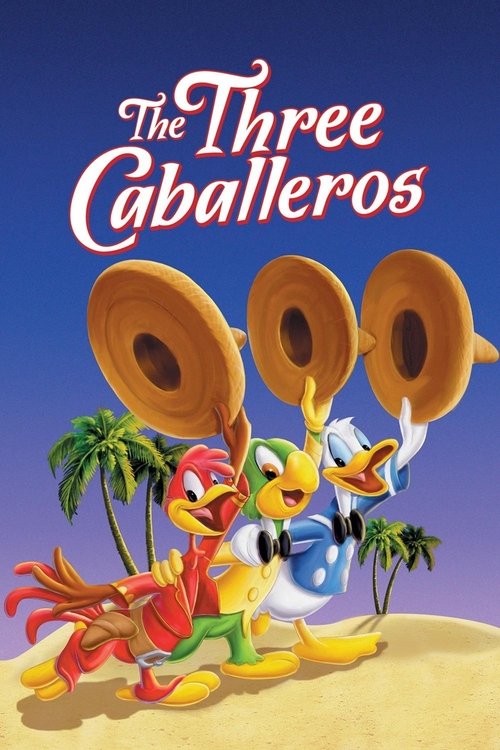
Walt Disney's exuberant follow-up to Saludos Amigos deepens the studio's South American journey with a loosely structured anthology built around Donald Duck's birthday, as he opens gifts that each become a gateway into a new animated world. Reuniting with José Carioca and introducing the raucous Mexican rooster Panchito, the film blends hand-drawn animation with live-action footage in increasingly surreal and visually inventive ways, particularly in its later sequences set in Mexico and Brazil. Directed by Norman Ferguson, the film leans hard into sensation, spectacle, and musical energy, trading narrative cohesion for a kind of animated fiesta that pushes the boundaries of the form. As a collision of cultures, styles, and techniques held together by the pure pleasure of rhythm and color, The Three Caballeros remains one of the most formally daring films Disney produced in the studio's early decades.
Watch for
- The live-action and animation integration sequences in the Mexico and Brazil segments, where Donald Duck interacts with Carmen Molina and Aurora Miranda in real environments — a direct ancestor of Who Framed Roger Rabbit in its ambition, and more surreally uninhibited in its execution than anything Disney would attempt for another four decades.
- The kaleidoscopic finale sequences where the film abandons any pretense of narrative and becomes pure sensation — color, music, rhythm, and visual pattern driving the experience in ways that are closer to experimental film or music video than to conventional animated storytelling.
- Panchito Pistoles's introduction as a study in contrast with Donald and José — three distinct nationalities, three distinct rhythmic personalities, three distinct animation styles, all held together by the unifying energy of the Los Caballeros number that turns character difference into comedic harmony.
- The way the film uses José Carioca's cigar as a visual and narrative prop — it becomes a wand, a magic device, a portal, a scale reference — and how the animators find consistent new comedic and surreal applications for a single character prop throughout the runtime.
Production notes
The Three Caballeros emerged from the same Good Neighbor Policy goodwill trip that produced Saludos Amigos, but on a far more ambitious scale. Norman Ferguson again supervised, with directors Clyde Geronimi, Jack Kinney, Bill Roberts, and Harold Young handling individual sequences. The film paired its animated characters — Donald Duck, José Carioca, and the new Mexican rooster Panchito Pistoles — with live-action Latin American performers including Aurora Miranda (Carmen Miranda's sister), Dora Luz, and Carmen Molina. Combining animation and live-action photography on this scale was unprecedented; the studio used optical printers, traveling mattes, and elaborate stagecraft to put cartoon characters into real environments. Its surrealist climax, in which Donald Duck is overwhelmed by visions of women across Latin America, pushed the technique into territory that would not be revisited at the studio for decades.
Trivia
- Aurora Miranda's appearance dancing with an animated Donald Duck in 'Os Quindins de Yayá' represents one of the earliest instances of a major Hollywood star performing alongside an animated character in a feature film.
- Salvador Dalí and Walt Disney met during this period and discussed an animated short, Destino, which would not be completed until 2003 — almost 60 years later — by Roy E. Disney's team using Dalí's original storyboards.
- The film is also known by its Spanish title Los Tres Caballeros and was released first in Mexico City in December 1944, two months before its U.S. premiere.
- Donald Duck's iconic refrain in the film — 'Aye-aye-aye!' — became one of the character's signature gags and was sampled in subsequent Donald shorts for years.
- The Three Caballeros was nominated for two Academy Awards (Best Sound and Best Score) and was admired in animation circles for its technical ambition even as audiences found its pacing unconventional.
Legacy
The Three Caballeros is one of the strangest entries in the Disney canon — frenetic, sexually suggestive in places, formally daring, and unlike anything else the studio produced before or after. Its critical reputation has grown over time as a fascinating experiment; animator Glen Keane, director Pete Docter, and others have cited its unhinged inventiveness as a reminder that mainstream animation once permitted itself to be very weird. The film cemented the trio of Donald, José, and Panchito as Disney standards, and the characters returned in television specials, theme park attractions (notably Gran Fiesta Tour at EPCOT), and merchandise for generations. The live-action/animation blending it pioneered would resurface in Mary Poppins (1964), Bedknobs and Broomsticks (1971), and ultimately Who Framed Roger Rabbit (1988). It received two Academy Award nominations for Best Sound and Best Score, and was admired in animation circles for its technical ambition even as audiences found its pacing unconventional.