Treasure Planet
Vibe
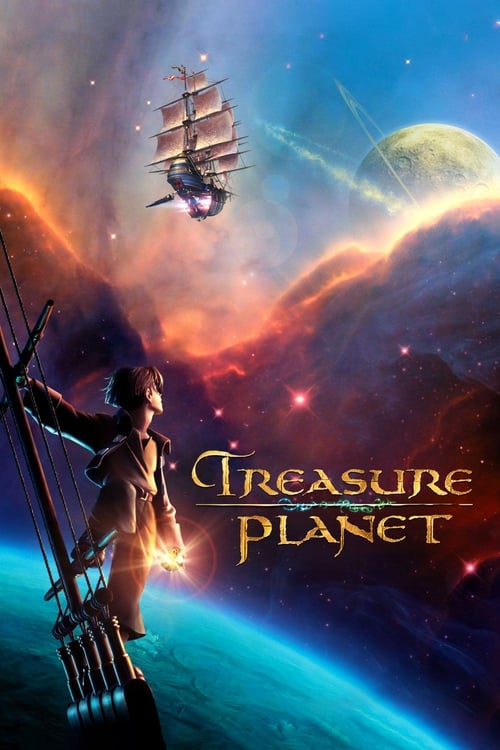
Walt Disney's ambitious reimagining of Robert Louis Stevenson's Treasure Island transplants the classic adventure into a retro-futurist solar system where wooden sailing ships cruise through space on solar winds and the colorful crew of the RLS Legacy hides loyalties as mysterious as the map Jim Hawkins carries. Directed by Ron Clements and John Musker, the film is one of the studio's most technically daring efforts of the era, combining traditional hand-drawn character animation with three-dimensional computer-generated environments in ways that still look striking. Jim Hawkins is one of the studio's most compelling adolescent protagonists — brooding, intelligent, and genuinely searching for the father figure he never had — and his relationship with the cyborg Long John Silver carries real emotional weight and moral complexity. Underperforming significantly at the box office, Treasure Planet remains one of Disney's great overlooked films — a visually spectacular, emotionally sincere adventure that took genuine creative risks and has grown considerably in reputation in the years since.
Watch for
- The solar sail navigation sequences and how Deep Canvas creates three-dimensional space within a hand-drawn animation framework — watch how the animators use the digital environment's depth to let the camera orbit the ship, track characters across its deck, and look down into the cosmic environment below in ways that traditional multiplane photography could never have allowed.
- Jim Hawkins's body language throughout as a study in emotional armor — Glen Keane designed Jim's physical vocabulary around the specific posture of adolescent defensiveness, with shoulders forward, gaze down, the constant suggestion of withdrawal, and watch how those physical habits gradually open as his relationship with Silver develops.
- Long John Silver's cyborg design and how it solves the narrative problem of making a villain sympathetic — his robotic components mark him as dangerous and other, while his organic face and the specific warmth of Brian Murray's voice performance create the credible impression of a character genuinely conflicted between his affection for Jim and his goals.
- The black hole sequence as a technical and narrative turning point — the spatial effects required for a convincingly rendered gravitational singularity demanded new approaches to particle simulation and light distortion, and the emotional stakes of the sequence, where Silver's choice between the treasure and Jim is made visible through action, make the technical ambition feel narratively justified.
Production notes
Treasure Planet had been Ron Clements and John Musker's dream project for nearly two decades — they had pitched it to Disney repeatedly going back to before The Little Mermaid. The film finally went into full production in 2000 with a budget of approximately $140 million and an ambitious technical brief: combine traditional 2D character animation with CGI environments and effects, rendered using an improved Deep Canvas that allowed sweeping camera moves through hand-painted-feeling spaces. The visual concept fused 18th-century maritime aesthetics with futuristic space-faring technology — solar-sail ships, mechanized crew members, alien planets reimagined as ports of call. Joseph Gordon-Levitt voiced the teenage Jim Hawkins, Brian Murray played John Silver, Emma Thompson was Captain Amelia, David Hyde Pierce played Doppler, and Martin Short voiced the comic-relief robot B.E.N.
Trivia
- John Silver in the film is partly cyborg; his replacement parts contain numerous in-character mechanical functions, and the animators developed an elaborate set of mechanical 'gestures' for the character that required the integration of CGI elements directly into 2D animation.
- The opening sequence of Jim solar-surfing on the cliffs of Montressor is widely cited as one of the most kinetic and exhilarating animated sequences ever produced at Disney — combining 2D character animation with 3D-tracked camera moves in a single continuous shot.
- Treasure Planet's failure was so severe that it caused Disney to write down its second-quarter 2003 earnings by $74 million; its commercial collapse is one of the most-cited turning points in the studio's pivot away from hand-drawn animation.
- Ron Clements and John Musker had pitched the Treasure Planet concept dozens of times over nearly two decades before it was greenlit — their original sketches dated back to before The Great Mouse Detective.
- The film's tagline — 'Find your place in the universe' — and its emphasis on a young protagonist's emotional journey through father-figure dynamics gave the film a tonal seriousness rarely matched in Disney action-adventure features.
Legacy
Treasure Planet's catastrophic theatrical performance ($110 million worldwide on a $140 million budget) is one of Disney's most painful animated chapters. Combined with the underperformance of Atlantis the year before, it triggered the closure of Disney's Florida animation studio and contributed to the corporate decision to end traditional 2D feature production. Yet the film's reputation has steadily climbed in the decades since — animation enthusiasts, science-fiction fans, and adults who saw it as children frequently cite it as one of the most underrated films Disney ever made. The visual ambition of its hybrid 2D/3D approach has aged well; the emotional core of Jim and Silver's relationship remains genuinely affecting; and the film's general mood — adventurous, melancholic, ambitious — has acquired a poignancy that its initial release didn't permit. The opening solar-surfing sequence is widely cited as one of the most kinetic and exhilarating animated sequences ever produced at Disney. A perpetually-rumored sequel has never materialized.