Wreck-It Ralph
Vibe
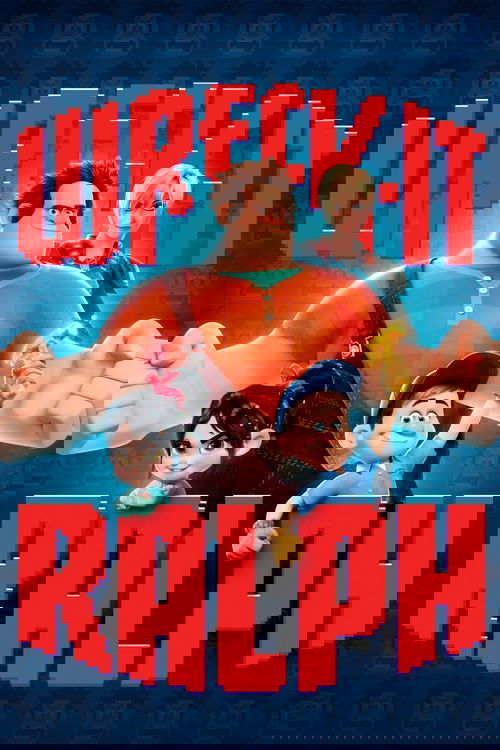
Walt Disney's inventive video game comedy follows Ralph, the villain of an old arcade game called Fix-It Felix Jr. who is tired of being feared and ignored and sneaks out of his game to earn a hero's medal — setting off a chain of events that takes him through a candy-coated racing game and a first-person shooter before he discovers that what he was looking for was never a medal at all. Directed by Rich Moore, the film's world-building is one of the great pleasures of the Disney computer-animated era, using its arcade setting to construct a sprawling, detailed universe of nostalgic video game references while telling a story that works entirely on its own terms. Vanellope von Schweetz — a glitching racing game outcast who becomes Ralph's unlikely companion — gives the film its emotional center and its funniest moments. A story about identity, acceptance, and what it means to define yourself beyond the role the world assigns you, Wreck-It Ralph is one of the studio's most imaginatively conceived and emotionally satisfying films of its era.
Watch for
- The world-building logic of Game Central Station as a conceit — watch how the film establishes rules for how video game characters exist between their games, how power strips work as transit hubs, and how the economic and social relationships between game characters function, creating a self-consistent internal logic that the film then exploits for both comedy and drama.
- The visual design differentiation between the three games — Fix-It Felix Jr.'s 8-bit pixelation within the game versus Ralph's smooth animation in the real world, Hero's Duty's dark military aesthetic contrasted with Sugar Rush's candy-physics, creates a film with three distinct animation registers that each reflect the design philosophy of their source material.
- Fix-It Felix Jr.'s animation and voice performance by Jack McBrayer as a study in aggressive positivity — watch how Felix's every gesture and expression radiates a quality of can-do warmth that tips just past normal range into something slightly uncanny, and how that edge of unreality creates the comedy of a character who has literally been programmed for one emotion.
- The King Candy reveal and how the animators embedded the tell in his character throughout — watch Ralph's first interactions with King Candy again after the revelation and notice how the character's movements, the specific quality of his over-performance, and the slightly wrong timing of his reassurances all contained the truth of his identity throughout, making it a film that rewards a second viewing.
Production notes
Wreck-It Ralph was developed for nearly two decades under various titles before director Rich Moore (a Simpsons and Futurama veteran making his feature debut) finally made it work. The film required Disney to license dozens of real video-game characters — Bowser, Sonic the Hedgehog, the ghosts from Pac-Man, Zangief from Street Fighter, and many others appeared as themselves through deals negotiated with Nintendo, Sega, Capcom, and Namco. The production designed the film's video-game worlds with distinct visual identities: the 8-bit-styled Niceland, the gritty FPS Hero's Duty, and the candy-colored kart-racing Sugar Rush. John C. Reilly voiced Ralph, Sarah Silverman played Vanellope, Jane Lynch voiced Calhoun, and Jack McBrayer was Felix. The film's screenplay was credited to Phil Johnston and Jennifer Lee — Lee's first Disney credit before her co-direction of Frozen the following year.
Trivia
- Sega was the first video game company to license its characters for the film — Sonic the Hedgehog and Doctor Robotnik appeared by name; this opened the door for Nintendo, Capcom, and Namco to follow, ultimately giving the film one of the most extensive cross-IP rosters in animation history.
- Jennifer Lee, the co-screenwriter, would go on to co-direct Frozen the following year, win the Academy Award for Best Animated Feature, and eventually become Chief Creative Officer of Walt Disney Animation Studios — Wreck-It Ralph was her first studio credit.
- The arcade Litwak's Family Fun Center, where most of the film is set, contains hundreds of small Easter-egg references to specific video games from the 1980s through 2010s; entire fan-created guides documenting them have circulated online.
- The film was nominated for the Academy Award for Best Animated Feature, losing to Pixar's Brave; it also won the Annie Award for Best Animated Feature that year.
- The 'Sugar Rush' kart-racing game in the film is fully developed enough that a real Wreck-It Ralph: Sugar Rush mobile game and several arcade adaptations were produced as tie-ins, blurring the boundary between fictional and real arcade games.
Legacy
Wreck-It Ralph grossed about $471 million worldwide and was a major creative success that signaled Disney Animation's confidence to take big swings on contemporary, non-fairy-tale concepts. The video-game-cameo structure it pioneered — licensing Bowser, Sonic, the Pac-Man ghosts, Zangief, and dozens more from Nintendo, Sega, Capcom, and Namco — has been imitated frequently since (most prominently by Steven Spielberg's Ready Player One in 2018), but Wreck-It Ralph remains the most graceful commercial-IP-mashup film yet made. Its 2018 sequel Ralph Breaks the Internet performed even better commercially. The film established Rich Moore as a major directing voice within Disney; he would go on to co-direct Zootopia. It also marked the first studio credit for Jennifer Lee, who would win the Academy Award for Frozen the following year and eventually become Chief Creative Officer of Walt Disney Animation Studios. The film won the Annie Award for Best Animated Feature and was nominated for the Oscar in the same category. Ralph and Vanellope joined the Disney character roster, and Vanellope is sometimes considered an honorary member of the Princess line.